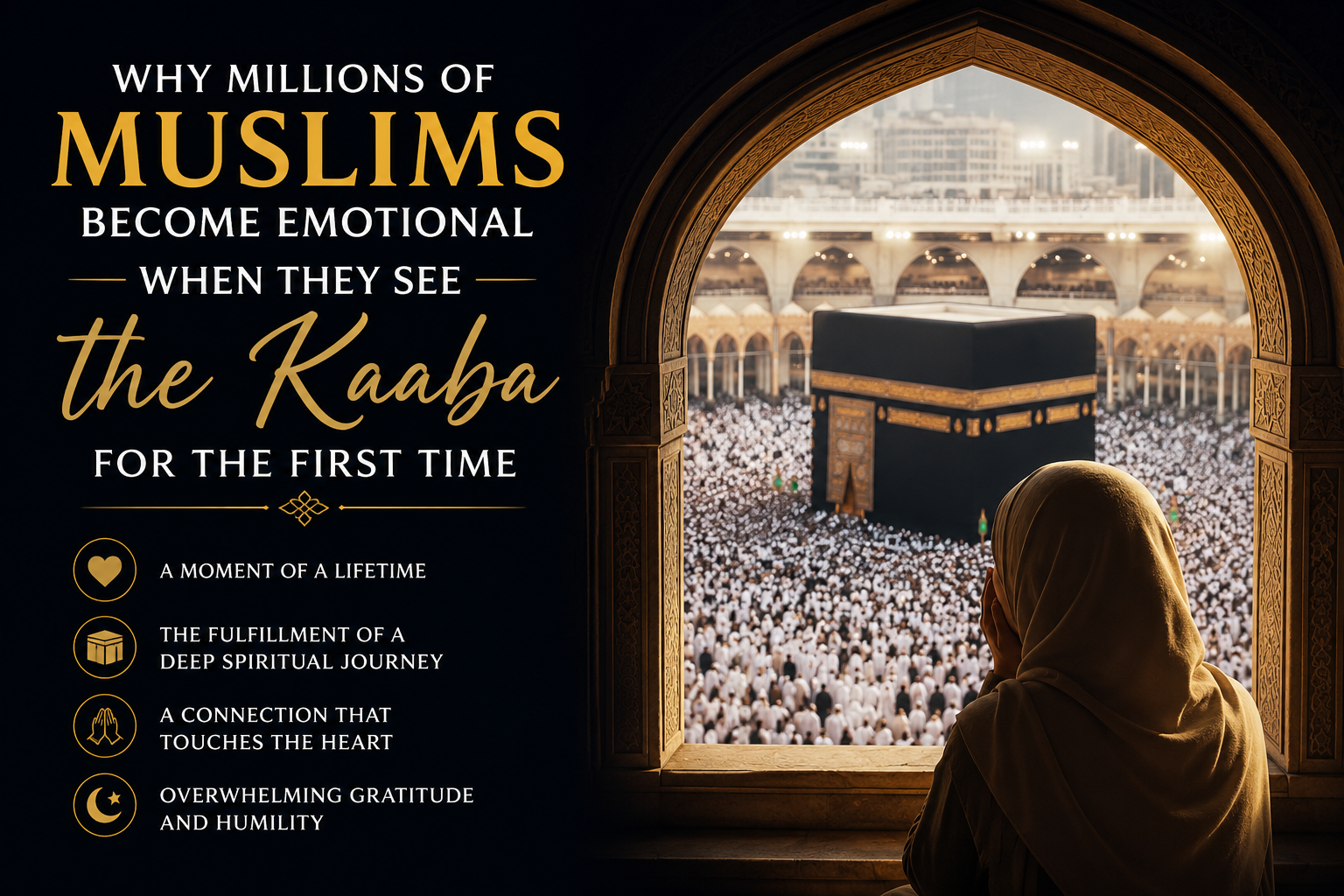
Why Millions of Muslims Become Emotional When They See the Kaaba for the First Time
For millions of Muslims, seeing the Holy Kaaba for the first time is a moment they imagine long before they ever reach Makkah. Some spend years saving for Hajj or Umrah. Others make dua for the opportunity throughout their lives. Then, after a long journey, they finally enter Masjid al-Haram and see the Sacred House standing before them.
For some people, the reaction is immediate. Tears begin to flow. Others become completely silent, overwhelmed by gratitude. Some smile, raise their hands in dua, or simply stand and look at the Kaaba without knowing what to say.
But why do people cry seeing the Kaaba? Is there a specific religious reason behind this emotional reaction? Is there a special dua that is guaranteed to be accepted when the Kaaba is seen for the first time?
The answers involve a combination of faith, personal emotions, anticipation, Islamic history, and the extraordinary spiritual meaning associated with the Sacred House.
The Kaaba Is More Than a Physical Structure
The Kaaba is a simple structure in appearance, but its meaning for Muslims is profound. It is the Qiblah toward which Muslims turn during their daily prayers and the central point around which pilgrims perform Tawaf.
A Muslim may spend years facing the Kaaba from thousands of kilometres away. Every Salah creates a spiritual connection with the direction of the Sacred House. When that same person eventually sees the Kaaba with their own eyes, an abstract direction suddenly becomes a physical reality.
That transformation can be deeply emotional.
Someone who has prayed toward the Kaaba since childhood may suddenly realise that they are standing in the very place they have imagined for years. The experience can bring together memories of prayers, dreams, sacrifices, family members, and countless personal duas.
This is one reason the Feeling when seeing Kaaba for first time can be difficult to describe in ordinary words.
Why Do People Cry Seeing the Kaaba?
There is no single emotional response that every pilgrim experiences. Some cry, some remain calm, and others feel happiness, peace, nervousness, or even disbelief.
So, Why do people cry seeing the Kaaba?
For many, tears are simply a natural response to an intensely meaningful moment. A person may remember how long they waited to make the journey, the difficulties they experienced, or the people who helped them reach Makkah.
Others may become emotional because they are reminded of Allah, their dependence upon Him, and the purpose of their existence.
There may also be a sense of humility. Standing among people from different countries, languages, cultures, and backgrounds while everyone worships Allah can make the individual feel part of something much larger than themselves.
Tears, therefore, should not be treated as a requirement. Crying does not make someone's pilgrimage more valid, and not crying does not mean that a person lacks faith.
Every person's emotional response is different.
The Spiritual Experience of Seeing the Kaaba
The Spiritual experience of seeing the Kaaba often begins long before the actual visit.
For many pilgrims, preparation starts months or even years before travelling. They learn about the rituals, study the history of Makkah, prepare physically, arrange travel plans, and make dua for a successful pilgrimage.
By the time they arrive, the Kaaba may already have a powerful place in their imagination.
When they finally see it, the experience can feel almost unreal.
The surroundings of Masjid al-Haram, the sound of the Talbiyah, the movement of pilgrims, the sight of the Kiswah, and the knowledge that generations of Muslims have worshipped in the same sacred environment can create a powerful emotional atmosphere.
For someone who has spent years praying toward the Kaaba, seeing it directly can feel like the completion of a deeply personal journey.
Why the First View Can Feel So Powerful
The first sight of the Kaaba can carry a unique psychological and spiritual impact because expectation meets reality.
Imagine repeatedly hearing about a place throughout your childhood, seeing photographs of it, learning its history, and facing its direction during prayer. Now imagine suddenly standing only a short distance away.
The mind connects all those previous experiences to the present moment.
A person may remember childhood prayers, Ramadan nights, Quran lessons, family conversations, or personal struggles. They may think about prayers they have made repeatedly and wonder at the fact that Allah has allowed them to reach Makkah.
This mixture of memories and gratitude can produce an overwhelming emotional response.
The experience is personal, and there is no single definition of how a pilgrim should feel.
Is There a Special Dua When Seeing the Kaaba?
A popular claim says that the First sight of Kaaba dua accepted is guaranteed to be answered.
This statement needs to be treated carefully.
There is no authentic evidence establishing that every dua made upon the first sight of the Kaaba is automatically accepted. A commonly circulated narration about dua being answered specifically when the Kaaba is seen has been judged very weak by scholars.
Therefore, it would be inaccurate to tell pilgrims that a particular first-sight dua is guaranteed to be accepted based on an authentic Hadith.
This does not mean that a person should avoid making dua when they see the Kaaba. Quite the opposite. A believer can make sincere dua to Allah at any time and ask for forgiveness, guidance, mercy, family wellbeing, success in the Hereafter, and other lawful needs.
The important point is to distinguish between making dua and claiming that a particular moment has a guaranteed special acceptance based on a narration that is not authentic.
What to Say When You See the Kaaba for the First Time
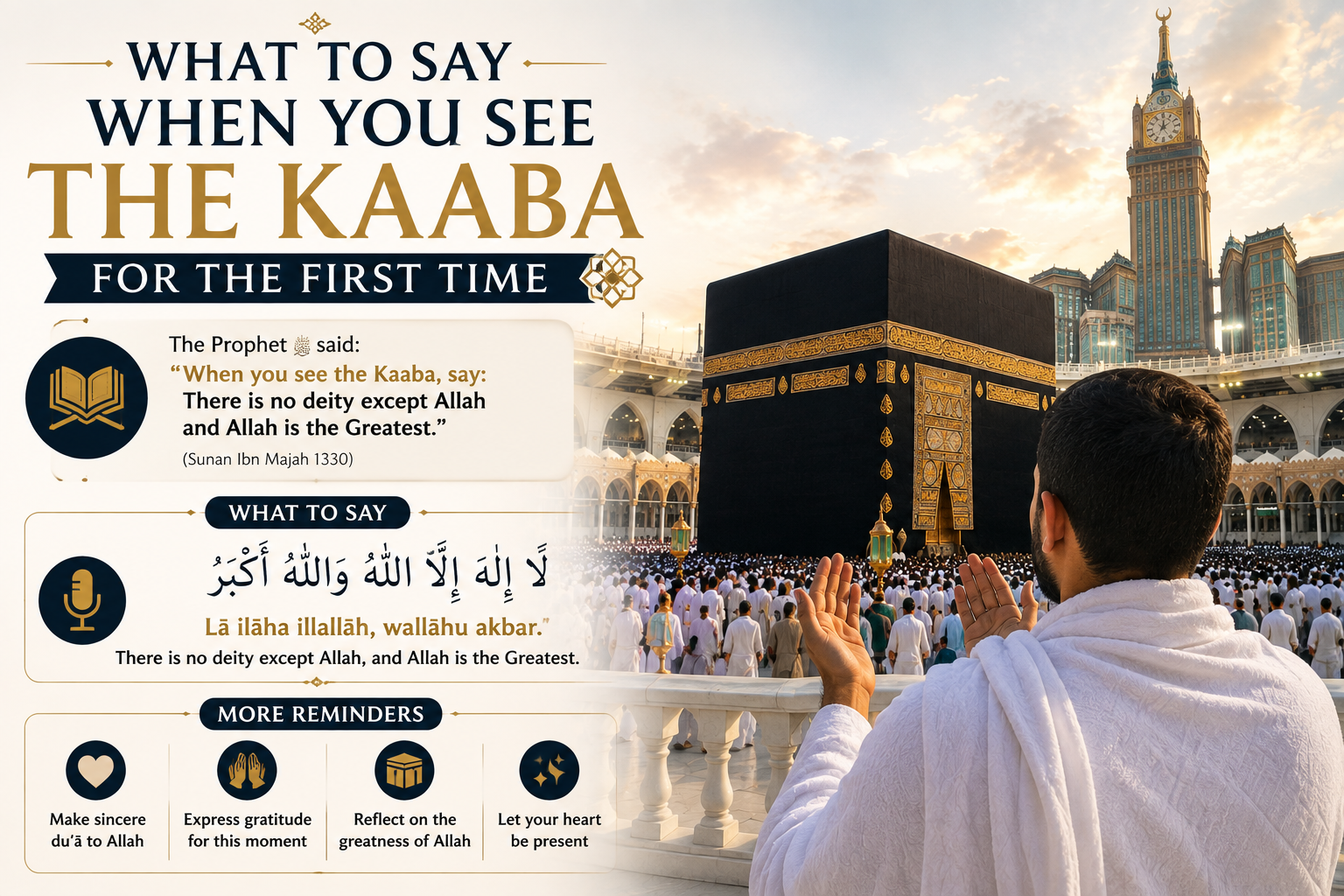
Many pilgrims search online for What to say when you see the Kaaba for the first time.
There is no single authentic, obligatory phrase that every Muslim must recite upon seeing the Kaaba for the first time.
A pilgrim can praise Allah, make personal dua, recite dhikr, or remain quietly thankful. The words can come naturally from the heart.
For example, a person may sincerely say:
“Alhamdulillah, O Allah, thank You for allowing me to reach Your Sacred House. Accept my worship, forgive my shortcomings, and make this journey a source of guidance and blessing.”
This is a personal supplication rather than a claim that it is a specific Sunnah dua for the first sight of the Kaaba.
If a pilgrim does not remember any special words, there is no need to panic. Worship is not dependent upon delivering a memorised speech at that exact moment.
The Kaaba and the Legacy of Prophet Ibrahim (AS)
Another reason the experience can be emotional is the history connected with the Sacred House.
The Kaaba is closely associated with Prophet Ibrahim (AS) and Prophet Ismail (AS), and its story is deeply connected with Islamic teachings about worship, obedience, sacrifice, and trust in Allah.
When pilgrims stand before the Kaaba, they are not simply visiting an old building. They are entering a place connected with a long religious history that has shaped the lives of Muslims across generations.
Thinking about this history can deepen the emotional impact of the visit.
The person standing in Makkah may realise that countless believers before them also came to this sacred place with their own hopes, fears, sacrifices, and prayers.
Seeing the Kiswah for the First Time
For many visitors, the Kiswah itself becomes an unforgettable part of the first encounter.
The rich black covering gives the Kaaba its distinctive appearance. Intricate Quranic calligraphy, carefully embroidered details, and the contrast between the black cloth and the surrounding white marble create a remarkable visual impression.
The Kiswah is more than decoration. It represents a long tradition of honouring and caring for the Sacred House.
At Kiswah Al Kabah, we celebrate this remarkable heritage by helping people learn more about the Kiswah and appreciate the craftsmanship associated with the Kaaba.
For someone seeing the Sacred House for the first time, noticing the Kiswah can make the experience even more memorable.
Why Some People Do Not Cry
It is important not to create an unrealistic expectation that everyone must cry when seeing the Kaaba.
Some pilgrims become emotional immediately. Others feel peaceful rather than tearful. Some may feel nervous, tired, amazed, or simply grateful. A person might even become emotional several hours or days later rather than at the first sight.
None of these reactions automatically indicate the strength or weakness of someone's faith.
Islam does not make tears a condition for sincere worship.
A person can have a deeply meaningful spiritual experience without shedding a single tear.
Likewise, someone who cries is not necessarily more spiritually devoted than someone who remains composed.
The sincerity of the heart and the worship offered to Allah are what matter.
The Importance of Gratitude During the Moment
Instead of worrying about producing a particular emotional reaction, pilgrims can focus on gratitude.
They can remember the enormous blessing of being able to reach Makkah, ask Allah to accept their journey, seek forgiveness, and pray for their loved ones.
The first sight of the Kaaba can become an opportunity to pause and recognise how many circumstances had to come together for that moment to happen.
Travel, finances, health, family responsibilities, permissions, timing, and countless other factors can affect a person's ability to make Hajj or Umrah.
Being present before the Kaaba can therefore inspire genuine shukr, or gratitude.
Making the First Visit Meaningful
A meaningful first visit does not depend on saying perfect words or having a dramatic emotional reaction.
Instead, pilgrims can prepare by learning about the rituals, understanding the significance of the Kaaba, studying authentic Islamic teachings, and entering Masjid al-Haram with humility.
They should also avoid becoming so focused on photographs and videos that they forget to experience the moment itself.
The first sight of the Kaaba may last only a few seconds, but the memory can remain with a person for the rest of their life.
Final Thoughts
The Feeling when seeing Kaaba for the first time is different for every Muslim. Some people cry because years of longing suddenly become reality. Others feel peaceful, grateful, speechless, or overwhelmed by the history and spiritual significance of the Sacred House.
So, Why do people cry seeing the Kaaba? There is no single answer. Tears can come from gratitude, humility, memories, longing, relief, love, or simply the emotional power of finally reaching a place that has occupied the heart for years.
The Spiritual experience of seeing the Kaaba is deeply personal, and Muslims should not judge their faith based on whether they cry.
It is also important to approach popular claims carefully. Although many people search for the First sight of Kaaba dua accepted, there is no authentic evidence guaranteeing that every supplication made at that particular moment will be accepted. A pilgrim is nevertheless encouraged to turn to Allah with sincere dua throughout the journey.
And when someone asks What to say when you see the Kaaba for the first time, the simplest answer is that there is no obligatory special phrase. Praise Allah, make sincere personal dua, remember Him, and allow the moment to unfold naturally.
The Kaaba has inspired generations of Muslims not because of one particular emotional reaction, but because it represents unity, worship, history, and devotion to Allah. For those blessed with the opportunity to see it, the experience can become one of the most treasured memories of their lives.
At Kiswah Al Kabah, we invite you to continue exploring the history, artistry, and spiritual heritage connected with the Sacred House and its magnificent Kiswah. May Allah grant every believer the opportunity to visit Makkah, worship sincerely, and return home with a heart strengthened by faith. Ameen.