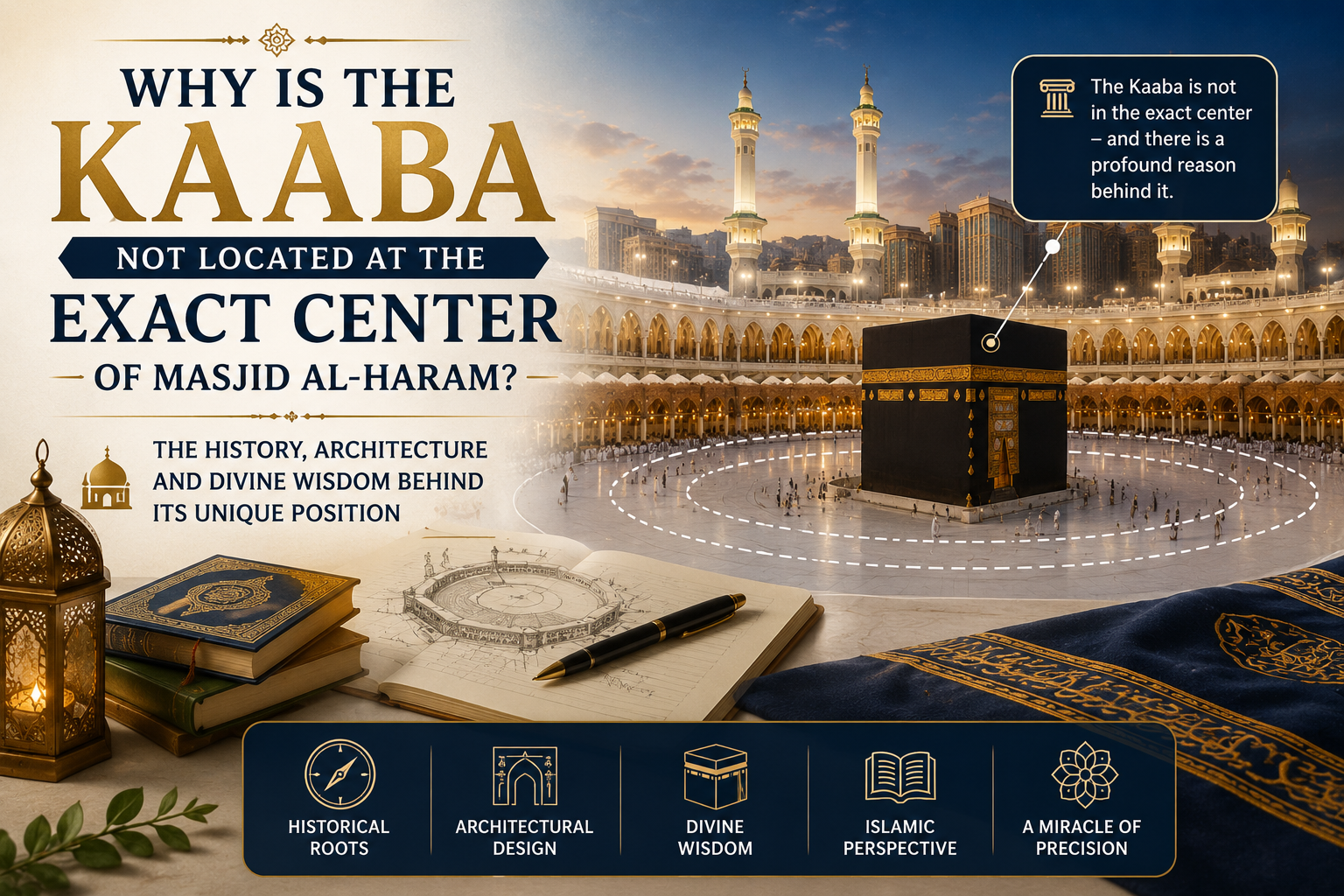
Why Is the Kaaba Not Located at the Exact Center of Masjid al-Haram?
The Holy Kaaba is the spiritual heart of Islam and the focal point of every Muslim's prayer. Millions of pilgrims gather around it during Hajj and Umrah, yet one question often surprises visitors looking at aerial photographs of Masjid al-Haram: is the Kaaba in the middle of Masjid al Haram? At first glance, it appears slightly offset rather than perfectly centred within the mosque.
This observation has led to many discussions about the design of the Grand Mosque, its historical development, and whether the Kaaba occupies the exact middle of the sacred complex. Understanding the answer requires exploring centuries of architectural expansion rather than looking only at the present-day layout.
In this article, we explain is the Kaaba in the middle of Masjid al Haram, examine the Masjid al Haram expansion history, explore the design of the Mataf courtyard architecture, discuss the popular belief is Kaaba in the exact center of Earth, and show how many Muslims preserve memories of the Sacred House through a Kiswah Kaaba piece.
The Kaaba Came Before the Mosque
The first point to understand is that the Kaaba existed long before the massive mosque surrounding it.
According to Islamic tradition, Prophet Ibrahim (AS) and Prophet Ismail (AS) raised the foundations of the Kaaba as a place devoted to the worship of Allah. At that time, there were no vast marble courtyards, towering minarets, or multi-level prayer areas.
As the number of Muslims grew throughout history, the surrounding mosque expanded gradually to accommodate increasing numbers of worshippers.
Is the Kaaba in the Middle of Masjid al Haram?
A common question is is the Kaaba in the middle of Masjid al Haram?
The answer is not exactly.
While the Kaaba remains the spiritual centre of the mosque, it is not positioned at the precise geometric centre of today's enormous Masjid al-Haram complex. The mosque has been enlarged many times over the centuries, often in response to population growth, surrounding buildings, and the local landscape. These practical considerations resulted in expansions that were not perfectly symmetrical.
Despite this, every section of the mosque is carefully designed to maintain clear access to the Kaaba and provide sufficient space for pilgrims performing Tawaf.
Understanding the Masjid al Haram Expansion History
The Masjid al Haram expansion history stretches across many centuries.
In its earliest form, the area surrounding the Kaaba was relatively open. As the Muslim community expanded, successive rulers introduced larger prayer areas and supporting facilities.
Major developments included:
Expanding prayer spaces around the Kaaba.
Constructing covered walkways.
Adding additional entrances.
Building multiple levels for worshippers.
Improving pathways for pilgrims during Hajj and Umrah.
Modern expansion projects have transformed Masjid al-Haram into one of the largest religious sites in the world while preserving the Kaaba as its central point of focus.
Mataf Courtyard Architecture
The open area surrounding the Kaaba is known as the Mataf, where pilgrims perform Tawaf by walking seven times around the Sacred House.
The Mataf courtyard architecture has been carefully developed to improve safety, movement, and accessibility for millions of visitors.
Its design considers:
Smooth pedestrian circulation.
Clear walking paths.
Crowd management.
Accessibility for elderly pilgrims and wheelchair users.
Uninterrupted views of the Kaaba.
Rather than aiming for perfect geometric symmetry, architects have prioritised functionality while preserving the spiritual experience of worship.
Is Kaaba in the Exact Center of Earth?
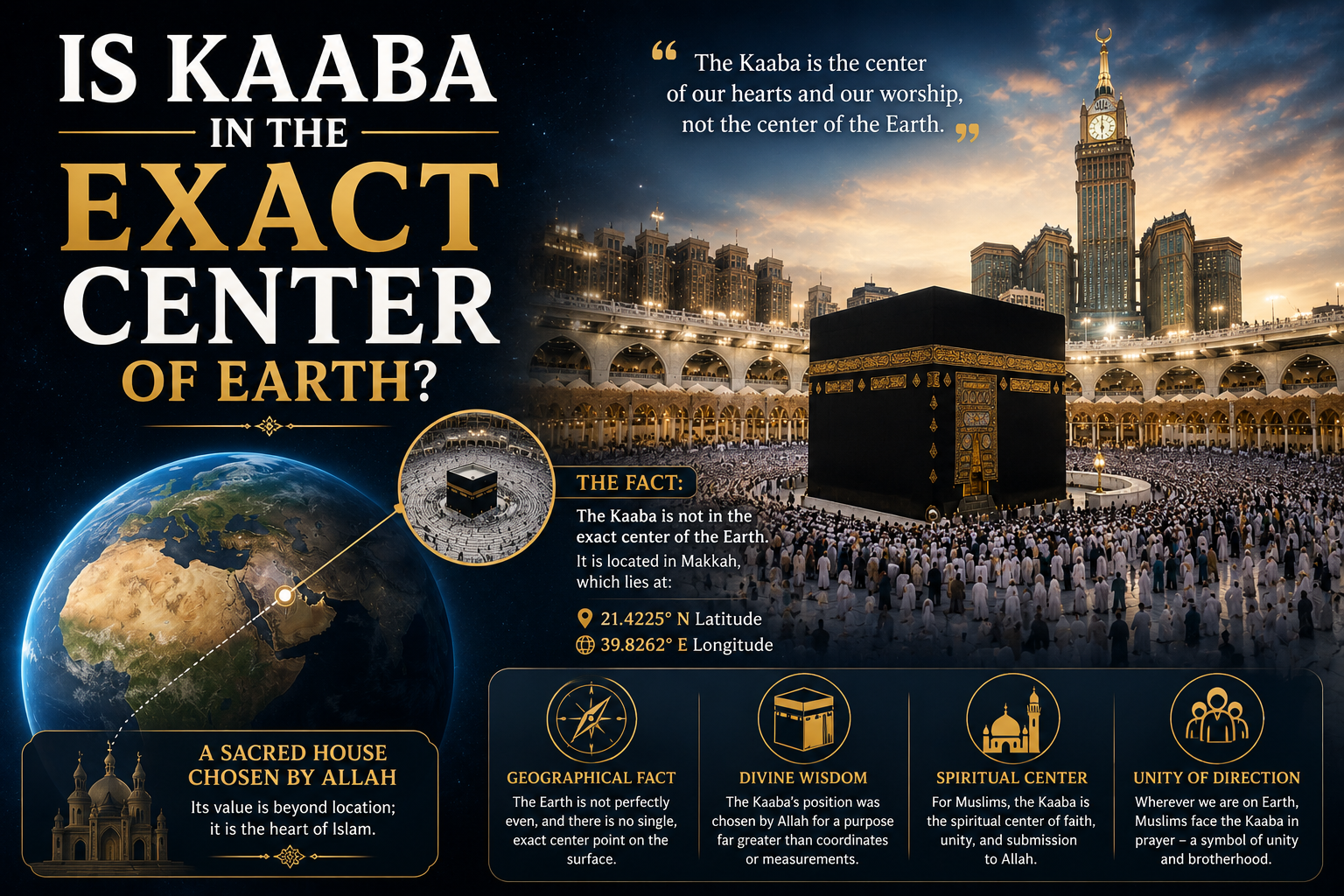
Another frequently discussed question is is Kaaba in the exact center of Earth?
From a religious perspective, Islam honours the Kaaba as the Qiblah, the direction Muslims face during prayer. This gives it profound spiritual significance.
However, the claim that the Kaaba is located at the exact geographical centre of the Earth is not established by the Qur'an or authentic Hadith, nor is it supported by geographical science. It is a popular belief shared in some discussions, but it should not be presented as a verified religious or scientific fact.
For Muslims, the Kaaba's importance comes from its role as the House of Allah and the unifying direction of worship, not from its geographic coordinates.
Why the Kaaba Appears Off-Centre
Modern aerial photographs can create the impression that the Kaaba sits slightly away from the middle of the mosque.
Several factors explain this appearance:
Historical expansions took place during different periods.
New prayer areas were added according to available space.
Infrastructure improvements prioritised pilgrim movement.
Architectural changes respected existing structures whenever possible.
Although the surrounding mosque has grown dramatically, every expansion has been planned to maintain the Kaaba as the visual and spiritual focus of Masjid al-Haram.
The Spiritual Centre Never Changes
Whether viewed from the courtyard, the upper prayer levels, or satellite images, the Kaaba remains the heart of Islamic worship.
Millions of Muslims around the world face the Kaaba every day during Salah, creating a remarkable symbol of unity that transcends geography, language, and culture.
Its spiritual position has never depended on mathematical symmetry. Instead, it reflects centuries of devotion shared by the global Muslim community.
Preserving the Memory of the Sacred House
Many pilgrims wish to keep a meaningful reminder of their visit to Makkah.
A certified Kiswah Kaaba piece offers a unique way to preserve that connection. Carefully presented within elegant displays, these authentic pieces of the Kaaba's historic covering represent exceptional Islamic craftsmanship while reminding families of the blessings associated with the Sacred House.
Displayed respectfully at home or presented as a thoughtful gift, a Kiswah Kaaba piece becomes a lasting symbol of faith and Islamic heritage.
Conclusion
Understanding the Kaaba in the middle of Masjid al Haram requires looking beyond modern aerial photographs and appreciating centuries of architectural development. The Masjid al Haram expansion history explains why the mosque has grown in different directions, while the thoughtful Mataf courtyard architecture continues to provide a safe and meaningful environment for millions of pilgrims.
Similarly, although many people ask is Kaaba in the exact center of Earth, its true significance lies in its role as the Qiblah and the spiritual centre of Islam. For believers wishing to honour this sacred legacy, an authentic Kiswah Kaaba piece serves as a meaningful reminder of Makkah and the timeless importance of the Holy Kaaba.