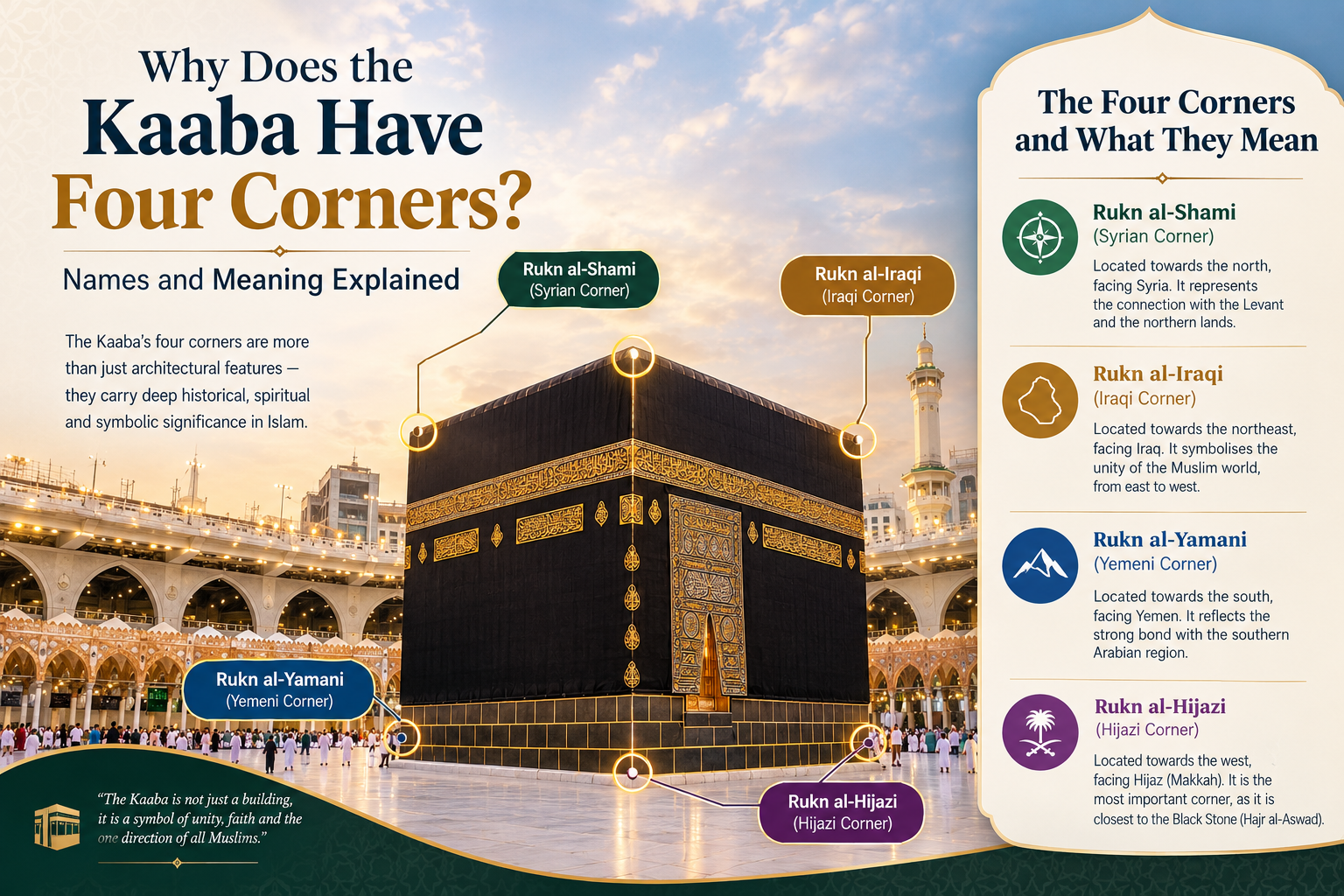
The Kaaba is one of the most sacred structures in Islam, attracting millions of Muslims to Masjid al-Haram in Makkah every year. Its distinctive cube-like shape, beautiful black covering, and intricate Quranic inscriptions make it instantly recognisable worldwide. However, many people still wonder: Why does the Kaaba have four corners, what are their names, and what is their significance in Islam?
Understanding the four corners provides valuable insight into the Kaaba’s architecture, Islamic traditions, and the spiritual importance of Tawaf. It also helps visitors appreciate the craftsmanship of the Kaaba Kiswah, the magnificent textile that covers this sacred structure.
Why Does the Kaaba Have Four Corners?
The Kaaba has four corners because of its roughly cuboid architectural design. Each corner is formed where two sides of the structure meet. These corners help define the Kaaba’s orientation and are recognised by traditional Arabic names.
The Kaaba has undergone rebuilding and restoration throughout history, but its four-sided form remains a defining feature. During Hajj and Umrah, pilgrims circle the Kaaba seven times in an act of worship known as Tawaf.
The corners serve as important geographical landmarks along this route. While each has a traditional name, Muslims worship Allah alone, and the Kaaba represents the direction towards which Muslims face during their daily prayers.
What Are the Four Corners of the Kaaba Called?
The four corners are known as Rukn al-Aswad, Rukn al-Iraqi, Rukn al-Shami, and Rukn al-Yamani. Each name reflects a particular historical association, geographical direction, or distinctive feature.
1. Rukn al-Aswad: The Black Stone Corner
Rukn al-Aswad is the corner containing the Hajar al-Aswad, or Black Stone. It is one of the most recognisable features of the Kaaba and holds special significance in Islamic tradition.
During Tawaf, pilgrims begin and complete each circuit at the Black Stone corner. When it is safe and practical, pilgrims may touch or kiss the stone. If reaching it would cause crowding or harm, pointing towards it is sufficient.
This corner connects the physical structure of the Kaaba with longstanding Islamic traditions and is an important landmark for visitors performing Hajj or Umrah.
2. Rukn al-Iraqi: The Iraqi Corner
Rukn al-Iraqi is traditionally associated with the direction of Iraq. It forms one of the four corners of the Kaaba and is passed by pilgrims as they continue their counterclockwise movement during Tawaf.
Its name reflects historical geographical associations rather than a separate act of worship. Learning about this corner helps visitors understand the traditional terminology used to describe the Kaaba’s structure.
3. Rukn al-Shami: The Syrian Corner
Rukn al-Shami is traditionally associated with the historical region of al-Sham, which includes areas connected with present-day Syria and neighbouring territories.
Like the Iraqi corner, its name relates to geographical orientation. Pilgrims pass this corner during Tawaf as they move around the Kaaba.
Although it does not have the Black Stone, Rukn al-Shami remains an important part of the structure’s traditional description and architectural identity.
4. Rukn al-Yamani: The Yemeni Corner
Rukn al-Yamani is associated with the direction of Yemen and is another well-known corner of the Kaaba.
According to Islamic tradition, pilgrims may touch this corner when performing Tawaf, provided doing so does not cause difficulty or harm to others. There is no requirement to kiss it.
The Yemeni corner is encountered shortly before the Black Stone corner when following the usual direction of Tawaf. Its significance comes from established Islamic traditions and its place in the pilgrimage route.
What Is the Spiritual Meaning of the Four Corners?
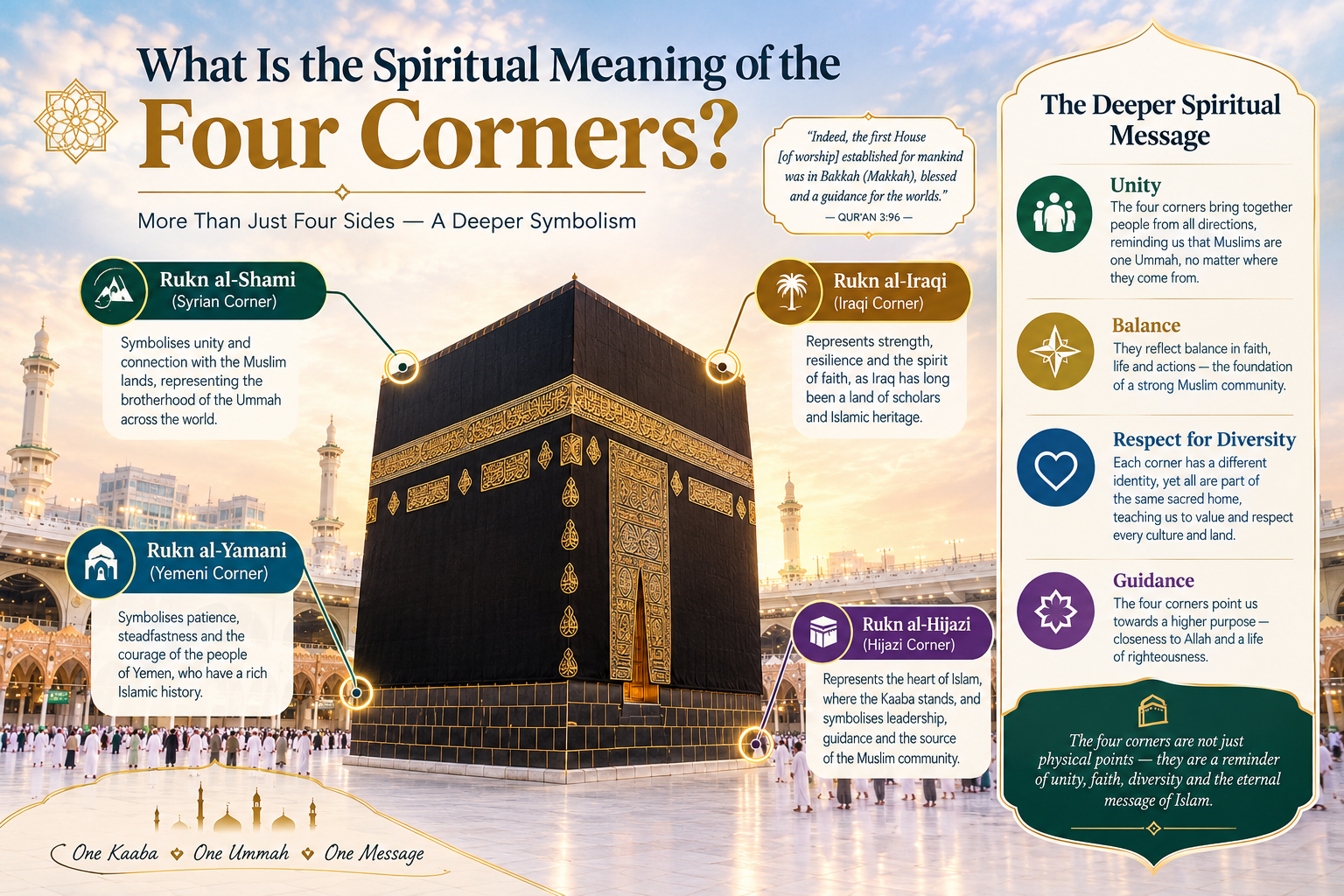
The four corners help identify the Kaaba’s physical structure and guide pilgrims during Tawaf. However, Islamic teachings do not assign four independent forms of worship or separate spiritual powers to these corners.
The Black Stone and Yemeni corners have particular relevance in Islamic traditions concerning Tawaf. The other two corners are important geographical landmarks.
Understanding these differences allows Muslims and visitors to appreciate the Kaaba’s religious significance while distinguishing established traditions from unsupported claims.
How Is the Kaaba Kiswah Connected to Its Four Corners?
The Kaaba is covered by the Kiswah, a specially crafted textile traditionally made from black silk and decorated with Quranic calligraphy embroidered using gold-coloured and silver-coloured threads.
The Kiswah is designed to cover the exterior of the Kaaba, following its sides and corners. Its detailed embroidery, carefully arranged panels, and elegant inscriptions demonstrate the skill of the artisans responsible for its production.
Kiswah Kaaba calligraphy is especially admired for its artistic beauty and religious significance. The inscriptions combine Arabic calligraphic traditions with intricate textile craftsmanship, creating one of the most distinctive features of the sacred structure.
For people interested in Islamic heritage, learning about the Kiswah offers a meaningful way to explore the history, artistry, and traditions associated with the Kaaba.
Can You Buy Authentic Kaaba Kiswah Online?
Many people interested in Islamic heritage search for information about how to buy authentic Kaaba Kiswah, where to buy Kaaba Kiswah, and whether it is possible to buy Kaaba Kiswah online.
Authentic Kiswah fragments may be available through specialist sellers, but availability, documentation, provenance, and prices can vary. The original Kiswah's production involves specialised materials and detailed craftsmanship, although the price of a fragment depends on its individual characteristics and verified history.
If you are considering purchasing a Gilafe Kaaba piece, check the seller’s background, available provenance documents, description, and authentication information. A certificate should be assessed carefully rather than accepted as automatic proof of authenticity.
To explore information about Kiswah heritage and available offerings, visit Kiswahalkabah.
Conclusion: Discover the Heritage of the Kaaba Kiswah
The four corners of the Kaaba—Rukn al-Aswad, Rukn al-Iraqi, Rukn al-Shami, and Rukn al-Yamani—each have a recognised name and place in Islamic tradition. Together, they help explain the Kaaba’s architectural design and the route followed during Tawaf.
Beyond its four corners, the Kaaba’s black Kiswah and beautiful Quranic calligraphy reflect centuries of craftsmanship and devotion.
Explore the beauty of Islamic heritage today. Visit Kiswahalkabah to learn more about the Kaaba Kiswah, its calligraphy, and the traditions surrounding this remarkable sacred structure.