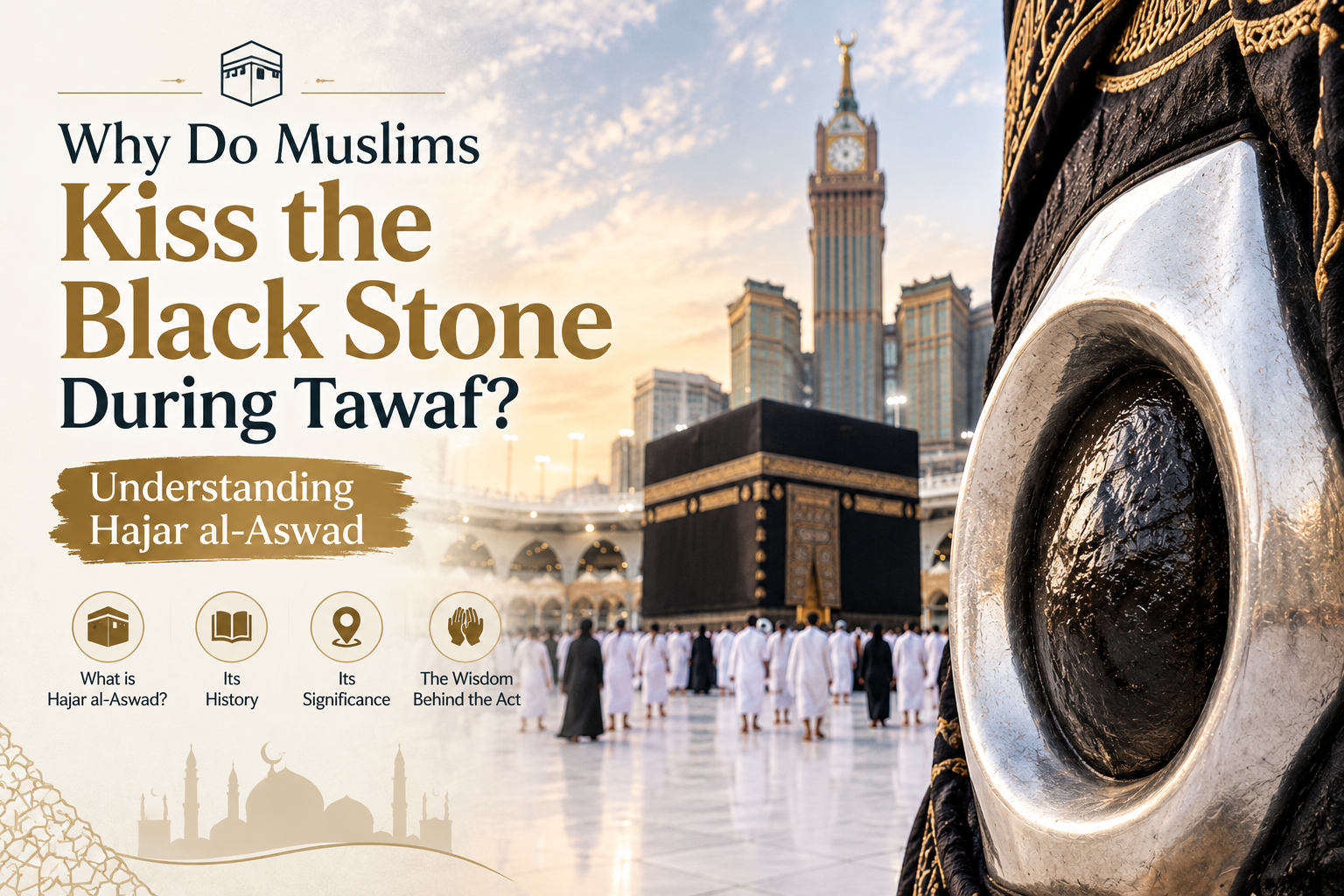
Every year, millions of Muslims visit Makkah to perform Hajj and Umrah. During Tawaf, many pilgrims try to approach and kiss the Black Stone, also known as Hajar al-Aswad. This centuries-old Islamic tradition raises an important question: Why do Muslims kiss the Black Stone during Tawaf, and what does this act mean?
The answer is connected to the teachings of Prophet Muhammad (peace be upon him), the principles of Islamic worship, and the historical importance of the Holy Kaaba. Learning about this practice offers a deeper understanding of Muslim pilgrimage and the sacred heritage associated with Makkah.
What Is Hajar al-Aswad?
Hajar al-Aswad is the Black Stone situated in the eastern corner of the Holy Kaaba in Makkah, Saudi Arabia. It serves as a reference point for Muslims performing Tawaf, the ritual of walking seven times around the Kaaba in an anticlockwise direction.
Tawaf is an essential part of the pilgrimage rituals associated with Hajj and Umrah. Pilgrims begin their circuits in line with the Black Stone and complete each round at the same point.
The stone has a special place in Islamic tradition because Prophet Muhammad (peace be upon him) kissed it. Muslims who follow this practice do so to honour his example and follow the established teachings of Islam.
Why Do Muslims Kiss the Black Stone During Tawaf?
The main reason Muslims kiss Hajar al-Aswad is to follow the Sunnah of Prophet Muhammad (peace be upon him). His actions provide guidance for Muslims, including how certain pilgrimage rituals are performed.
However, the meaning of this tradition goes beyond the physical act of kissing a stone.
Following the Example of the Prophet
Muslims consider the Prophet's teachings and actions an important guide for their religious lives. Authentic Islamic narrations describe him kissing the Black Stone during Tawaf.
When pilgrims follow this practice, they express their love for the Prophet and their commitment to his teachings. The action is an expression of religious obedience rather than a belief that the stone should be worshipped.
Understanding the Difference Between Respect and Worship
Islam teaches that worship belongs to Allah alone. Kissing the Black Stone does not mean treating it as a deity or believing that it independently controls a person's life.
A well-known narration describes Umar ibn al-Khattab (may Allah be pleased with him) explaining that the stone could neither benefit nor harm by itself. He kissed it because he had seen the Prophet do so.
This account helps explain why the tradition remains important: Muslims follow the Prophet's example while maintaining their belief in the oneness of Allah.
Connecting with Islamic History
Hajar al-Aswad is closely associated with the history of the Kaaba and the pilgrimage traditions practised by Muslims across generations. Its position also helps pilgrims identify where each circuit of Tawaf begins and ends.
For many visitors, learning about the Black Stone adds historical context to their journey and deepens their appreciation of the rituals performed in the Grand Mosque.
Is It Necessary to Kiss the Black Stone During Tawaf?
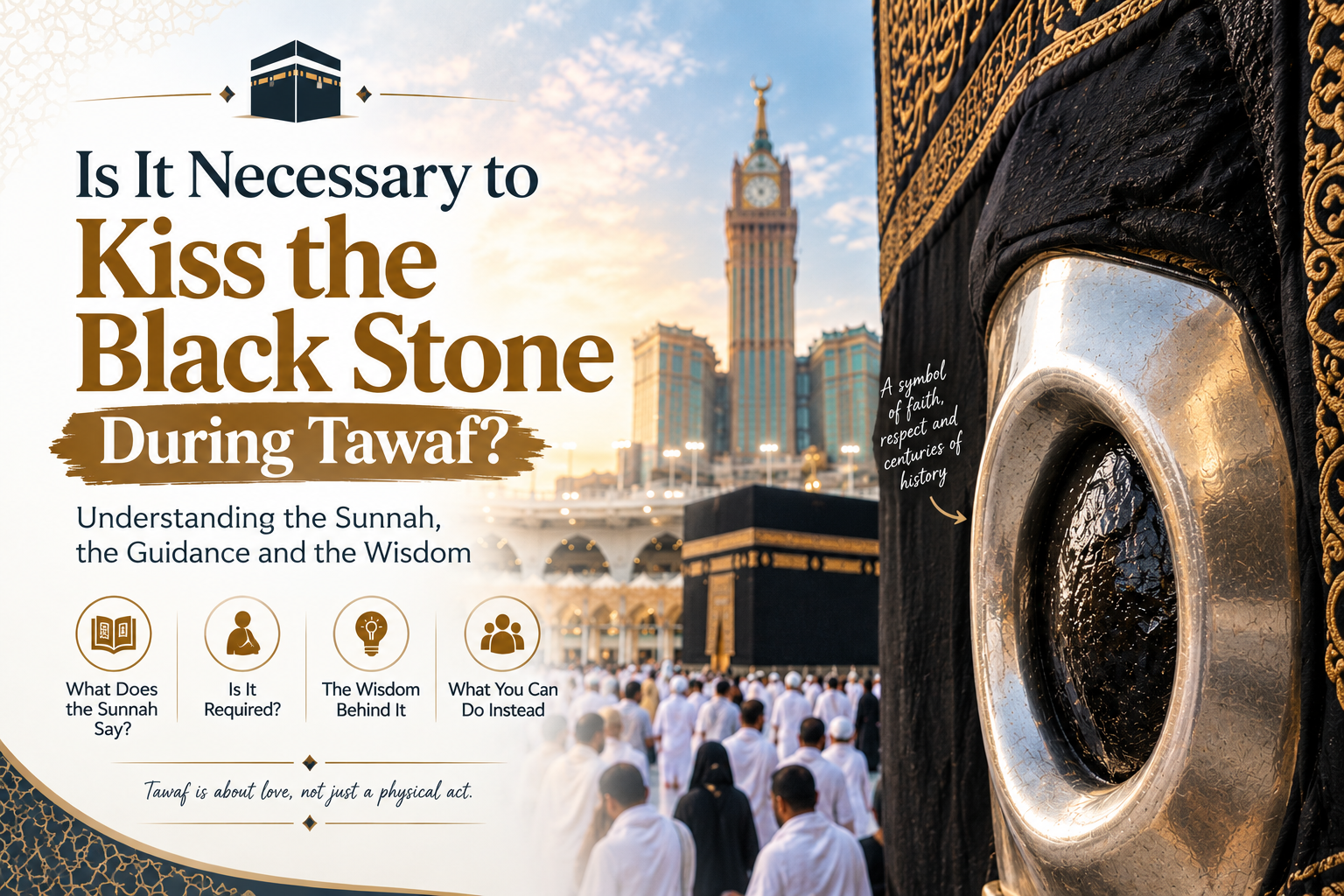
No. Kissing the Black Stone is not compulsory for completing a valid Tawaf.
When the area is accessible and it is safe to approach, pilgrims may kiss the stone. If reaching it is difficult, they can gesture towards it from a distance when beginning a circuit, following the relevant Sunnah.
Crowds around the Kaaba can become particularly dense during Hajj, Ramadan, and other busy periods. Trying to reach the stone by pushing or hurting other people contradicts the consideration pilgrims should show one another.
If you cannot reach Hajar al-Aswad, continue your Tawaf calmly. Your inability to kiss the stone does not mean that your pilgrimage has failed.
How Is the Black Stone Different from the Kaaba Kiswah?
The Black Stone and the Kiswah are different elements of the Holy Kaaba.
Hajar al-Aswad is the stone located in the Kaaba's eastern corner. The Kiswah is the covering placed over the Kaaba's exterior. This black textile is recognised for its intricate Quranic inscriptions, decorative embroidery, and remarkable craftsmanship.
People interested in Islamic art frequently explore Kaaba Kiswah calligraphy to learn about the designs and skilled work associated with the covering. The Kiswah also has cultural and historical importance for Muslims who appreciate Islamic heritage.
Although both are connected with the Kaaba, the Black Stone's role in Tawaf should not be confused with the textile artistry of the Kiswah.
Can You Buy Kaaba Kiswah Online?
Interest in Islamic heritage has encouraged many people to search for Kaaba-related keepsakes and historical textile pieces. Common questions include, “Where to buy Kaaba Kiswah?” and “How do I buy authentic Kaaba Kiswah?”
Availability depends on the seller and the specific item. Before purchasing a Kiswah-related artifact, consider its origin, supporting documentation, and the seller's transparency.
If you are researching buy Kiswah Kaaba online options, keep these guidelines in mind:
Request clear information about the item's history and source.
Examine any certificate or provenance documents provided.
Ask whether the item's authenticity has been independently verified.
Compare prices in relation to the item's size, condition, and documentation.
Be cautious of sellers making extraordinary claims without supporting evidence.
Search terms such as “original Kaaba Kiswah price,” “Gilafe Kaaba piece for sale,” and “Is it possible to buy Kaaba Kiswah?” may help you research the market. However, the price of an item alone cannot establish that it is genuine.
Kiswah Al Kabah provides a place to explore Kiswah-related products and Islamic heritage. Before making a purchase, review the available product details and any authenticity information carefully.
Frequently Asked Questions
Why do Muslims kiss the Black Stone?
Muslims kiss Hajar al-Aswad to follow the Sunnah of Prophet Muhammad (peace be upon him). They do not kiss it because they consider it a deity.
Can Tawaf be completed without kissing Hajar al-Aswad?
Yes. Kissing the stone is not compulsory. Pilgrims who cannot approach it safely may gesture towards it in accordance with the Sunnah.
Is the Black Stone part of the Kiswah?
No. The Black Stone is located in the eastern corner of the Kaaba, while the Kiswah is the textile covering over its exterior.
What should pilgrims do if the area is crowded?
Pilgrims should avoid pushing, follow the guidance of mosque authorities, and continue their rituals safely. Kissing the stone is not worth risking another person's safety.
Explore the Heritage of the Holy Kaaba
The practice of kissing Hajar al-Aswad reflects the importance of following the Prophet's example in Islamic worship. It also reminds pilgrims that sincere devotion, patience, and consideration for others are central to a meaningful pilgrimage.
For those who wish to learn more about the artistry and heritage associated with the Kaaba, exploring Kiswah-related pieces can offer another perspective on Islamic craftsmanship and cultural history.
Discover more Islamic heritage and Kiswah-related pieces at Kiswah Al Kabah.
Visit Kiswahalkabah to explore the collection, review product information, and discover the historical artistry associated with the covering of the Holy Kaaba.