What Is the Kaaba Made Of? Inside the Structure of the Holy Kaaba
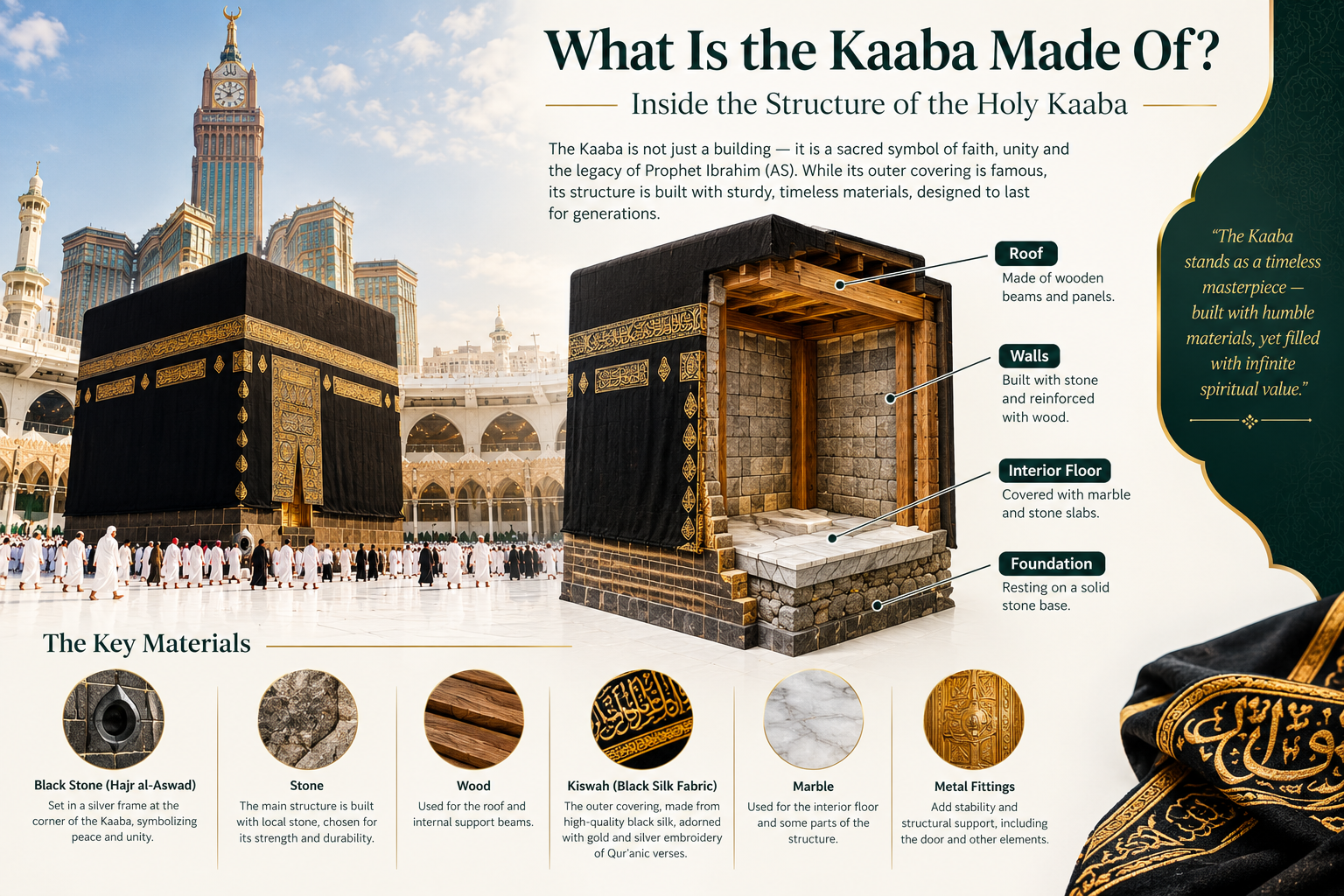
Positioned at the center of Islam's most sacred mosque, Masjid al-Haram in Makkah, the Holy Kaaba serves as the Qibla—the direction toward which over 1.9 billion Muslims turn in prayer five times daily.
While millions perform Tawaf around this sacred building during Hajj and Umrah, many wonder about its construction: What is the Kaaba made of? What does its interior look like, and what materials give the structure its timeless strength?
1. The Exterior Structure: Local Makkah Granite
The core structural body of the Holy Kaaba is constructed from thick, durable blocks of grey granite sourced from the surrounding hills of Makkah, particularly Mount Ka'ba (Jabal Ka'ba).
Dimensions: The cubic structure stands approximately 13.1 meters (43 feet) high, with base dimensions measuring roughly 11.03 meters by 12.86 meters.
Roofing & Ceiling: The roof is constructed from multi-layered, water-resistant timber treated to withstand the desert climate, supported by heavy structural beams.
Mortar & Foundations: The masonry blocks are set with a traditional mixture of mortar, set atop a marble-paved foundation base called the Shadhrawan, which stabilizes the structure against heavy rainwater runoff.
2. The Golden Door (Bab al-Kaaba)
Located on the northeastern wall of the Kaaba, elevated roughly 2.2 meters above the ground, is the magnificent golden door of the Kaaba (Bab al-Kaaba).
Material: Constructed from almost 300 kilograms of pure gold set over a reinforced steel base.
Calligraphy: The door features hand-engraved Quranic verses, Islamic geometric patterns, and intricate Arabic calligraphy created by master artisans.
3. The Kiswah: The Silk and Gold Covering
The outer walls of the Kaaba are draped in the Kiswah, the iconic black silk cloth adorned with gold and silver embroidery.
Raw Materials: Made from roughly 670 kilograms of pure black-dyed silk.
Precious Metal Inscriptions: The calligraphic bands running around the Kiswah use approximately 120 kilograms of gold thread and 100 kilograms of pure silver thread.
Design Elements: The cloth is embroidered with verses from the Holy Quran, praises of Allah, and intricate Islamic motifs.
4. What Is Inside the Holy Kaaba?
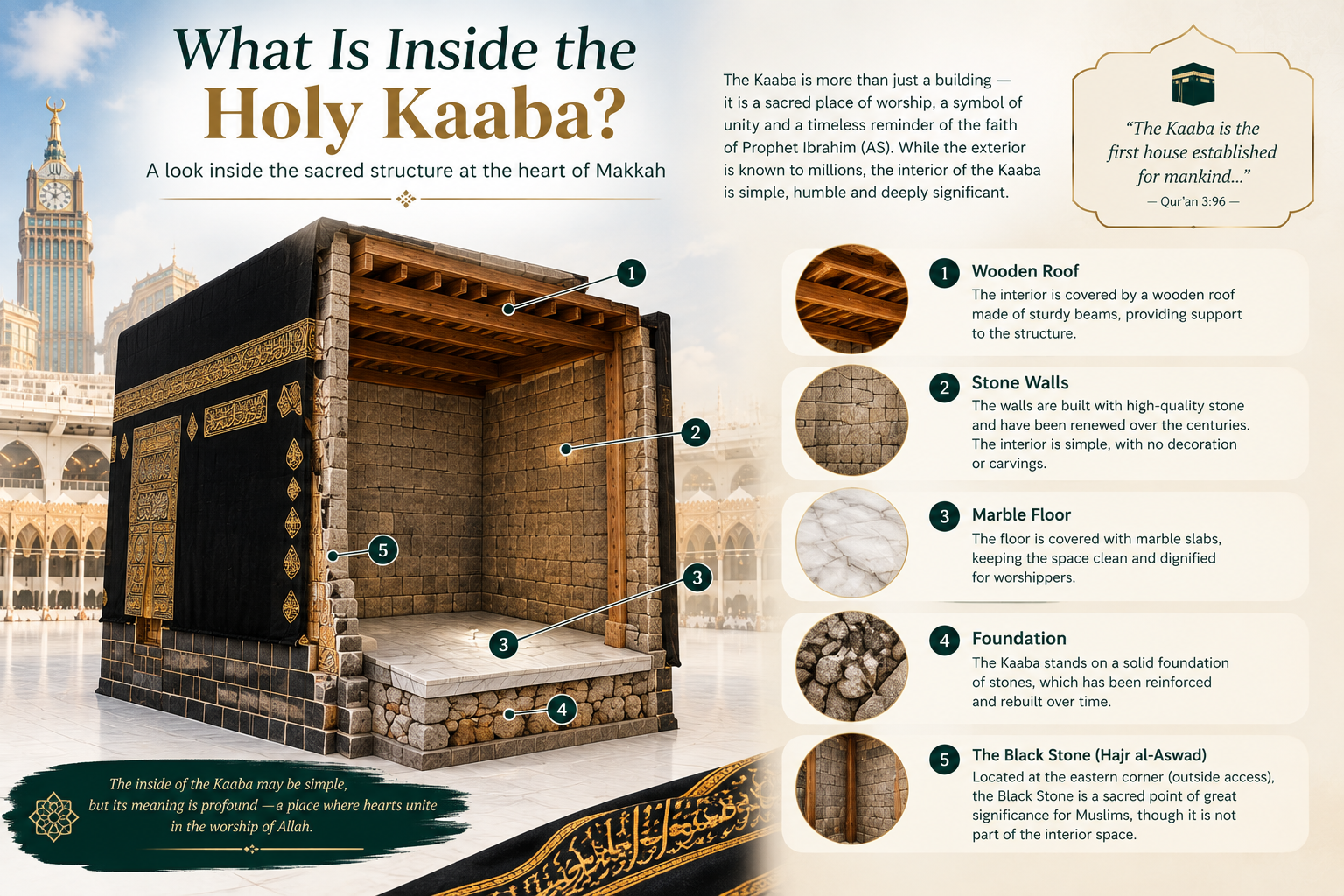
While entry into the interior of the Kaaba is reserved for select dignitaries and maintenance teams, historical documentation details its architectural elements.
Interior Feature | Material & Construction Details |
Pillars | Three tall wooden pillars made from ancient teak wood support the roof. |
Walls & Floor | Lined with polished, imported white and gray marble panels decorated with Arabic inscriptions. |
Ceiling Linings | Hanging green silk curtains inscribed with Quranic verses cover the upper interior walls. |
Lighting & Accents | Historical bronze and silver lamps hang between the central support pillars. |
Musaqlah (Staircase) | An internal enclosed staircase leads to the roof for routine maintenance access. |
5. Key Architectural Elements Around the Kaaba
To understand the full structure of the Kaaba, several adjacent features complete its sacred layout:
Hajar al-Aswad (The Black Stone): Set in the eastern corner, encased in a pure silver frame.
Rukn al-Yamani (The Yemeni Corner): The southern corner of the structure built with exposed granite blocks.
Meeqat & Hijr Ismail (Hateem): A semi-circular marble wall opposite the northwestern wall, marking the original footprint of the Kaaba as built by Prophet Ibrahim (AS).
Meezab al-Rahmah: A gold-plated rainwater spout located on the roof edge facing the Hateem.
Bringing the Heritage of the Kaaba to Your Home
The materials, calligraphy, and craftsmanship surrounding the Holy Kaaba carry deep historical and spiritual significance. The elegance of the Kiswah and the architecture of Makkah inspire Islamic art around the world.
At Kiswah Al Kaaba, we celebrate this sacred tradition by offering authentic Islamic decor, Kiswah-inspired wall art, calligraphic tapestries, and prayer accessories. Explore our collection at Kiswah Al Kaaba to adorn your living space with the timeless beauty of Islamic heritage.