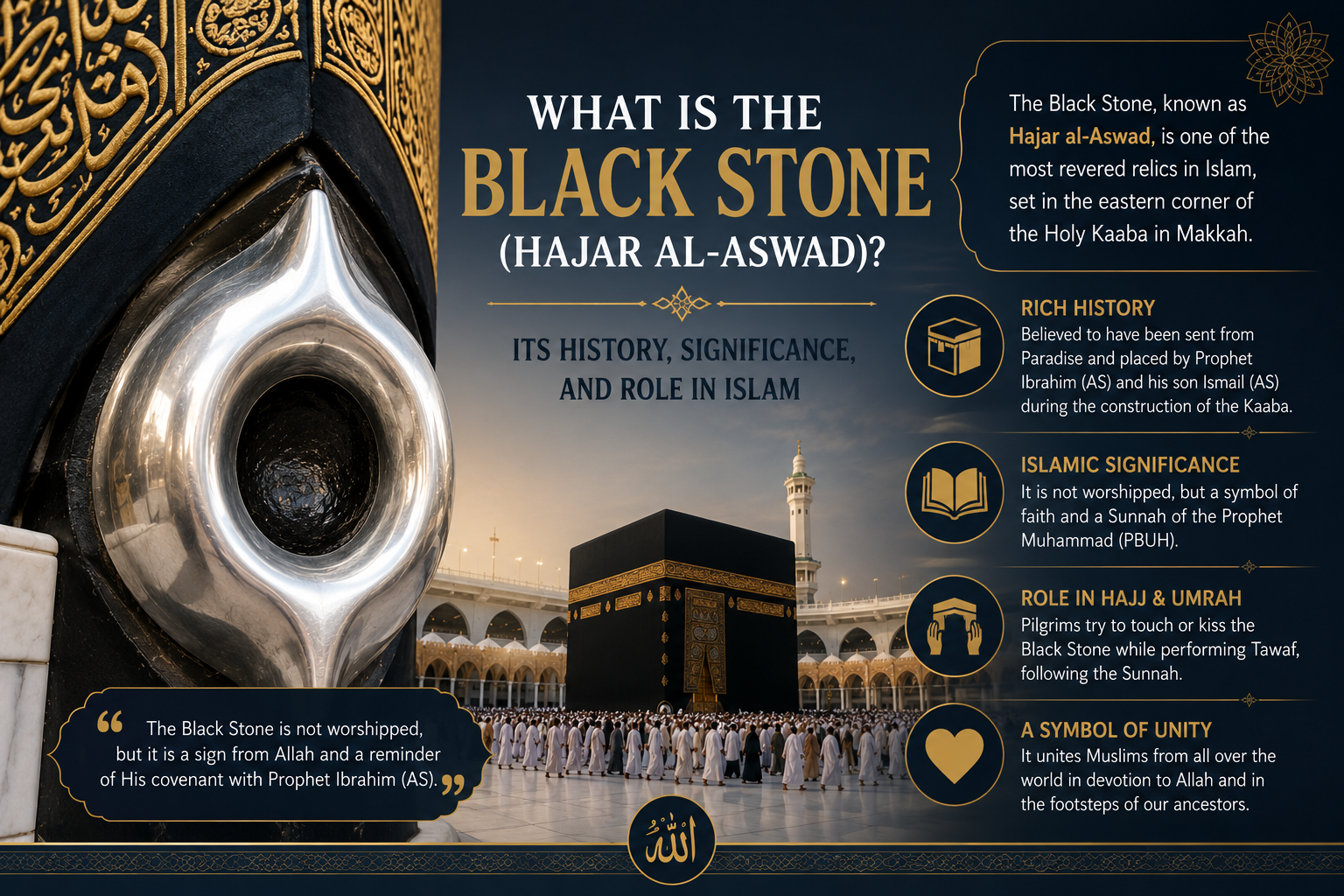
What Is the Black Stone (Hajar al-Aswad)? Its History, Significance, and Role in Islam
Every year, millions of Muslims travel to Makkah hoping to complete Hajj or Umrah and stand before the Holy Kaaba. One feature that attracts particular attention is the Black Stone Kaaba, known in Arabic as Hajar al-Aswad. Set into the eastern corner of the Kaaba, this revered stone has been honoured by Muslims for centuries and is closely connected to the history of the Sacred House.
Many people wonder about the Hajar al Aswad history, ask why do Muslims kiss the Black Stone, or are curious about what is inside the Black Stone frame. Understanding these questions helps explain why the Black Stone holds such a respected place in Islamic tradition while correcting common misconceptions.
What Is Hajar al-Aswad?
The Black Stone, or Hajar al-Aswad, is a sacred stone embedded in one corner of the Holy Kaaba inside Masjid al-Haram in Makkah. It is enclosed within a silver frame that protects the remaining fragments of the stone after centuries of natural wear and historical events.
Islamic tradition relates that the stone was placed in the Kaaba during its reconstruction by Prophet Ibrahim (AS) and his son Prophet Ismail (AS). Since then, it has remained an important part of the Kaaba and one of the most recognised symbols associated with Islam's holiest site.
Although Muslims honour the Black Stone, they do not worship it. Worship is directed to Allah alone.
Hajar al Aswad History
The Hajar al Aswad history stretches back to the earliest days of the Kaaba.
According to Islamic tradition, when Prophet Ibrahim (AS) and Prophet Ismail (AS) rebuilt the Kaaba by Allah's command, the Black Stone was placed into its present position to mark the starting point for Tawaf, the act of circling the Kaaba during pilgrimage.
Throughout history, the Kaaba has undergone repairs following floods, rebuilding projects, and other events. Despite these changes, the Black Stone has remained part of the Sacred House. Over time, it became fragmented due to historical incidents, and a protective silver setting was designed to hold the remaining pieces securely in place.
Its preservation reflects the care devoted to one of Islam's most treasured landmarks.
Why Do Muslims Kiss the Black Stone?
One of the most frequently asked questions is why do Muslims kiss the Black Stone.
During Tawaf, pilgrims begin each circuit from the corner where the Black Stone is located. If they are able to approach safely without causing harm or difficulty to others, they may kiss the stone or touch it. When the area is crowded, many pilgrims simply raise their hand toward it as they pass.
This practice follows the example (Sunnah) of Prophet Muhammad ﷺ. It is an expression of obedience and respect for his teachings rather than an act of worship directed toward the stone itself.
The well-known statement of Caliph Umar ibn al-Khattab (RA) beautifully explains this understanding. He acknowledged that the stone cannot benefit or harm anyone by itself and said he kissed it only because he saw the Prophet ﷺ do so. This highlights that the act is based on following the Sunnah, not believing the stone possesses divine power.
What Is Inside the Black Stone Frame?
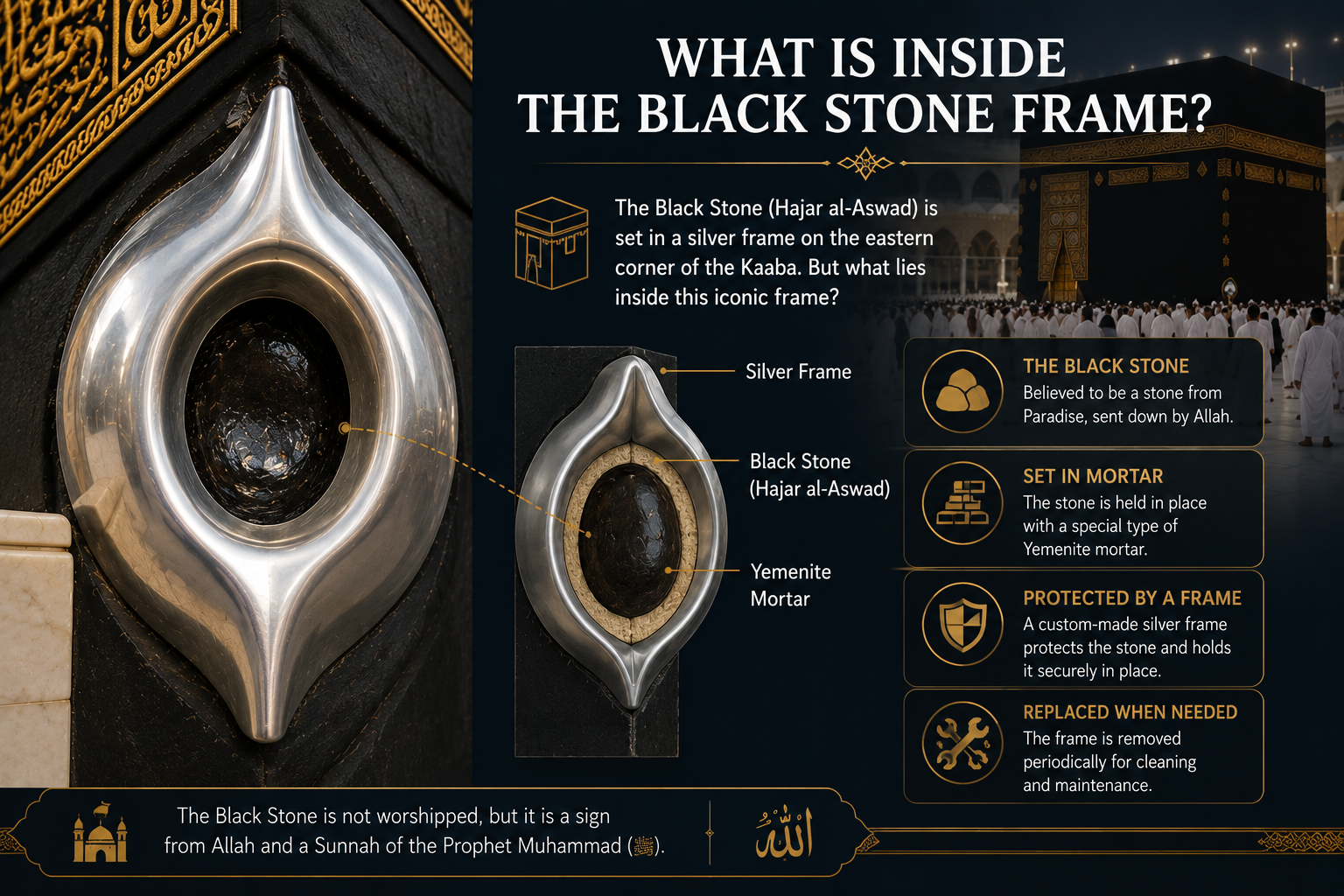
Another common question is what is inside the Black Stone frame.
The silver frame does not contain hidden objects or relics. Its purpose is to support and protect the remaining fragments of Hajar al-Aswad that are visible today.
Because the stone has experienced damage throughout history, the frame keeps the pieces secure while allowing pilgrims to recognise its location. It also helps preserve the stone for future generations.
The frame itself has been repaired and renewed over the centuries as needed, but its purpose has always remained the same: safeguarding the sacred stone.
The Spiritual Significance of the Black Stone
The importance of the Black Stone comes from its connection to the Kaaba and Islamic worship.
It serves as:
The starting point for Tawaf.
A reminder of the legacy of Prophet Ibrahim (AS).
A symbol associated with Hajj and Umrah.
A connection to the Sunnah of Prophet Muhammad ﷺ.
Its significance is therefore spiritual and historical rather than mystical. Muslims respect it because of its place within Islamic tradition.
Common Misunderstandings
People unfamiliar with Islamic practices sometimes assume Muslims worship the Black Stone.
This is incorrect.
Islam teaches that worship belongs only to Allah. The Black Stone is honoured because of its association with the Sacred House and because the Prophet Muhammad ﷺ acknowledged it during pilgrimage.
Similarly, not every pilgrim is able to touch or kiss the stone. During busy periods, pointing towards it while continuing Tawaf is considered sufficient according to Islamic practice.
The Black Stone and the Kaaba Today
Millions of visitors see the Black Stone each year while performing Tawaf.
Because of the large number of pilgrims, access to the stone is carefully managed to maintain safety and order. Many worshippers choose not to attempt reaching it if doing so would inconvenience others.
The focus of pilgrimage remains devotion to Allah, sincere worship, and completing the rites of Hajj or Umrah with humility.
Preserving Islamic Heritage Through Authentic Islamic Artifacts
The Kaaba and the Black Stone continue to inspire Muslims around the world. Many believers choose to celebrate this rich heritage through authentic Islamic artifacts that reflect the beauty and significance of Islam's holiest sanctuary.
Popular choices include:
Framed Kaaba Kiswah displays.
Islamic calligraphy artwork.
Certified Kiswah pieces.
Elegant Qur'anic wall decor.
Handcrafted Islamic gifts inspired by the Sacred House.
These meaningful items serve as reminders of faith while honouring centuries of Islamic history and craftsmanship.
Conclusion
The Black Stone Kaaba, known as Hajar al-Aswad, remains one of the most recognised features of Islam's holiest site. Learning about the Hajar al Aswad history, understanding why do Muslims kiss the Black Stone, and discovering what is inside the Black Stone frame helps provide a clearer appreciation of its place in Islamic tradition.
Rather than being an object of worship, the Black Stone represents continuity, remembrance, and obedience to the example of Prophet Muhammad ﷺ. Its presence within the Kaaba continues to inspire millions of Muslims while reminding believers of the rich spiritual heritage connected with the Sacred House.