What Is Provenance in Islamic Art? Why Documentation Matters for Collectors and Buyers

Buying Islamic art is about more than appreciating beautiful calligraphy, intricate textiles, historic designs, or exceptional craftsmanship. For serious collectors, understanding an object's history can be equally important. This history is known as provenance.
Provenance can help establish where an artwork came from, who owned it previously, how it changed hands, and what evidence supports its current description. For Islamic art buyers, especially those considering valuable textiles and heritage pieces, reliable documentation can make a significant difference.
What Is Provenance in Art Collecting?
So, what is provenance in art collecting?
In simple terms, provenance is the recorded history of an artwork or collectible. It may include information about its original creation, previous owners, exhibitions, publications, auctions, acquisitions, and transfers between collections.
For example, a historic Islamic textile might have records showing when it was acquired, who previously possessed it, and how it eventually reached its current owner.
Provenance does not necessarily need to be an unbroken record stretching back to the object's creation. Even partial documentation can provide useful information when combined with physical examination and other evidence.
Why Provenance Matters in Islamic Art
Understanding Why provenance matters in Islamic art is particularly important when purchasing objects associated with significant religious or cultural locations.
Islamic art includes a huge variety of objects, from manuscripts and ceramics to textiles, metalwork, carpets, architectural elements, and calligraphic pieces. Some objects may be centuries old, while others are relatively contemporary but have important cultural connections.
When an item is described as having a connection to Makkah, Madinah, the Kaaba, or another significant Islamic site, provenance becomes especially relevant.
A seller's description alone cannot establish historical origin. Documentation can provide additional evidence supporting the story attached to an object.
What Can Provenance Documents Include?
Provenance records can take different forms depending on the object's age and history.
Potential evidence may include:
Previous ownership records
Purchase invoices
Auction catalogues
Exhibition records
Museum documentation
Published references
Estate inventories
Expert assessments
Certificates
Photographic archives
Import or export documentation
Not every artwork will have all these records. Older objects may have incomplete histories because documentation can be lost over decades or centuries.
The important consideration is whether the available evidence is consistent with the object's claimed identity.
Provenance in Islamic Art UK
For buyers researching Provenance in Islamic art UK, documentation can be particularly useful when purchasing from galleries, dealers, auction houses, or private sellers.
UK collectors should carefully retain all documents received with a purchase. These records can become part of the object's own history and may be valuable if the artwork is later sold, insured, appraised, or donated.
Buyers should also ask whether information provided by a seller is based on documented evidence or simply an attribution.
A description such as "believed to be from" is different from a documented historical record. Understanding that distinction can prevent unrealistic assumptions about an item's background.
Provenance and Authenticity Are Not the Same
An important point is that provenance and authenticity are related but different.
Provenance concerns an object's documented history. Authenticity concerns whether the object is genuinely what it is claimed to be.
A strong ownership history can support an authenticity assessment, but provenance alone does not automatically prove that an artwork is genuine.
Likewise, an authentic object may have limited provenance because its historical records were never preserved.
Collectors should therefore consider provenance alongside materials, craftsmanship, condition, age, technical characteristics, and expert opinion.
Islamic Art Provenance and Valuation UK
There is often a relationship between Islamic art provenance and valuation UK collectors should understand.
An artwork with clear and credible documentation may be easier to evaluate than an otherwise similar piece with an uncertain history.
Provenance can provide context that helps specialists understand an object's significance. A documented connection to a notable collection, exhibition, publication, or historical event may contribute to an item's desirability.
However, provenance does not automatically determine price. Other factors can influence valuation, including rarity, artistic quality, condition, materials, age, cultural significance, market demand, and authenticity.
A collector should therefore avoid assuming that a certificate or ownership record guarantees a particular monetary value.
Why Documentation Is Important for Kiswah Pieces
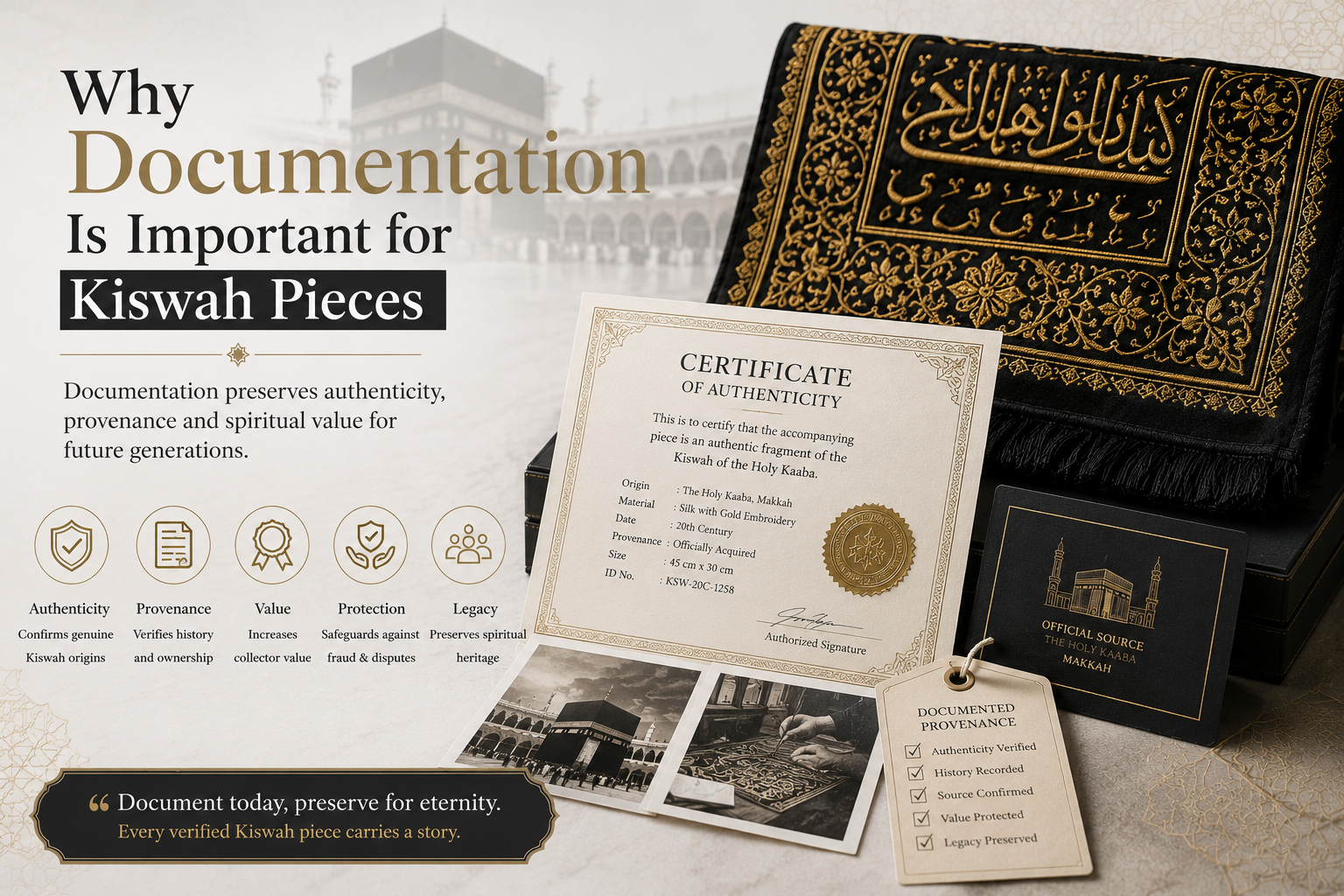
Islamic textiles connected with the Kiswah of the Holy Kaaba can be especially meaningful to collectors.
Because Kiswah-inspired reproductions and decorative textiles exist, buyers should distinguish between a textile that resembles the Kiswah and one that is genuinely documented as having originated from it.
Useful documentation might include details about the textile's source, previous ownership, dimensions, materials, acquisition history, and authentication.
The stronger the evidence, the easier it is for a collector to understand what they are actually purchasing.
Questions to Ask Dealers About Islamic Art Provenance
If you are researching Questions to ask dealers about Islamic art provenance UK, consider asking the following:
Where did the piece originate?
Ask the dealer to explain the item's known history rather than relying on a short product description.
Who previously owned it?
Previous ownership can provide useful context, particularly when records are available.
Is there supporting documentation?
Ask to see invoices, catalogues, certificates, photographs, or other relevant records.
Has the piece been published or exhibited?
References in established publications or exhibition catalogues can add useful historical context.
Who authenticated the object?
Find out whether an independent specialist, institution, conservator, or another qualified professional has examined it.
Are there any gaps in the provenance?
Gaps are not automatically suspicious. The important thing is whether the dealer clearly explains what is known and what remains uncertain.
Does the documentation refer specifically to this item?
A general certificate or photograph should not automatically be assumed to document the exact piece being offered.
How Buyers Can Check Provenance
Collectors should take a methodical approach.
First, request every available document from the seller. Next, compare the information across invoices, certificates, photographs, catalogues, and descriptions.
Check whether dimensions, materials, dates, ownership details, and other identifying characteristics remain consistent.
For high-value purchases, consider obtaining an independent assessment from an appropriately qualified specialist before completing the transaction.
It is also sensible to preserve digital copies of all documentation and correspondence.
Warning Signs to Consider
Buyers should be cautious when a seller:
Refuses to explain an item's history
Provides inconsistent ownership information
Uses vague claims without supporting evidence
Cannot identify the source of a certificate
Pressures buyers to make immediate decisions
Makes extraordinary historical claims without documentation
Provides photographs that do not clearly show the entire object
These signs do not automatically establish that an object is inauthentic, but they justify additional investigation.
Provenance Adds Context to Collecting
Collecting Islamic art should involve curiosity as well as caution. Provenance allows collectors to understand an object's journey and place it within a wider historical context.
A textile, manuscript, or decorative object becomes more meaningful when its story is supported by credible evidence.
For buyers, documentation also creates a permanent record of ownership that can accompany the object throughout its collecting life.
Final Thoughts
Provenance is an important part of responsible Islamic art collecting. It helps buyers investigate an object's history, understand its background, evaluate supporting evidence, and make more informed decisions.
Whether you are asking What is provenance in art collecting, researching Why provenance matters in Islamic art, exploring Provenance in Islamic art UK, studying Islamic art provenance and valuation UK, or preparing Questions to ask dealers about Islamic art provenance UK, documentation should be treated as an important part of the buying process.
For collectors interested in Islamic textiles and heritage pieces, the most valuable information is not always found in the appearance of an object. Sometimes, its history tells the most important part of the story.