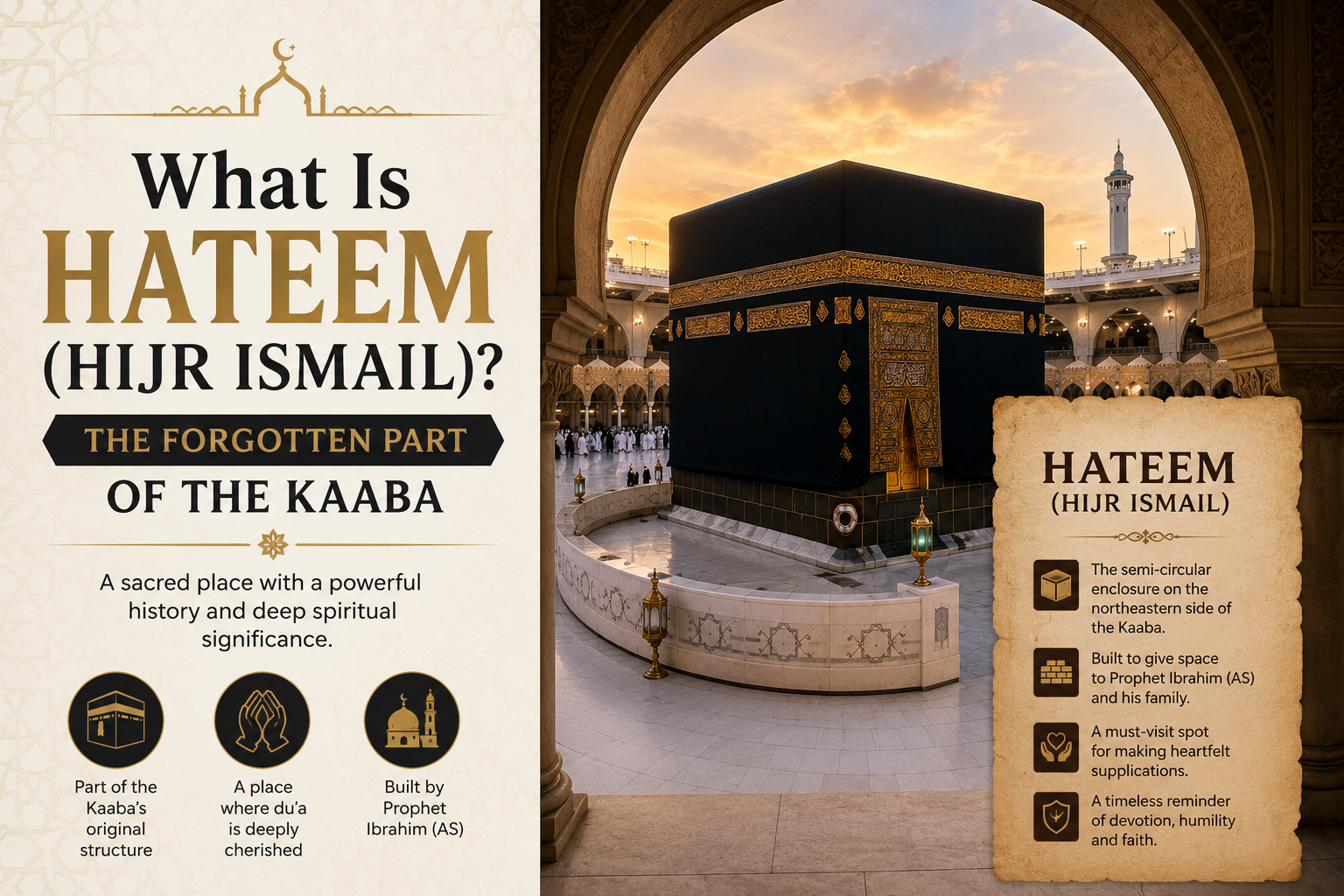
Every year, millions of Muslims travel to Makkah hoping to experience the blessings of seeing the Holy Kaaba. While many pilgrims recognize the Black Stone, the Kiswah, and Maqam Ibrahim, fewer understand the significance of Hateem, also known as Hijr Ismail. This semi-circular area beside the Kaaba holds immense historical and spiritual value, making it one of the most beloved places for worship during Hajj and Umrah.
Many visitors ask, what is Hateem of Kaaba, why is it separated from the main structure, and whether praying there carries any special reward. Learning about Hateem helps Muslims appreciate an important part of Islamic history and deepens their connection to the Sacred House of Allah.
In this guide, we'll explore the history of Hijr Ismail, explain why is Hateem outside the Kaaba, discuss the virtues of praying inside Hateem Kaaba, and understand the lasting Hijr Ismail importance for every believer.
What Is Hateem of Kaaba?
Hateem, commonly known as Hijr Ismail, is the semi-circular area enclosed by a low white marble wall attached to the north-west side of the Holy Kaaba. Although it appears to be outside the Kaaba today, Islamic history tells us that this space originally formed part of the Kaaba built by Prophet Ibrahim (AS) and his son Prophet Ismail (AS).
When the Quraysh rebuilt the Kaaba before the Prophet Muhammad ﷺ received revelation, they faced financial limitations. They agreed to use only lawful wealth for construction, but the funds were insufficient to rebuild the entire original foundation. As a result, they shortened the building and left this section outside, marking it with the semi-circular wall that pilgrims see today.
This historical event explains why is Hateem outside the Kaaba, even though it remains part of the original sacred foundation.
Why Is Hateem Outside the Kaaba?
One of the most common questions asked by pilgrims is why is Hateem outside the Kaaba.
The answer lies in the reconstruction carried out by the Quraysh approximately five years before the Prophet Muhammad ﷺ received prophethood. Because they refused to use wealth earned through unjust means, they lacked enough resources to complete the Kaaba according to Prophet Ibrahim's original foundation.
Instead of extending the walls fully, they built the Kaaba smaller and placed a curved boundary to indicate the remaining sacred area. This boundary became known as Hijr Ismail or Hateem.
Later, the Prophet Muhammad ﷺ explained to Aisha (RA) that if the Quraysh had not been so close to their pre-Islamic traditions, he would have rebuilt the Kaaba upon the original foundations of Prophet Ibrahim (AS), including the area of Hateem.
This narration demonstrates that the space enclosed within Hateem is spiritually regarded as part of the Kaaba itself.
The Historical Connection to Prophet Ismail (AS)
The name Hijr Ismail is closely linked with Prophet Ismail (AS), who assisted his father, Prophet Ibrahim (AS), in constructing the Kaaba.
According to Islamic tradition, this area is associated with the family of Prophet Ismail and holds deep historical significance. Although authentic narrations do not conclusively establish that Prophet Ismail (AS) is buried there, Muslims have long respected the area because of its connection to the original construction of the Sacred House.
The importance of Hijr Ismail is therefore rooted not only in history but also in its relationship with the prophets who dedicated themselves to the worship of Allah.
Hijr Ismail Importance in Islam
Understanding the Hijr Ismail importance helps pilgrims appreciate why this area is treated with such reverence.
Some of its greatest virtues include:
It forms part of the original foundation of the Kaaba.
It reminds Muslims of the sincerity and sacrifice of Prophet Ibrahim (AS) and Prophet Ismail (AS).
It is one of the most desired places for voluntary prayer during Hajj and Umrah.
It offers worshippers an opportunity to pray within the original boundaries of the Sacred House.
It strengthens the spiritual connection between believers and the history of Islam.
Although every part of Masjid al-Haram is blessed, Hateem occupies a unique position because of its historical relationship with the Kaaba.
Praying Inside Hateem Kaaba
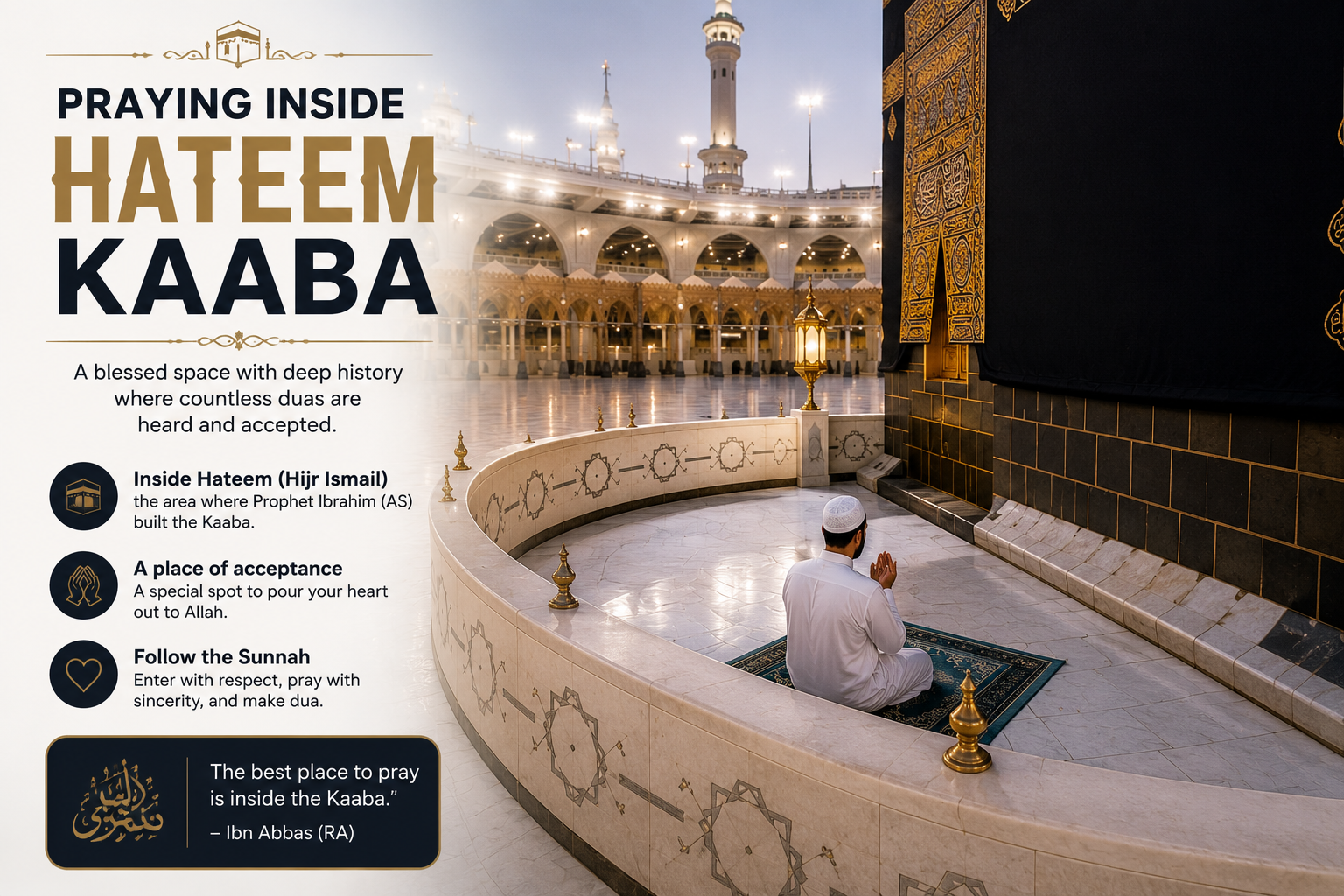
One of the greatest blessings for pilgrims is praying inside Hateem Kaaba.
Since this area belongs to the original structure of the Kaaba, offering voluntary prayers there is regarded similarly to praying inside the Kaaba itself. For this reason, many pilgrims patiently wait for an opportunity to enter the enclosed space when it is not overcrowded.
If you are fortunate enough to enter Hateem, you may:
Perform two voluntary rak'ahs.
Make sincere du'a.
Recite the Qur'an.
Engage in remembrance of Allah.
Seek forgiveness and guidance.
Because of the large crowds throughout the year, pilgrims should remain patient, avoid pushing others, and follow the instructions of the mosque authorities. Worship performed with kindness and respect reflects the true spirit of Islam.
Can Everyone Enter Hateem?
Yes. Hateem is generally open to pilgrims when conditions permit. However, access depends on crowd management, prayer times, and safety regulations established by the authorities of Masjid al-Haram.
During Ramadan, Hajj, and peak Umrah seasons, entry may become temporarily restricted due to the enormous number of visitors.
If you cannot enter Hateem, remember that Allah rewards sincere intentions. Worship anywhere within Masjid al-Haram carries immense blessings.
Common Misconceptions About Hateem
Several misunderstandings surround Hijr Ismail. Clarifying them helps Muslims practice their faith correctly.
Myth: Hateem is a separate holy site.
Reality: Hateem is not separate from the Kaaba. It remains part of its original foundation.
Myth: Every du'a made in Hateem is automatically accepted.
Reality: Muslims are encouraged to make heartfelt supplications everywhere, trusting Allah's wisdom and mercy.
Myth: Pushing others to enter Hateem is justified.
Reality: Islam teaches patience, compassion, and respect. Causing hardship to fellow worshippers contradicts Islamic manners.
Myth: Prophet Ismail (AS) is definitively buried inside Hateem.
Reality: While traditional reports mention this belief, there is no authentic evidence establishing it with certainty.
Preserving the Legacy of the Kaaba
The Kaaba is more than a physical structure; it represents centuries of faith, devotion, and Islamic heritage. Every element surrounding it—including the Black Stone, Multazam, Maqam Ibrahim, the Kiswah, and Hijr Ismail—reminds believers of the sacrifices made by the Prophets and generations of Muslims.
Many people choose to preserve that spiritual connection by displaying original Kiswah pieces, framed Kiswah designs, and authentic Islamic artifacts in their homes or prayer spaces. These meaningful pieces serve as daily reminders of the sacred journey to Makkah and inspire continuous remembrance of Allah.
At Kaaba Kiswa, we are dedicated to offering authentic Islamic decor and original Kiswah pieces that reflect the beauty, heritage, and timeless significance of the Holy Kaaba, allowing believers to cherish this sacred legacy with dignity and respect.
Conclusion
Understanding what is Hateem of Kaaba allows Muslims to appreciate one of the most remarkable yet often overlooked sections of the Sacred House. The history behind why is Hateem outside the Kaaba, the profound Hijr Ismail importance, and the privilege of praying inside Hateem Kaaba all highlight the enduring connection between today's believers and the legacy of Prophet Ibrahim (AS) and Prophet Ismail (AS).
Whether you are preparing for Hajj, planning your first Umrah, or simply expanding your knowledge of Islamic history, learning about Hateem deepens your appreciation of Islam's holiest site.
If you're appreciate by the timeless beauty and heritage of the Holy Kaaba, explore Kaaba Kiswa's collection of authentic Islamic artifacts, original Kiswah pieces, and meaningful Islamic gifts designed to bring a lasting reminder of Makkah into your home.