The Architecture of the Kaaba: Design, Construction, and Hidden Details Explained
The Holy Kaaba is the most revered structure in Islam and the spiritual heart of Masjid al-Haram in Makkah. Every day, millions of Muslims around the world face the Kaaba during prayer, and each year countless pilgrims gather around it to perform Tawaf during Hajj and Umrah. While its religious importance is universally recognised, many people are equally fascinated by its remarkable architecture, precise proportions, and centuries of reconstruction.
This Kaaba architecture guide explores how the Sacred House has been designed, rebuilt, and preserved throughout history. From its carefully measured dimensions to the materials used in its construction, every element reflects a combination of practical engineering, historical tradition, and deep spiritual significance. Understanding these architectural details allows visitors and admirers alike to appreciate the Kaaba beyond its outward appearance.
The Story Behind the Kaaba's Structure
Islamic tradition teaches that the Kaaba was first established as a place of worship by Prophet Ibrahim (AS) and his son Prophet Ismail (AS). Over many centuries, the building experienced damage caused by natural events such as floods and underwent several reconstructions to maintain its stability.
Although the Kaaba has been rebuilt at different points in history, its purpose has never changed. It remains the Qiblah, the direction towards which Muslims perform their daily prayers, symbolising unity and devotion across the Islamic world.
Today's structure preserves the traditional cubic form that has become instantly recognisable to Muslims everywhere while incorporating carefully planned engineering improvements to ensure its long-term preservation.
Understanding the Kaaba Dimensions and Structure
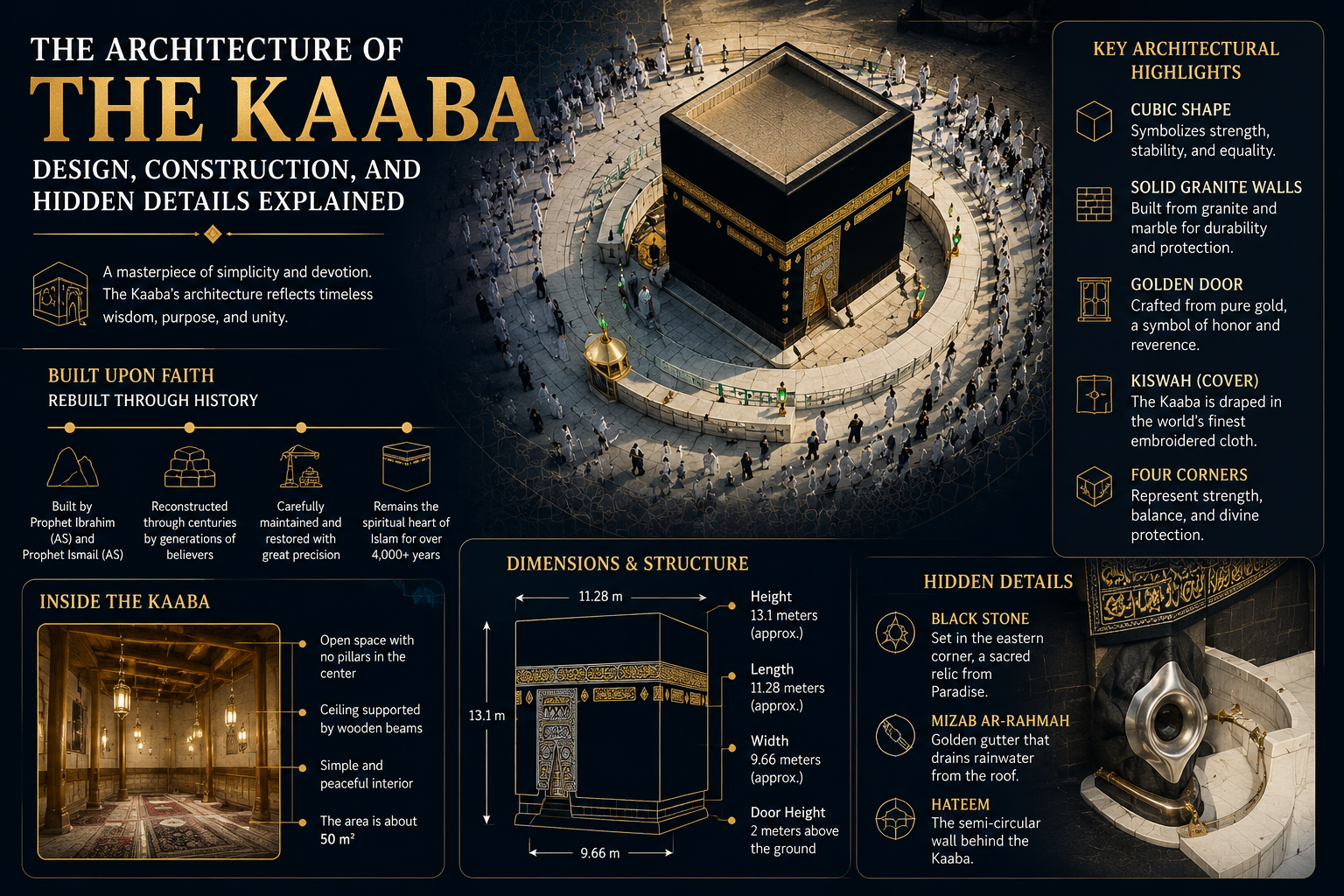
One of the most interesting aspects of the Sacred House is its carefully balanced design. The Kaaba dimensions and structure have remained remarkably consistent despite numerous restoration projects.
Rather than forming a perfect cube, the Kaaba is slightly rectangular. This subtle proportion contributes to its distinctive appearance while maintaining architectural harmony. The walls rise to a height of approximately 13 metres, creating an impressive yet modest presence within the vast courtyard of Masjid al-Haram.
The building rests on a solid stone foundation and is elevated slightly above the surrounding marble floor. This design helps define the sacred structure while protecting it from surface water during heavy rainfall.
Every side of the Kaaba has a specific orientation, with the eastern corner housing Hajar al-Aswad (the Black Stone), the starting point for Tawaf.
Kaaba Construction Material Through the Centuries
The durability of the Sacred House is closely connected to the quality of its Kaaba construction material.
Historically, locally sourced granite from the hills surrounding Makkah has been the primary building material. Granite was selected because of its exceptional strength, resistance to weathering, and ability to withstand the desert climate.
Large stone blocks form the external walls, carefully joined to create a structure capable of enduring both environmental conditions and the immense number of visitors who gather around it every year.
Over time, restoration projects have strengthened the building while preserving its original appearance. Modern engineering methods have occasionally been introduced where necessary, but they have always respected the historical character of the Kaaba.
The famous black Kiswah that covers the exterior is not part of the structural framework. Instead, it serves as a ceremonial covering woven from high-quality silk and adorned with Quranic calligraphy embroidered in gold and silver-plated thread.
Exterior Features That Define the Kaaba
Although simple in appearance, the Kaaba contains several architectural elements that distinguish it from any other building.
Among its most recognisable features are:
The Golden Door
Positioned above ground level, the beautifully crafted golden door provides controlled access to the interior. Its elevated placement offers additional protection while reflecting the honour given to the Sacred House.
Hajar al-Aswad
Embedded within the eastern corner, the Black Stone marks both the beginning and end of every circuit of Tawaf. Its silver frame protects the stone while making it easily identifiable to pilgrims.
Mizab al-Rahmah
Projecting from the roof above the Hateem, the golden water spout channels rainwater away from the roof during storms. Despite its practical purpose, it has become one of the Kaaba's most admired architectural details.
The Kiswah
The elegant black silk covering transforms the Kaaba into one of the world's most recognisable religious landmarks. Replaced annually, the Kiswah reflects centuries of craftsmanship and devotion while protecting the stone walls beneath.
Architectural Simplicity with Deep Symbolism
Unlike many famous monuments known for elaborate decoration, the Kaaba demonstrates that profound beauty can exist through simplicity.
Its clean geometric form, balanced proportions, and restrained design create an atmosphere of humility rather than grandeur. This architectural simplicity directs attention away from the building itself and towards the worship of Allah.
The absence of excessive ornamentation reinforces the Kaaba's purpose as a sacred place of devotion rather than a display of architectural extravagance.
This timeless design has allowed the Kaaba to remain instantly recognisable for generations while preserving its spiritual focus.
How the Kaaba Fits Within Masjid al-Haram
The Kaaba occupies the centre of the Mataf, the open marble courtyard where pilgrims perform Tawaf. Its placement allows worshippers to circulate freely around all four sides while maintaining an uninterrupted flow during busy pilgrimage seasons.
The surrounding mosque has expanded dramatically over the centuries to accommodate growing numbers of visitors. Despite these expansions, the Kaaba has always remained the focal point of the entire complex.
This careful urban planning ensures that every architectural addition continues to support—not overshadow—the Sacred House itself.
Appreciating the Kaaba Beyond Its Appearance
For architects, historians, and pilgrims alike, the Kaaba offers far more than visual beauty. Every measurement, material, and design feature reflects centuries of preservation, careful craftsmanship, and religious significance.
Learning about these architectural details encourages visitors to appreciate not only what they see but also the remarkable planning that has protected one of the world's most important religious structures through countless generations.
Inside the Kaaba: A Space of Simplicity and Reverence
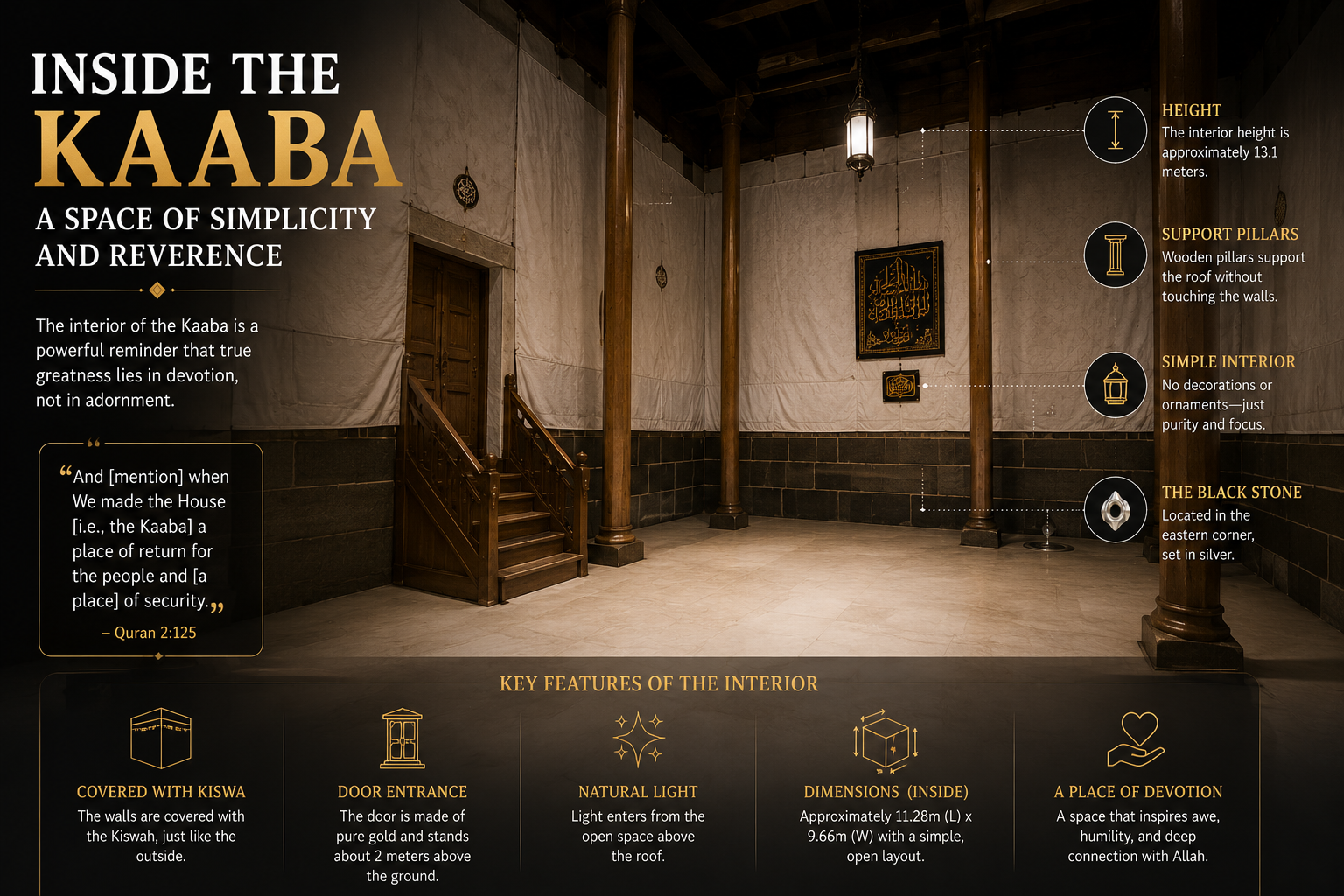
The exterior of the Kaaba is familiar to millions of Muslims, but only a small number of people have had the opportunity to see its interior. Contrary to popular assumptions, the inside is not filled with elaborate decoration or valuable treasures. Instead, it reflects simplicity, dignity, and careful craftsmanship.
One of the most searched topics is Inside Kaaba interior columns and pillars because the interior remains inaccessible to the public except on special occasions. Historical records describe a calm and uncluttered space that supports worship and reflection rather than display. The simplicity of the interior mirrors the spiritual purpose of the Kaaba itself.
The Interior Columns and Pillars
Among the most remarkable architectural features are the Inside Kaaba interior columns and pillars that support the roof of the Sacred House.
The interior contains three sturdy wooden columns, positioned in a straight line to carry the weight of the roof. These columns have been maintained and restored over the centuries whenever required to preserve the building's structural integrity.
Between the columns hang decorative lamps and lanterns that have been gifted throughout different periods of Islamic history. While these items add historical character, they do not distract from the simple atmosphere inside the Kaaba.
The polished flooring and carefully maintained walls demonstrate that functionality and respect have always taken priority over unnecessary ornamentation.
The Roof and Structural Engineering
Although the Kaaba appears simple from the outside, its roof is an impressive example of practical engineering.
The flat roof is designed to withstand Makkah's demanding climate, including intense heat and occasional heavy rainfall. Strong beams support the roof while distributing weight evenly across the stone walls.
The famous Mizab al-Rahmah (Water Spout of Mercy) extends from the roof above the Hateem, directing rainwater safely away from the building. Besides serving an architectural purpose, it has become one of the Kaaba's most recognisable external features.
Regular inspections and conservation work ensure that the structure continues to remain secure while preserving its historical authenticity.
Architectural Changes Throughout History
Although the Kaaba's overall appearance has remained familiar for centuries, it has experienced several restoration and reconstruction projects.
Floods, natural weathering, and the passage of time have occasionally required repairs. During each reconstruction, great care has been taken to preserve the Sacred House's traditional form while strengthening its foundations and structural stability.
Modern conservation methods are introduced only when necessary, ensuring that historical authenticity is maintained without compromising safety.
This balance between preservation and engineering has allowed the Kaaba to remain one of the world's oldest continuously revered religious structures.
Grand Mosque Makkah from Orbit
Modern technology has provided people with entirely new perspectives of the Holy Mosque. High-resolution satellite imagery clearly reveals the Grand Mosque Makkah from orbit, highlighting the remarkable scale of the entire complex.
From above, the white marble courtyards surrounding the Kaaba form a striking contrast with the black Kiswah covering the Sacred House. The continuous movement of pilgrims performing Tawaf creates a unique circular pattern that is instantly recognisable in aerial imagery.
While the Kaaba itself occupies only a small portion of the mosque, its central position makes it the unmistakable focal point of Masjid al-Haram. Satellite photographs also illustrate how carefully planned expansions have increased the mosque's capacity while preserving the Kaaba at its heart.
The Harmony of Design and Function
Every architectural element of the Kaaba serves both a practical and symbolic purpose.
The granite walls provide strength and durability. The elevated entrance offers protection. The roof drainage system prevents water accumulation. The Black Stone marks the beginning of Tawaf, while the Kiswah protects the exterior and enhances the dignity of the Sacred House.
This combination of engineering and symbolism demonstrates why the Kaaba continues to inspire architects, historians, and pilgrims alike. Rather than relying on elaborate decoration, its design achieves greatness through balance, proportion, and purpose.
Why Understanding the Kaaba's Architecture Matters
Learning about the Kaaba's design allows Muslims to appreciate the Sacred House from a deeper perspective.
Understanding the Kaaba dimensions and structure helps explain why Tawaf is performed in a particular way. Exploring the Kaaba construction material reveals how traditional building methods have preserved the structure for generations. Discovering the Inside Kaaba interior columns and pillars offers insight into a space that few people ever see.
This knowledge strengthens appreciation for both Islamic history and the remarkable craftsmanship involved in maintaining one of the world's most significant religious landmarks.
Conclusion
This Kaaba architecture guide reveals that the Sacred House is far more than a simple stone structure. Every aspect of its design—from the carefully planned Kaaba dimensions and structure to the durable Kaaba construction material—reflects centuries of preservation, skilled craftsmanship, and thoughtful engineering.
Exploring the Inside Kaaba interior columns and pillars provides a rare glimpse into one of Islam's most respected spaces, while viewing the Grand Mosque Makkah from orbit highlights the remarkable scale of the sacred complex surrounding it. Together, these perspectives show how history, architecture, and faith come together in one extraordinary place.
At Kiswah Al Kabah, we celebrate the timeless beauty and heritage of the Holy Kaaba by sharing authentic knowledge and preserving its legacy through genuine Kiswah pieces and Islamic art. Whether you are preparing for Umrah, studying Islamic history, or simply wishing to deepen your understanding, learning about the Kaaba's architecture offers a meaningful way to connect with one of the most treasured landmarks in the Muslim world.
The Kaaba's enduring design reminds us that true greatness is not found in complexity but in purpose, devotion, and the lasting spiritual connection it creates for millions of believers across every generation.