Inside the Kaaba: What Is Actually Inside the Holy Kaaba?
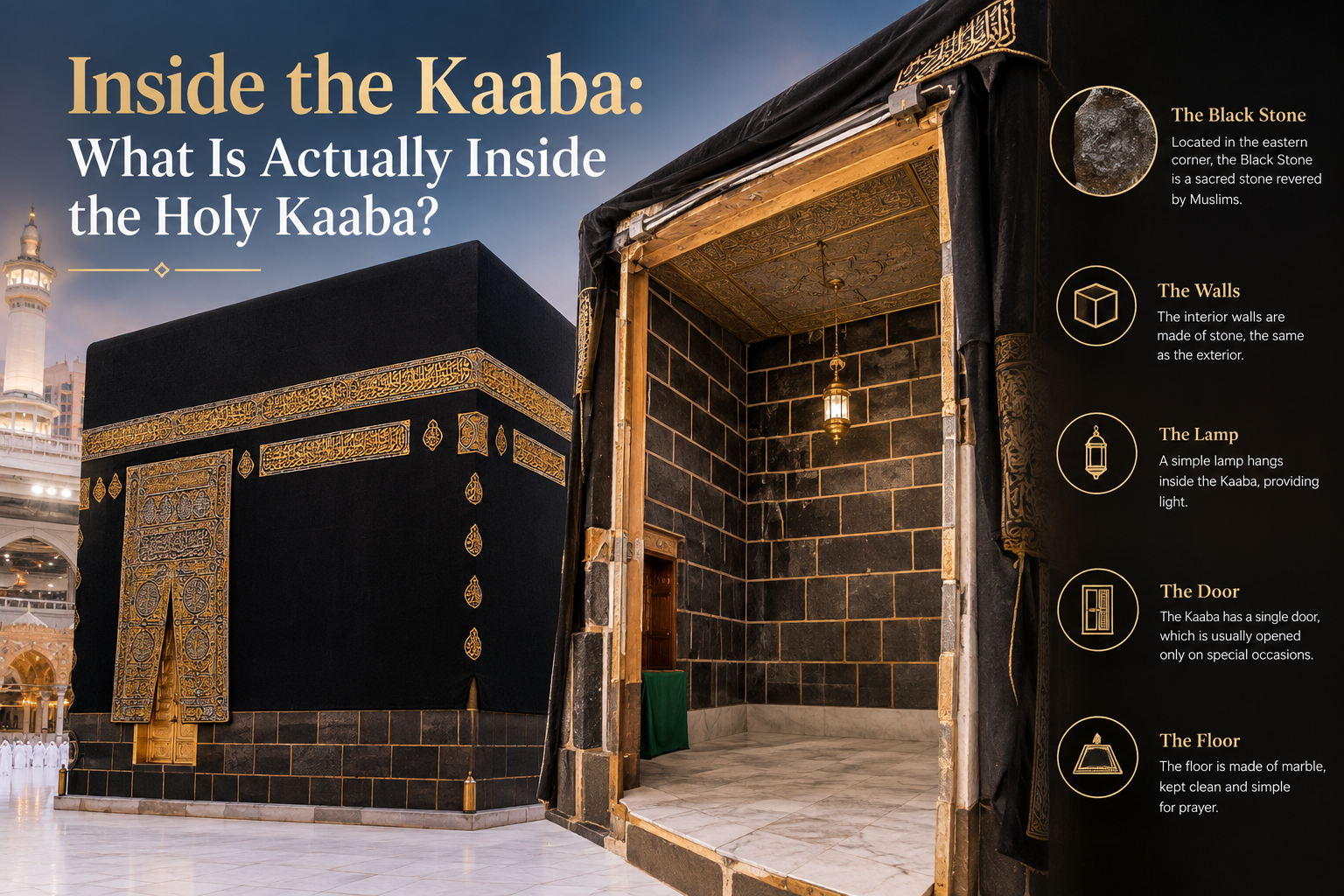
For over two billion Muslims around the globe, the Holy Kaaba in Makkah is the spiritual center of the world. Five times a day, believers turn toward this sacred cube structure during prayer, and millions circumambulate it during Hajj and Umrah.
While the exterior of the Kaaba—draped in its magnificent golden-embroidered black cloth (Kiswa)—is familiar to everyone, few people ever get the opportunity to step across its threshold.
This leads to a question asked by pilgrims and curious minds alike: What is actually inside the Kaaba?
Is the interior empty, or does it hold ancient relics? Here is an authentic look inside the Holy Kaaba, covering its architectural layout, spiritual significance, and historical features.
What Does the Interior of the Kaaba Look Like?
Contrary to common myths, the inside of the Kaaba is not a hollow, dark space, nor does it contain idols or complex chambers. It is a peaceful, beautifully maintained sanctuary with simple yet profound architecture.
[ NORTH WALL ]
+------------------------------+
| [Bab al-Tawbah Stairs] |
| |
[ WEST | (Pillar 1) (Pillar 2) |[ EAST
WALL ] | (Pillar 3) | WALL ]
| |
| [Small Table] |
| [Door of Kaaba] |
+------------------------------+
[ SOUTH WALL ]
The interior room measures roughly 180 square meters. The atmosphere inside is perfumed with pure oud, rose water, and musk, maintaining a serene environment reserved for royal dignitaries, state guests, and caretakers who clean the sanctuary twice a year.
Key Features Inside the Holy Kaaba
Feature | Description & Detail |
Three Wooden Pillars | Three carved pillars made from teak wood extend from the floor to the ceiling to support the roof. These pillars are over 1,300 years old, installed during the era of Abdullah ibn al-Zubayr (RA). |
Marble Walls & Floor | The lower half of the walls and the entire floor are covered in white and grey marble, with intricate Quranic inscriptions carved along the perimeter. |
Green Silk Curtains | The upper walls and inner ceiling are draped in dark green silk cloth embroidered with Quranic verses in silver thread, crafted with the same care as the outer Kiswa. |
Hanging Lanterns & Lamps | Gold and silver hanging lamps, donated by various Caliphs, Sultans, and rulers throughout Islamic history, hang suspended from a crossbeam between the pillars. |
Bab al-Tawbah (Door of Repentance) | A enclosed golden door in the corner leads to a enclosed marble staircase giving access to the roof of the Kaaba. |
Commemorative Inscriptions | Marble plaques embedded in the walls record historical repairs and renovations carried out by rulers across the centuries. |
Where Did the Prophet (ﷺ) Pray Inside the Kaaba?
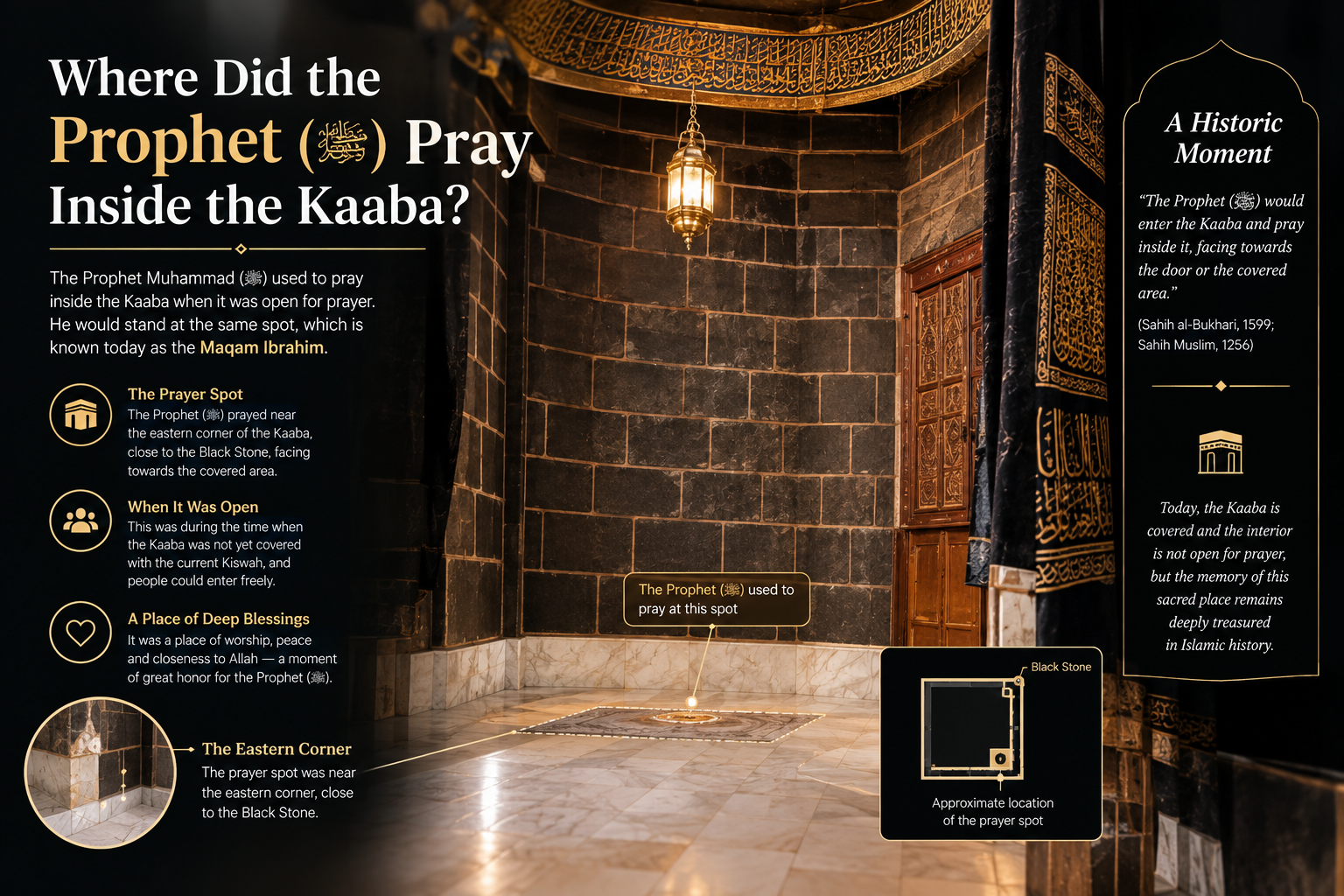
When Prophet Muhammad (ﷺ) entered the Kaaba during the Conquest of Makkah (Fath Makkah) in 630 CE, he ordered the removal of all idols and images. He then offered voluntary prayers inside the sanctuary.
According to authentic Hadiths in Sahih al-Bukhari:
The Prophet (ﷺ) entered with Usama bin Zaid, Bilal bin Rabah, and Uthman bin Talha (RA).
He walked inside, placed two pillars to his left, one to his right, and three behind him, keeping about three cubits distance from the front wall.
He performed prayer (Salah) at that specific spot.
Today, a distinct marble mark on the floor indicates the exact location where Prophet Muhammad (ﷺ) prayed.
The Spiritual Meaning of the Interior
Why is the interior of the Kaaba so simple?
In Islam, the Kaaba represents absolute monotheism (Tawhid). It is not a dwelling place for God, as Allah (SWT) is beyond physical space. Instead, it serves as the physical direction (Qibla) for unity among believers.
The simplicity inside reminds Muslims that worldly grandeur fades, while faith, devotion, and submission to the Creator remain paramount.
Bring the Sacred Aesthetics into Your Home with Kiswa Al Kaaba
While stepping inside the Kaaba is a privilege reserved for a select few, you can bring the spiritual beauty and heritage of Makkah into your daily life.
At Kiswah Al Kaaba, we offer authentic Islamic heritage collections, including:
Kiswa-Inspired Wall Tapestries: Detailed replicas featuring golden Quranic calligraphy.
Luxury Prayer Rugs: High-density velvet prayer mats crafted for comfort and devotion.
Framed Islamic Calligraphy: Artwork depicting the sacred history of Al-Masjid al-Haram.
Oud & Fragrance Collections: Premium scents inspired by the perfumes used inside the Holy Sanctuaries.
Explore our full collection today at Kiswah Al Kaaba and connect with the history of the Holy Mosque!