How to Verify the Authenticity of Islamic Textile Art Before Buying Online
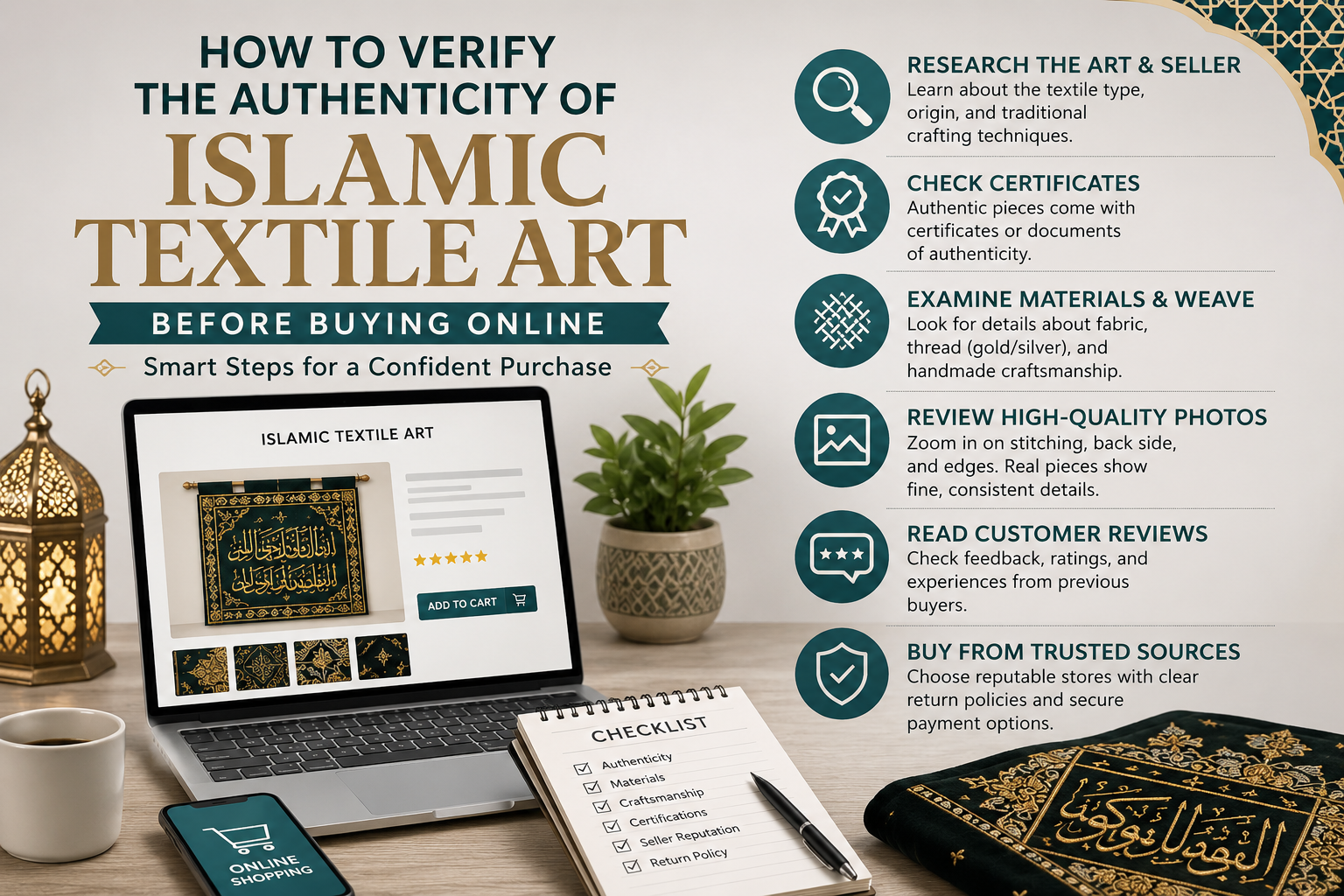
Buying Islamic textile art online can be an exciting way to own a piece connected with Islamic craftsmanship, history, and cultural heritage. However, when an item is described as an authentic Kiswah fragment, Rawdah Al Sharif cloth, or another valuable Islamic textile, buyers should take time to verify its authenticity before making a purchase.
Photographs can show beautiful embroidery and intricate patterns, but appearance alone cannot establish where a textile came from. Genuine heritage textiles require careful examination of their provenance, materials, craftsmanship, documentation, and seller information.
If you are learning How to verify authentic Islamic art online, the following checks can help you make a more informed purchasing decision.
1. Understand Exactly What You Are Buying
Start by identifying the textile accurately.
Ask whether the item is an original historical textile, an authentic fragment from a specific religious textile, a contemporary piece made using traditional techniques, or simply a decorative reproduction.
These categories can look similar in photographs but have very different meanings and collectible importance.
A seller should clearly explain the item's claimed origin instead of using broad descriptions such as "Islamic-style" or "Kaaba-inspired" when selling an item as authentic heritage material.
2. Ask for Provenance
Provenance means the documented history of an object. It can include information about where the textile originated, how it was acquired, previous ownership, and how it reached the current seller.
For a significant Islamic textile, provenance is one of the most useful forms of supporting evidence.
Ask the seller:
Where did the textile originate?
When was it acquired?
Is its previous ownership documented?
Is there information about the specific textile from which the fragment came?
Are photographs or records available?
Has an expert or recognised institution examined it?
A detailed answer is generally more useful than a simple statement that an item is "100% genuine."
3. Examine the Certificate of Authenticity
A Certificate of authenticity Islamic art UK buyers receive should contain specific information about the item rather than functioning as a generic sales document.
Check whether the certificate identifies the textile, dimensions, materials, claimed origin, date or period where applicable, and the person or organisation issuing the document.
Also determine what the certificate actually verifies. A certificate confirming that a seller sold an item is not necessarily equivalent to independent authentication of its historical origin.
For expensive purchases, additional professional assessment may be worthwhile.
4. Examine the Textile Closely
Request high-resolution photographs before purchasing.
Look at the front and reverse sides of the textile. Close-up photographs can reveal stitching, weaving, embroidery construction, edges, backing, wear patterns, and possible repairs.
Ask for photographs taken in natural lighting rather than heavily edited images. Digital enhancement can make colours and metallic embroidery appear different from their actual condition.
The dimensions should also be clearly stated. Compare measurements shown in the listing with photographs and supporting documentation.
5. How to Evaluate Gold Embroidery
Gold-coloured embroidery does not automatically mean that a textile contains solid gold.
Traditional Islamic textiles can use different metallic threads and techniques, including silver-based threads with gold plating. Therefore, judging precious-metal content simply from colour or photographs can be misleading.
If you are researching How to test real gold thread embroidery in Islamic textiles, avoid damaging the textile with informal home testing. Acid tests, scraping, burning, or cutting threads can permanently damage an important heritage object.
Instead, ask for information about the thread's composition and construction. For valuable pieces, a qualified textile conservator or appropriate specialist can advise on non-destructive examination methods.
The claimed metal content should be supported by evidence rather than assumptions based on appearance.
6. Be Careful With Kiswah Claims
The Kiswah is the textile covering associated with the Holy Kaaba in Makkah. Because of its profound religious and cultural importance, authentic fragments can attract considerable interest from collectors.
However, many decorative textiles reproduce black silk, gold calligraphy, and Kaaba-inspired designs.
These visual characteristics do not by themselves prove that a textile was previously part of the actual Kiswah.
When evaluating a claimed Kiswah fragment, examine its provenance, documentation, construction, dimensions, embroidery, and seller history together.
7. Verifying Rawdah Al Sharif Cloth
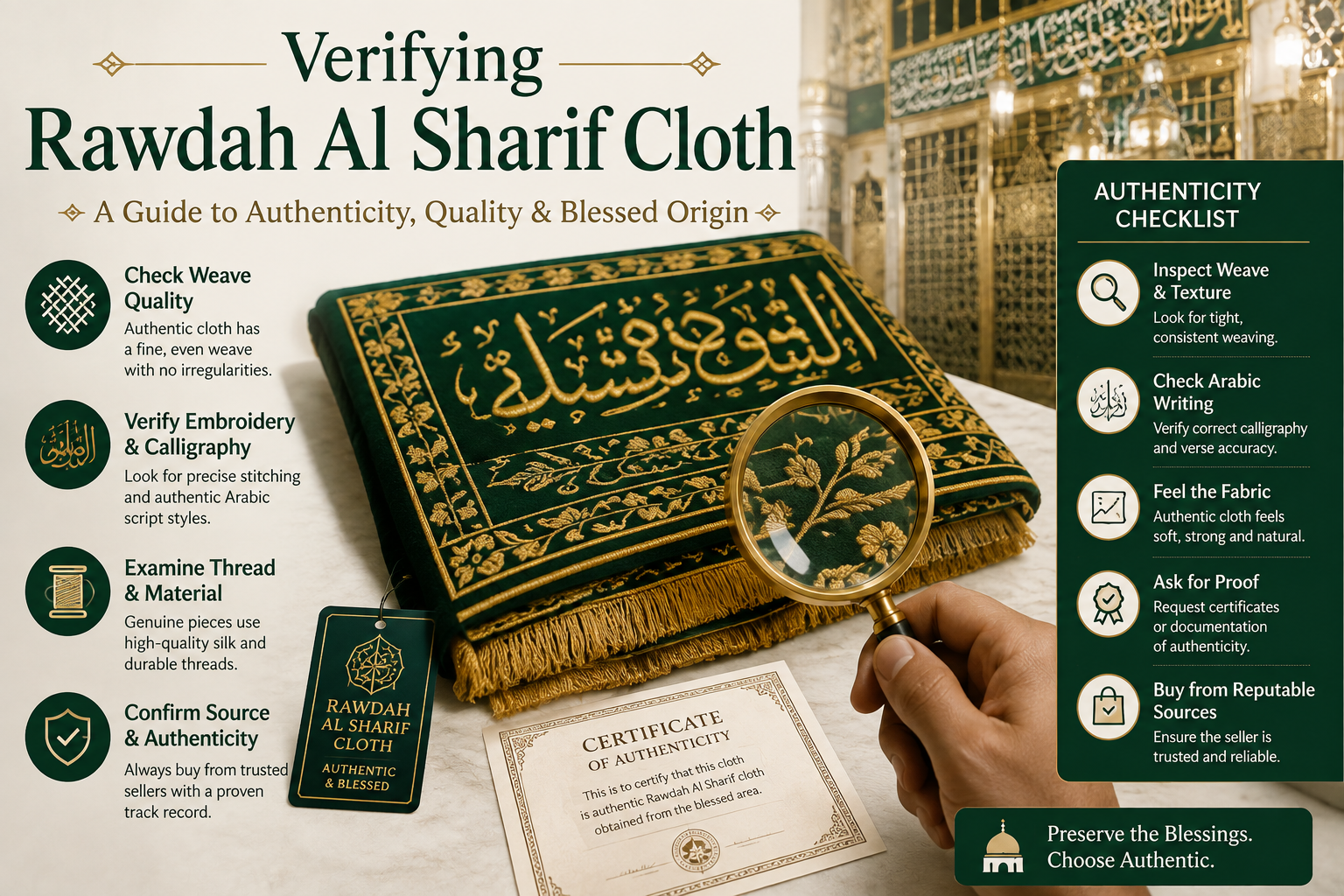
Buyers searching for Authentic Rawdah Al Sharif cloth verification UK should apply the same principle: religious significance should be supported by credible documentation.
Ask the seller to explain precisely what the cloth is, where it originated, and how its connection to the claimed location was established.
Be especially cautious when descriptions rely entirely on religious association without providing specific evidence.
The more important the claim, the more important detailed documentation becomes.
8. Research the Seller
The seller is an important part of the authentication process.
Before ordering, examine the company's website, business information, product descriptions, policies, customer feedback, and history of selling Islamic textiles.
A trustworthy seller should be willing to answer reasonable questions about authenticity and provide clear information about the item.
Avoid making an expensive purchase solely because a listing uses words such as "rare," "museum quality," or "certified." Such terms should be supported by evidence.
9. Check Return and Refund Policies
Even after extensive research, online purchases involve uncertainty.
Read the seller's return policy before completing payment. Understand the conditions for returning an item, the permitted timeframe, refund procedure, and whether custom framing or other services affect eligibility.
For expensive heritage textiles, keep copies of the original product description, photographs, certificate, invoice, correspondence, and other documentation.
These records can become valuable if questions arise later.
10. Compare Information From Multiple Sources
Do not rely on a single online listing when researching an important textile.
Compare descriptions with reputable museum collections, recognised textile references, conservation information, and established Islamic art resources.
Museum collections can be particularly useful for understanding historic textile materials, techniques, designs, and regional characteristics.
Comparison does not prove that a particular item is authentic, but it can help you identify inconsistencies that deserve further investigation.
11. Where to Buy Authentic Certified Kiswa Pieces
People researching Where to buy authentic certified Kiswa pieces in the UK should prioritise sellers that provide transparent product information and appropriate supporting documentation.
Before purchasing, confirm:
The exact dimensions
Material composition
Embroidery details
Claimed origin
Provenance information
Authentication documentation
Condition
Framing or mounting details
Seller contact information
Return policy
Do not assume that a higher price automatically indicates authenticity. A convincing purchase should be supported by evidence, not simply a premium price tag.
12. Red Flags to Watch For
Certain warning signs deserve additional attention.
Be cautious if a seller:
Refuses to provide additional photographs
Gives inconsistent information
Cannot explain the item's origin
Offers vague certificates
Pressures you to pay immediately
Makes extraordinary historical claims without evidence
Avoids questions about materials
Uses heavily edited photographs
Provides no clear return policy
None of these points alone proves that an item is fake, but several warning signs together should encourage greater caution.
Final Buying Checklist
Before purchasing Islamic textile art online, ask yourself five basic questions:
What exactly is the item?
Understand whether it is an original heritage textile, authentic fragment, contemporary artwork, or reproduction.
Can its history be documented?
Look for credible provenance and acquisition information.
Is the certificate meaningful?
Check who issued it and precisely what it confirms.
Are the materials properly described?
Verify information about silk, embroidery, metallic threads, and other components.
Is the seller transparent?
A reputable seller should provide sufficient information for an informed decision.
Conclusion
Authenticating Islamic textile art online requires more than examining beautiful photographs. Provenance, documentation, material information, craftsmanship, condition, seller transparency, and appropriate certification all contribute to a responsible purchasing decision.
Whether you are learning How to verify authentic Islamic art online, investigating a Certificate of authenticity Islamic art UK, researching How to test real gold thread embroidery in Islamic textiles, checking Authentic Rawdah Al Sharif cloth verification UK, or searching for Where to buy authentic certified Kiswa pieces in the UK, always prioritise evidence over appearance.
An authentic Islamic textile can carry extraordinary cultural and artistic significance. Taking the time to investigate its history before buying helps protect both your investment and the heritage represented by the piece.