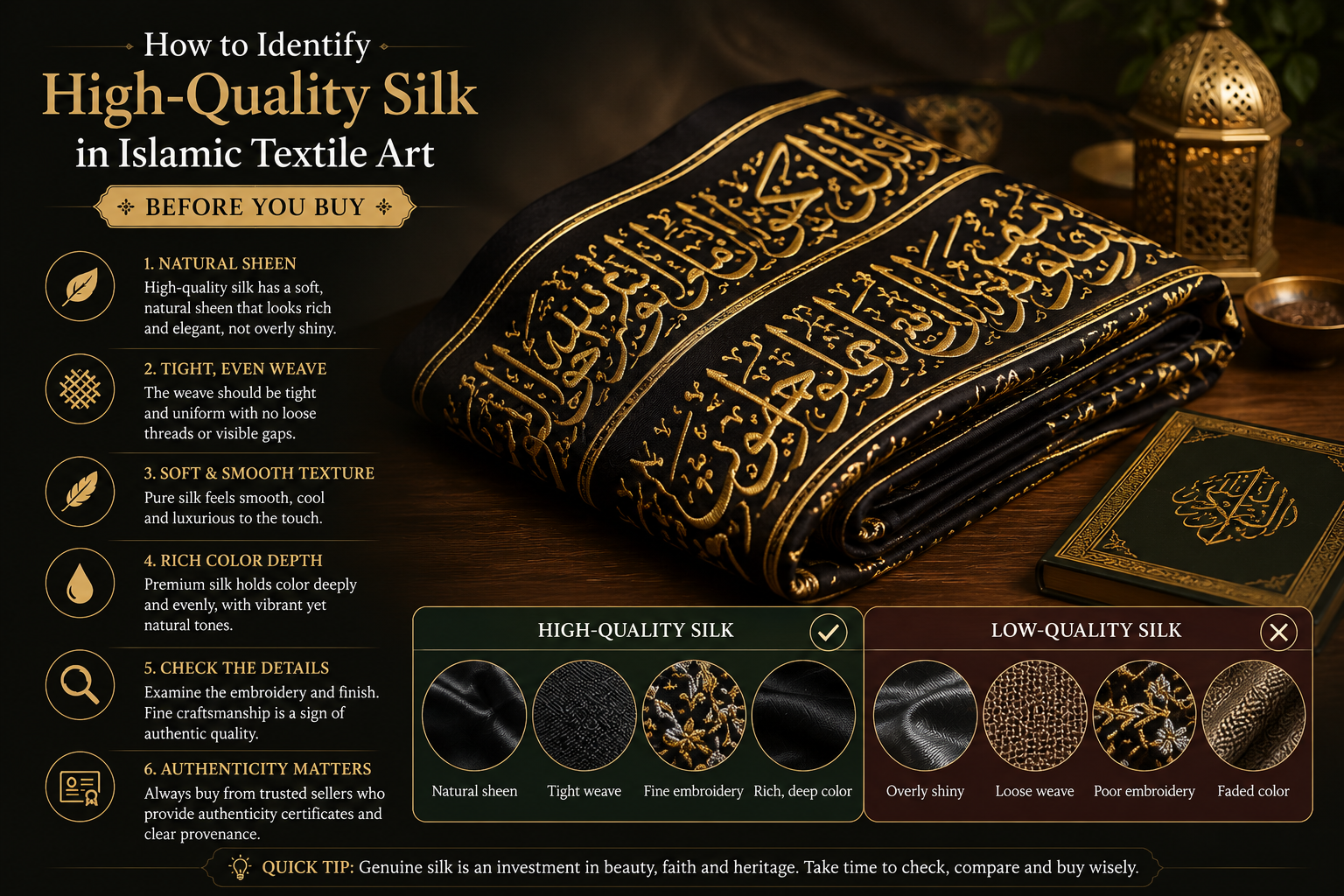
Silk has been valued in Islamic textile traditions for centuries because of its distinctive softness, natural sheen, strength, and ability to hold detailed decoration. When silk is used for Islamic wall art, calligraphy, or historic textiles, its quality can have a significant effect on the appearance and longevity of the finished piece.
However, buying silk artwork online can be challenging. Photographs may make different fabrics appear similar, while descriptions such as “premium silk” or “luxury textile” do not necessarily explain what the material actually is.
Knowing what to examine can help buyers make a more informed decision before purchasing.
Why Silk Quality Matters in Islamic Textile Art
Good-quality silk has characteristics that make it particularly suitable for detailed textile artwork. Its smooth surface can provide an elegant background for embroidery, while its natural lustre allows decorative threads and colours to stand out.
The quality of the finished artwork also depends on how the silk was woven, dyed, embroidered, stored, and preserved.
A beautiful design therefore does not automatically indicate high-quality silk. The fabric itself deserves careful attention.
How to Identify Real Silk Art in the UK
If you are researching how to identify real silk art UK, begin by asking the seller for specific material information.
A reliable product description should ideally identify the fibre composition rather than simply calling an item “silk-style” or “silk finish.”
Real silk generally has a distinctive combination of softness, subtle lustre, and natural variation. Its appearance is usually less uniformly glossy than many synthetic fabrics.
Buyers should also remember that professional authentication is more reliable than attempting to identify a fibre solely from an online photograph. If the material is particularly valuable, independent textile expertise can provide greater confidence.
Examine the Weave
The construction of the fabric can reveal useful information.
Look closely at the weave through detailed photographs. A quality textile should have a coherent and consistent structure appropriate to its stated construction.
Ask whether the fabric is handwoven, mechanically woven, printed, embroidered, or produced using a combination of techniques.
These distinctions matter because “silk artwork” can describe many different production methods.
Hand Embroidered Silk vs Machine Woven Tapestry
Understanding hand embroidered silk vs machine woven tapestry is particularly important for collectors.
Hand embroidery involves individual stitches created by an artisan. Small variations can occur naturally because the work is produced by hand. These variations are not necessarily defects and can form part of the character of handmade artwork.
Machine-produced textiles generally demonstrate greater uniformity because the design is created mechanically.
Neither method automatically makes a textile worthless. The important point is that buyers should know exactly what they are purchasing.
If an artwork is advertised as hand embroidered, ask whether the embroidery itself was completed by hand and which parts, if any, were machine produced.
Look at the Embroidery Closely
Embroidery is one of the most important visual elements in Islamic textile art.
Examine the density of the stitching, the precision of the patterns, the edges of embroidered shapes, and the way threads interact with the silk.
For Quranic calligraphy, accuracy is especially important. The Arabic text should be clearly identified, and buyers should request high-resolution photographs if the lettering cannot be examined properly.
A sophisticated design cannot compensate for incorrect religious text or misleading product information.
Ottoman Silk Wall Hanging Authentication UK
Buyers interested in Ottoman silk wall hanging authentication UK should take additional care because historic Ottoman textiles can be highly complex.
An Ottoman attribution should not be based simply on a floral pattern, Arabic-inspired decoration, or an antique-looking appearance.
Researchers may examine the textile's weave, motifs, colours, construction, inscriptions, dimensions, condition, and provenance.
Documentation can be especially valuable. Previous ownership records, specialist assessments, collection references, or other historical evidence may help support an attribution.
If a seller claims that a wall hanging is genuinely Ottoman, ask what evidence supports that statement.
How Can You Tell If an Islamic Silk Wall Hanging Is Authentic?
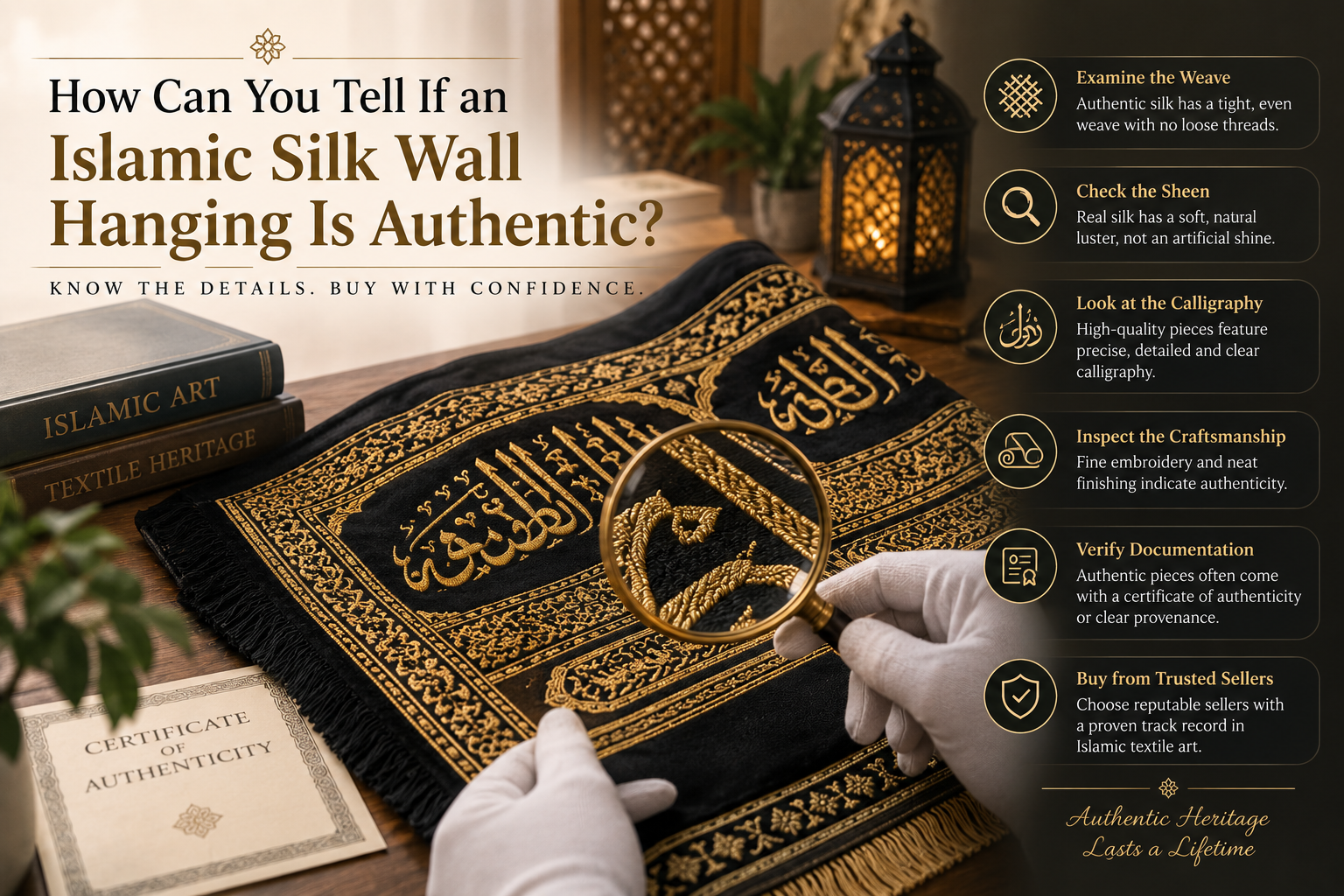
So, How can you tell if an Islamic silk wall hanging is authentic?
There is no single visual test that can establish authenticity.
Instead, consider several factors together:
Fibre and fabric construction
Embroidery technique
Design and motifs
Calligraphy
Age-related characteristics
Condition
Dimensions
Provenance
Supporting documentation
Seller reputation
An authentic historical textile should have a story that makes sense. If the claimed age, construction, materials, and provenance contradict one another, further investigation is necessary.
For valuable pieces, professional examination is preferable to relying on an online checklist.
Why Are Pure Gold and Silver Thread Silk Calligraphies So Expensive?
Many collectors ask, Why are pure gold and silver thread silk calligraphies so expensive?
Several factors can contribute to their price.
First, fine silk provides a high-quality foundation for detailed textile work. Second, metallic embroidery can require considerable craftsmanship. Third, genuine precious-metal content, where verified, can add material value.
However, buyers should distinguish genuine precious-metal thread from gold-coloured or silver-coloured synthetic alternatives.
The historical importance, craftsmanship, rarity, provenance, and condition of the artwork may also have a greater influence on collectible value than the raw quantity of precious metal alone.
If a seller claims that an artwork contains pure gold or silver, request specific information about the thread's composition and supporting evidence.
Ask the Seller the Right Questions
Before purchasing an expensive Islamic textile, ask:
What is the exact fibre composition?
Is the embroidery handmade or machine produced?
What technique was used to create the artwork?
What are the precise dimensions?
Is the Quranic text verified?
Does the piece have documented provenance?
Is there a certificate or specialist assessment?
How has the textile been stored and preserved?
Clear answers can help distinguish a carefully documented artwork from a product described using vague luxury terminology.
Be Careful With Online Photographs
Online images can hide important details.
Lighting can exaggerate the shine of synthetic fabric, while image editing can make colours appear richer than they are. A photograph may also conceal repairs, stains, loose threads, or damaged areas.
Request close-up photographs showing the fabric, embroidery, reverse side, edges, labels, and any certificates.
For expensive purchases, consider asking for a video showing the textile under natural or neutral lighting.
Consider Provenance and Certification
Material quality is only one part of authentication.
A well-documented textile may be considerably more interesting to collectors because its history can be traced. Provenance can include previous ownership, acquisition records, photographs, specialist reports, or other supporting evidence.
Certification can also help, but buyers should investigate who issued the certificate and what exactly it verifies.
A generic certificate should not automatically be treated as proof of historical origin.
Final Thoughts
Identifying high-quality silk in Islamic textile art requires more than judging softness or shine. Buyers should examine the fabric construction, embroidery technique, calligraphy, materials, provenance, condition, and documentation together.
Whether you are learning how to identify real silk art UK, comparing hand embroidered silk vs machine woven tapestry, researching Ottoman silk wall hanging authentication UK, asking How can you tell if an Islamic silk wall hanging is authentic?, or investigating Why are pure gold and silver thread silk calligraphies so expensive?, careful verification is essential.
The most valuable purchase is not necessarily the most expensive one. It is the piece whose materials, craftsmanship, history, and authenticity can be understood and supported by credible evidence.