How to Choose a Trusted Islamic Art Seller Online: 10 Things Every Buyer Should Check
Buying Islamic art online can give collectors access to beautiful calligraphy, historic textiles, Kiswah fragments, wall decor, and other culturally meaningful pieces. However, not every website offering Islamic artwork provides the same level of transparency, authenticity, or customer protection.
A professional-looking website does not automatically mean that every product is genuine. Before purchasing an expensive Islamic artwork, buyers should investigate the seller, product information, documentation, payment process, and after-sales policies.
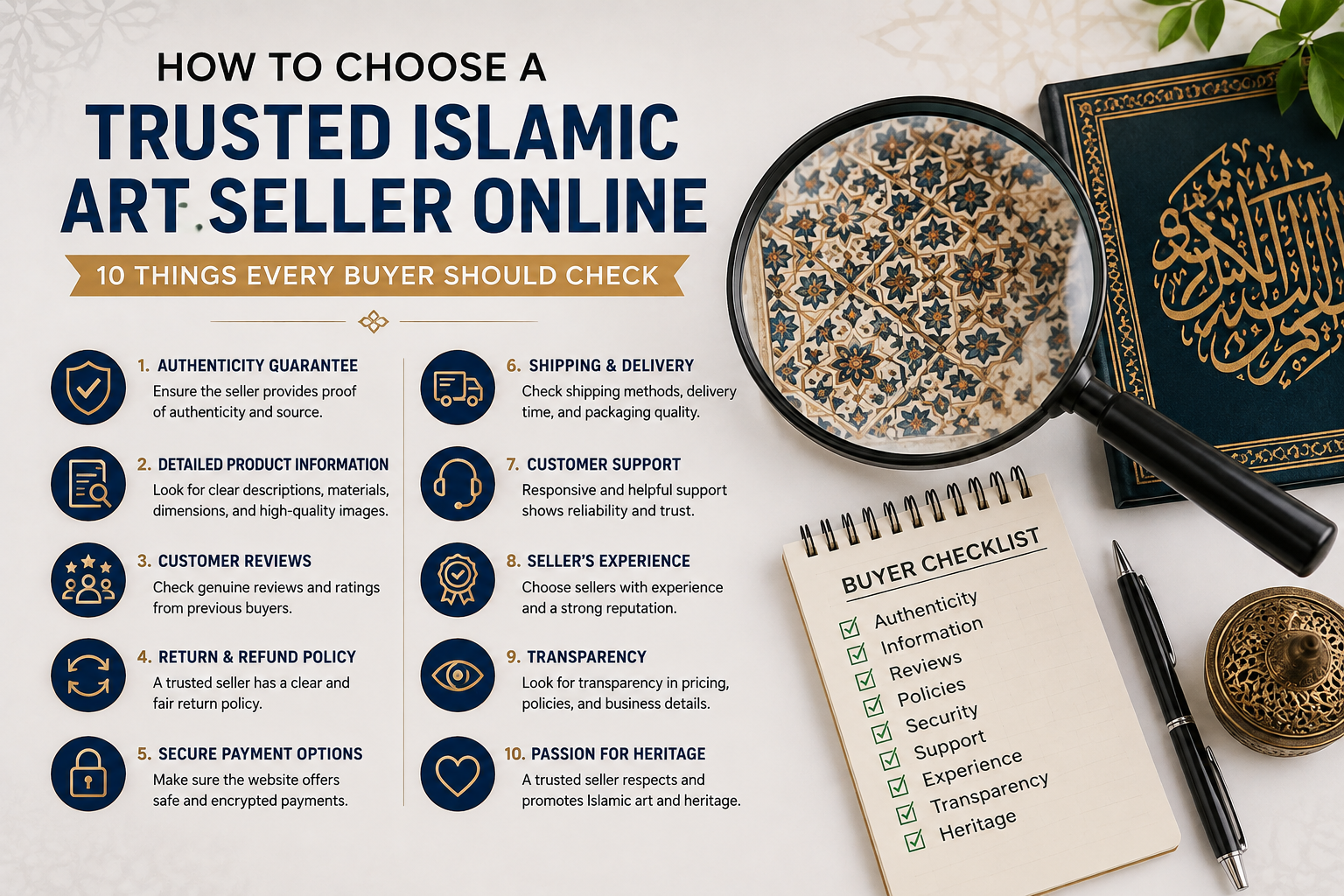
Here are ten important checks that can help you make a safer and more informed decision.
1. Research the Seller's Background
Start by investigating the business behind the website.
Look for a clear company name, contact details, physical business information where applicable, customer service channels, and information about its experience with Islamic art.
A trusted Islamic art store in the UK should make it reasonably easy for customers to understand who they are buying from.
Check whether the business has a consistent online presence and whether its product descriptions provide meaningful information rather than generic claims.
2. Examine Product Descriptions Carefully
A reliable seller should explain what each artwork actually is.
If you are purchasing a textile, for example, the listing should ideally provide information about dimensions, materials, condition, embroidery, origin, and any available historical documentation.
Be cautious when a seller uses words such as "original," "rare," "antique," or "authentic" without explaining the evidence supporting those claims.
The more valuable the item, the more detailed its description should generally be.
3. Ask About Provenance
Provenance refers to the documented history of an artwork.
For Islamic heritage pieces, provenance can be particularly important. Ask where the item originated, how it was acquired, whether previous ownership is known, and whether supporting records are available.
A seller should be able to distinguish between documented information and assumptions.
If an item is claimed to have originated from an important Islamic site, ask what evidence supports that connection.
4. Request Authentication Documentation
Certificates can be useful, but buyers should examine what they actually verify.
If an artwork comes with a certificate of authenticity, check who issued it and whether the document identifies the specific item.
Useful information may include the item's dimensions, materials, description, claimed origin, identification number, and authentication basis.
A generic certificate containing little information should not automatically be treated as proof of historical authenticity.
For expensive purchases, independent specialist advice can provide additional reassurance.
5. Look at Detailed Photographs
Good photographs allow buyers to inspect an artwork before making a decision.
Request clear images showing the complete item as well as close-ups of important details.
For textiles, examine the front, reverse, edges, stitching, embroidery, backing, and signs of repair.
For framed artwork, ask about the frame, glazing, mounting method, and condition of the artwork itself.
Avoid relying exclusively on heavily edited promotional photographs. Accurate images should help you understand what you will actually receive.
6. Compare the Seller With Other Sources
When researching Where to buy authentic Islamic art online in the UK, do not rely on one website alone.
Compare descriptions, materials, historical information, and pricing with reputable galleries, museum collections, auction records, and established Islamic art resources.
This research can help you identify unusual claims or unrealistic descriptions.
Price comparison is also useful, but remember that two apparently similar artworks may have very different values because of provenance, craftsmanship, condition, rarity, and documentation.
7. Check for Warning Signs
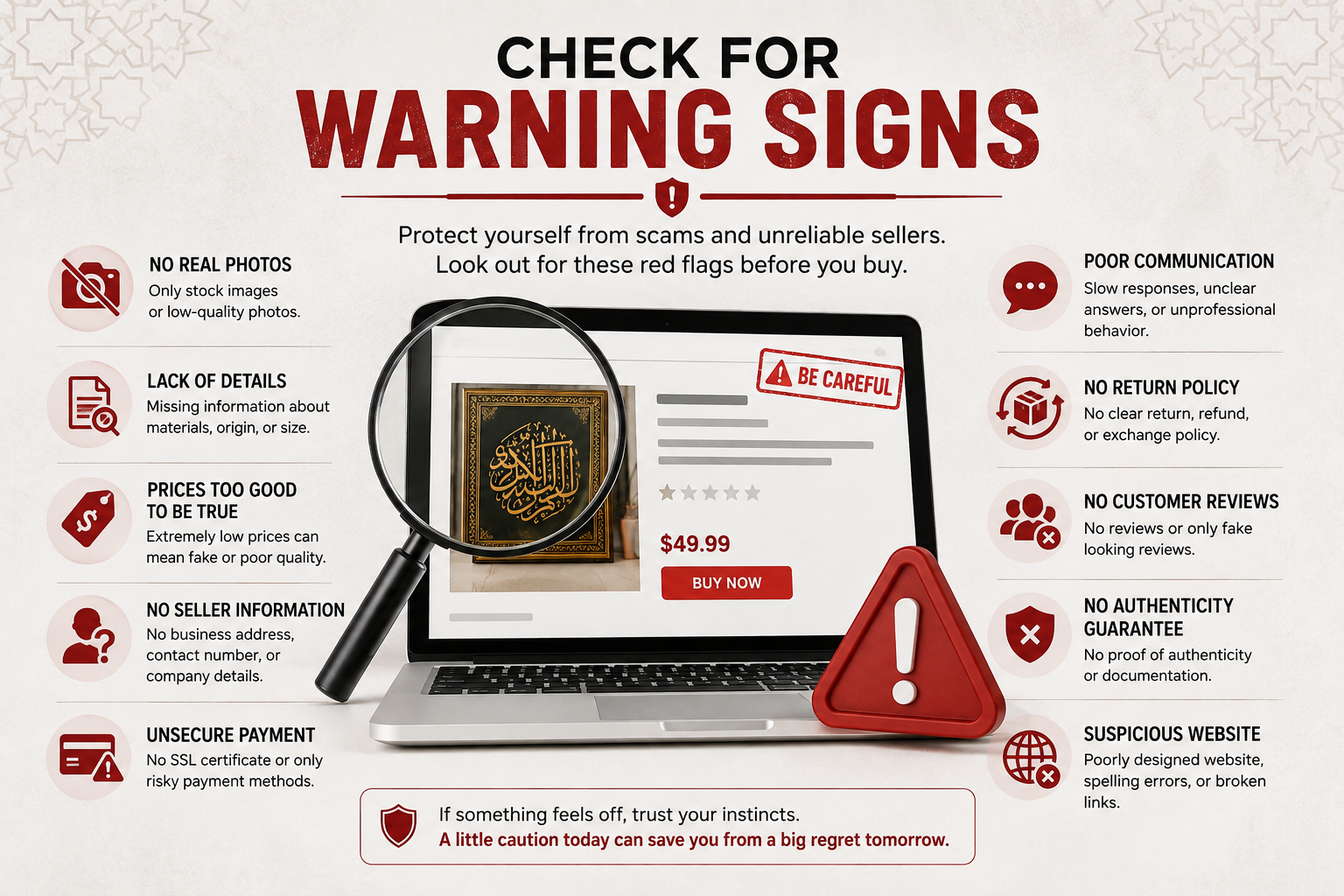
Knowing how to avoid fake Islamic art websites can protect buyers from potentially expensive mistakes.
Be cautious if a website:
Provides almost no company information
Uses copied or low-quality product photographs
Makes extraordinary claims without evidence
Refuses to answer reasonable questions
Offers certificates without identifying the issuer
Creates excessive pressure to purchase immediately
Has unclear refund conditions
Provides inconsistent product information
Makes authenticity claims based only on appearance
One warning sign does not necessarily prove that a seller is unreliable. Several concerns appearing together, however, deserve further investigation.
8. Examine Payment Security
Payment security should be another priority when purchasing online.
Buyers searching for Islamic art online store secure payment options UK should check whether the website provides established payment methods and uses secure checkout technology.
Look for a secure connection during checkout and review the payment methods offered.
Avoid sending money through unusual channels simply because a seller claims that payment must be completed immediately.
For high-value purchases, buyers should understand exactly who receives the payment and whether transaction records will be provided.
9. Understand Shipping, Insurance and Returns
A valuable artwork should not be treated like an ordinary parcel.
Before ordering, ask how the item will be packaged, whether shipping is insured, and who is responsible if damage occurs during transportation.
International buyers should also investigate customs requirements, import charges, and delivery restrictions where relevant.
Read the return policy carefully. Check the permitted return period, refund conditions, and whether custom framing or personalised work affects eligibility.
Keep copies of the product listing, invoice, photographs, certificate, and correspondence after purchasing.
10. Assess Customer Service Before Buying
Customer service can reveal a lot about a seller.
Send questions before purchasing and see whether the response is clear, specific, and helpful.
A knowledgeable seller should be able to discuss materials, dimensions, provenance, authenticity documentation, preservation, and delivery arrangements without avoiding straightforward questions.
Poor communication before a sale can become a bigger problem after payment.
Good customer service does not prove that an artwork is authentic, but it can indicate that the business takes transparency and customer relationships seriously.
Buying Genuine Islamic Wall Art
Customers looking to Buy genuine Islamic wall art UK should first determine whether they want an original historical artwork, contemporary calligraphy, handmade décor, or a reproduction.
These categories can all have artistic value, but they should not be confused with one another.
If an item is advertised as antique or historically significant, ask for information supporting its age and provenance.
If it is contemporary artwork, the seller should describe it honestly as such.
Clear terminology helps buyers understand exactly what they are purchasing.
Don't Judge Authenticity by Appearance Alone
Islamic art can be reproduced using modern printing, digital design, machine embroidery, synthetic textiles, and other techniques.
A reproduction may look remarkably similar to an original.
For this reason, authenticity should be evaluated using several forms of evidence, including provenance, materials, craftsmanship, documentation, condition, and seller information.
This is especially important for expensive textiles or objects claimed to have connections with historically significant Islamic locations.
Keep Your Own Records
Once you purchase an important artwork, create your own collection file.
Keep:
Original invoice
Certificate of authenticity
Product photographs
Seller correspondence
Provenance information
Appraisal documents
Shipping records
Conservation information
These records can help establish the object's ownership history and may become useful for insurance, future appraisal, resale, or inheritance.
Final Thoughts
Choosing an Islamic art seller online requires more than finding an attractive product at an appealing price. Buyers should investigate the seller, examine product details, request documentation, understand provenance, check payment security, and review return and shipping policies.
Whether you are searching for a Trusted Islamic art store UK, researching Where to buy authentic Islamic art online UK, learning How to avoid fake Islamic art websites, planning to Buy genuine Islamic wall art UK, or comparing Islamic art online store secure payment options UK, careful research should come before payment.
The goal is not simply to find beautiful Islamic art. It is to purchase from a transparent seller while understanding the authenticity, history, condition, and value of the artwork you are bringing into your collection.