How Tall Is the Kaaba? Complete Dimensions, Structure, and Fascinating Facts
Standing at the heart of Masjid al-Haram in Makkah, the Holy Kaaba is the most sacred site in Islam. Every day, millions of Muslims across the world face it while performing Salah, and each year, millions more travel to Makkah to perform Hajj and Umrah. Although nearly every Muslim recognises the Kaaba instantly, many people are curious about its actual size.
How tall is the Kaaba? Is it a perfect cube? What materials were used to build it? Has its size changed over time?
These questions reveal the remarkable architectural and historical story behind one of the world's most revered religious landmarks. In this guide, we'll explore the Kaaba's dimensions, construction, unique design, and several fascinating facts that make it unlike any other building on Earth.
How Tall Is the Kaaba?
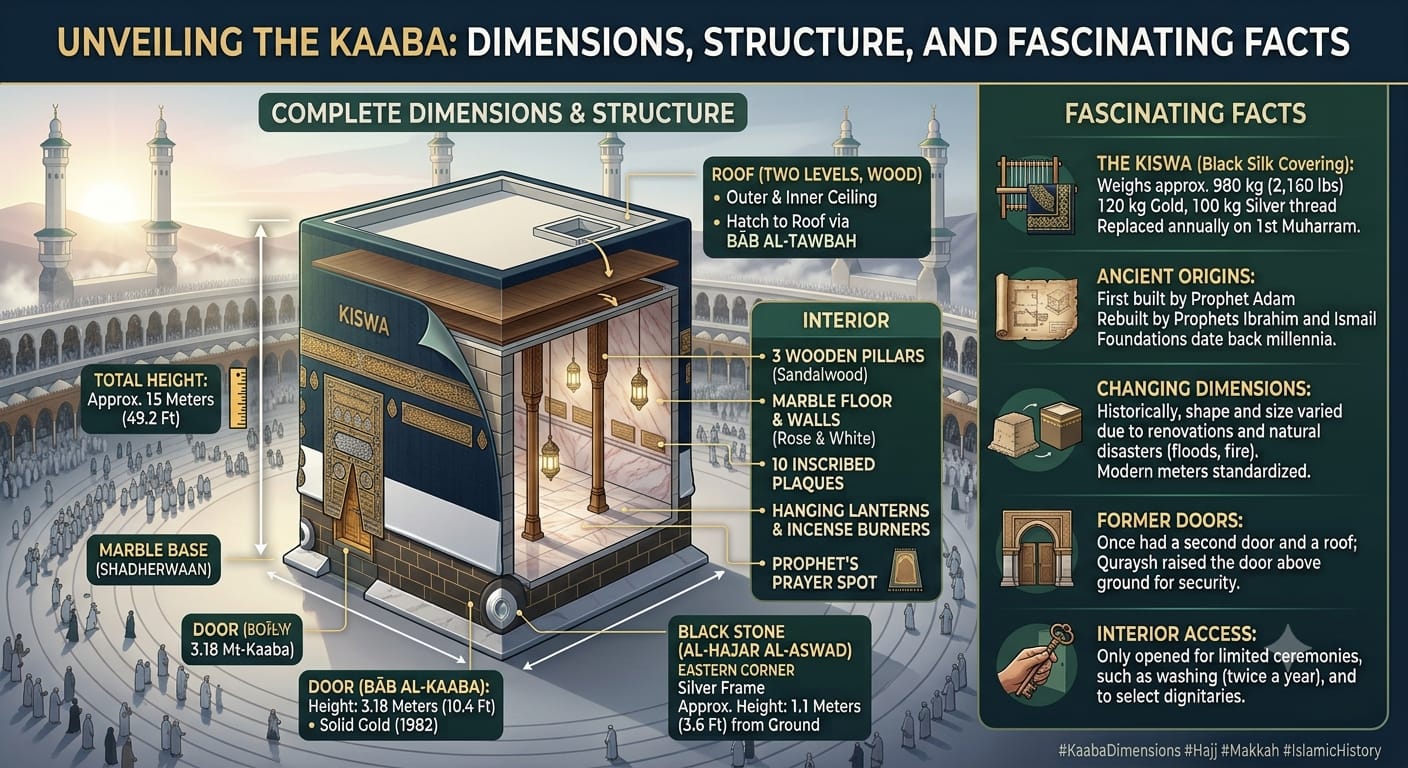
The Holy Kaaba stands at approximately 15 metres (49 feet) in height, making it comparable to a modern four-storey building. Although it appears perfectly symmetrical from a distance, the Kaaba is actually a slightly irregular cuboid rather than a mathematically perfect cube.
Its impressive height allows the magnificent black Kiswah to drape gracefully over the structure, creating the iconic appearance recognised by Muslims around the globe.
The Complete Dimensions of the Kaaba
The Kaaba's four walls are not identical in length. Modern measurements show slight variations between each side.
Approximate dimensions include:
Height: 15 metres (49 feet)
Eastern wall: 11.68 metres
Western wall: 12.04 metres
Northern wall: 9.90 metres
Southern wall: 10.18 metres
These measurements demonstrate that the Kaaba is not a perfect square, giving it its distinctive architectural form.
Why Doesn't the Kaaba Look Large in Photographs?
Many first-time visitors are surprised that the Kaaba appears smaller than expected.
This illusion happens because the surrounding Grand Mosque is enormous, with vast open courtyards and multiple levels capable of accommodating millions of worshippers. Against such a massive backdrop, the Kaaba naturally appears more compact.
Yet when pilgrims stand close to it during Tawaf, its height and solid stone walls become much more impressive.
What Materials Is the Kaaba Made From?
The present structure is built primarily from strong granite quarried in the mountains surrounding Makkah.
Its construction also includes:
Marble flooring
Limestone elements
Heavy timber supporting the roof
Reinforced structural components added during restorations
The famous black exterior seen by pilgrims is not the stone itself. The building is covered by the beautifully embroidered Kiswah, which is replaced every year before the Hajj season.
The Kaaba Has Been Rebuilt Several Times
Although the Kaaba's religious importance has never changed, its physical structure has undergone rebuilding and restoration throughout history.
Natural events such as floods, weather damage, and ageing materials have required repairs over many centuries.
Each reconstruction carefully preserved the Kaaba's sacred role while strengthening its structure for future generations.
The present building reflects centuries of continuous care and preservation.
The Famous Door of the Kaaba
One of the Kaaba's most distinctive features is its magnificent golden door.
Unlike ordinary entrances, the door is positioned about 2.25 metres above the ground, a design historically intended to protect the interior from floodwater. The current gold-plated door measures roughly 3.1 metres high and 1.9 metres wide.
Access to the interior is only possible using a specially designed staircase.
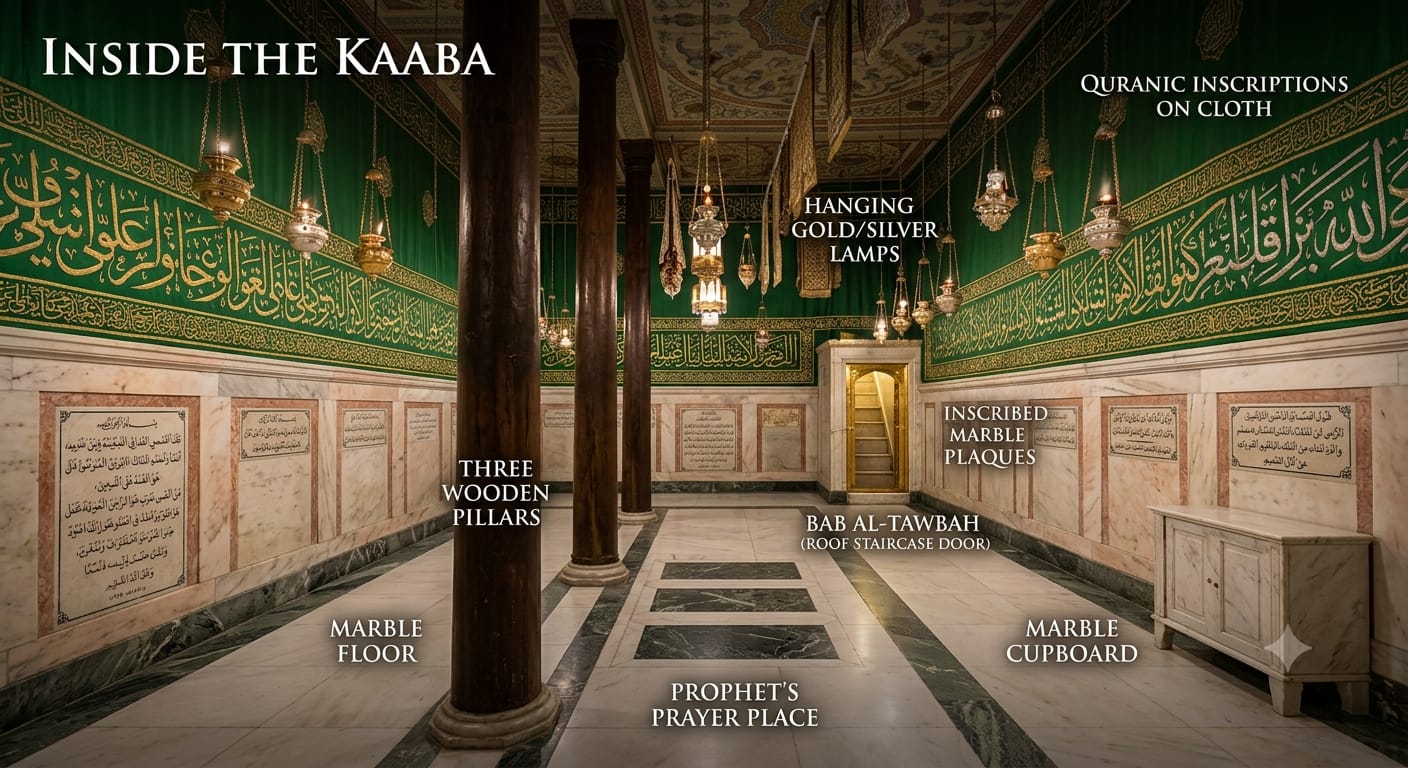
What Is Inside the Kaaba?
The interior of the Kaaba is surprisingly simple.
Inside visitors would find:
Three wooden pillars supporting the roof
Marble flooring
Marble-covered walls
Hanging lamps
Decorative inscriptions
Fragrant perfumes applied regularly
Unlike many famous religious buildings, the Kaaba contains no throne, altar, or elaborate furnishings. Its simplicity reflects the Islamic emphasis on worshipping Allah alone rather than material decoration.
The Sacred Kiswah That Covers the Kaaba
The Kaaba's appearance would not be complete without the breathtaking Kiswah.
Made from premium black silk, the Kiswah is decorated with Quranic verses embroidered using gold- and silver-coloured thread. Every section is produced with extraordinary precision by skilled craftsmen before being installed over the Kaaba each year.
The annual replacement of the Kiswah continues a centuries-old tradition that symbolises honour and respect for Islam's holiest sanctuary.
After replacement, authentic sections of previous Kiswahs become valuable historical artefacts appreciated by collectors, museums, and those who cherish Islamic heritage.
At Kiswah Al Kabah, we are passionate about preserving this remarkable tradition by offering carefully authenticated Kiswah pieces that celebrate the craftsmanship and history of the Sacred House.
Fascinating Facts About the Kaaba
The Kaaba continues to inspire curiosity because of its remarkable history.
Here are some interesting facts:
Muslims across every continent face the Kaaba during their daily prayers.
The Kiswah covering weighs hundreds of kilograms due to its silk fabric and detailed embroidery.
Millions of pilgrims perform Tawaf around the Kaaba every year during Hajj and Umrah.
The Kaaba's corners are traditionally known as the Black Stone Corner, Yemeni Corner, Iraqi Corner, and Levantine Corner.
The building has survived numerous floods, repairs, and renovations while remaining the spiritual centre of Islam.
Despite its global importance, the Kaaba's architectural design remains elegant and remarkably simple.
Why the Kaaba's Size Matters Less Than Its Meaning
Although many people search for the Kaaba's dimensions, its true importance cannot be measured in metres.
Its significance comes from what it represents.
For Muslims, the Kaaba symbolises unity, devotion, and complete submission to Allah. Every prayer directed toward it strengthens the bond shared by the worldwide Muslim community.
Whether someone visits Makkah once in a lifetime or simply turns toward the Qibla every day from home, the Kaaba remains a constant reminder of faith and spiritual connection.
Conclusion
The Holy Kaaba stands approximately 15 metres tall, with four walls of varying lengths that give it its distinctive shape. Built from durable granite and covered by the magnificent Kiswah, it has remained the spiritual centre of Islam for centuries.
Its measurements, architecture, and annual Kiswah replacement all reflect a rich legacy that continues to inspire millions of believers around the world.
For those who wish to preserve a tangible connection to this sacred heritage, authentic Kiswah pieces offer a meaningful reminder of the House of Allah and the remarkable craftsmanship associated with its annual covering.