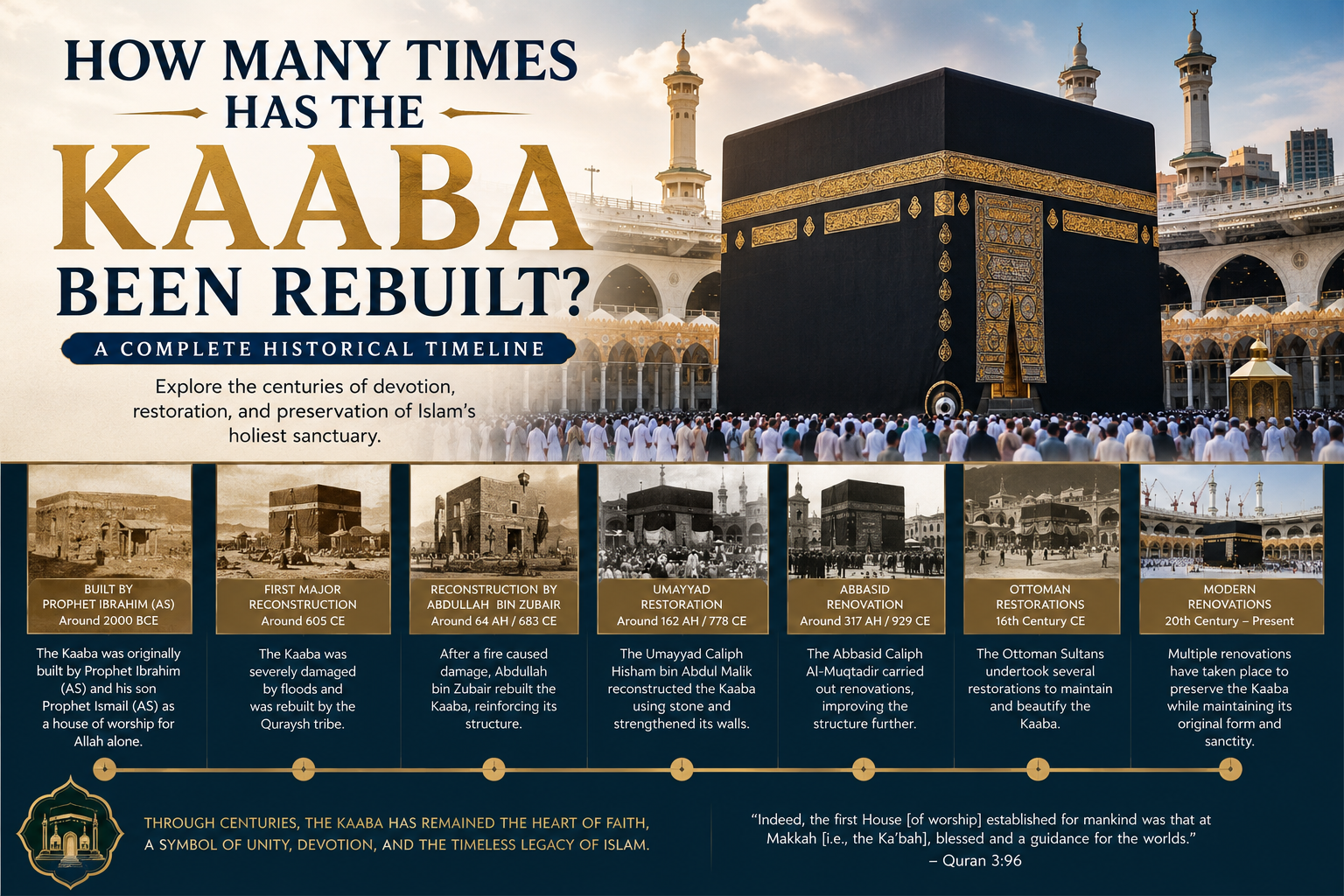
How Many Times Has the Kaaba Been Rebuilt? A Complete Historical Timeline
The Holy Kaaba is the spiritual centre of Islam and the direction of prayer for Muslims across the globe. Every day, millions of believers face this sacred structure during Salah, while countless pilgrims travel to Makkah each year to perform Hajj and Umrah. Despite its enduring presence, many people are surprised to learn that the Kaaba has been rebuilt and restored several times throughout history.
Natural disasters, ageing materials, and extraordinary weather events have all contributed to periods of reconstruction. Yet every rebuilding project has aimed to preserve the sanctity and legacy of the House of Allah.
In this article, we answer the question how many times has Kaaba been rebuilt, explore the history of Kaaba reconstruction, examine the Kaaba rebuilt by Quraish, discuss the impact of Kaaba flood history, and explain how this remarkable heritage is honoured through meaningful items such as a Kaaba Kiswa frame.
Why Has the Kaaba Been Rebuilt?
The Kaaba is made from stone and mortar, making it vulnerable to damage over long periods. Throughout history, Makkah has experienced floods, heavy rainfall, and natural wear that affected the building's stability.
Whenever major structural concerns arose, Muslim leaders ensured that repairs or reconstruction respected the Kaaba's sacred status. The objective was never to change its religious significance but to preserve it for future generations.
How Many Times Has Kaaba Been Rebuilt?
When asking how many times has Kaaba been rebuilt, it is important to distinguish between complete reconstructions and routine maintenance.
Islamic historical records describe several major rebuilding phases, while numerous restoration projects have taken place over the centuries.
The most widely recognised milestones include:
1. The Foundations Raised by Prophet Ibrahim (AS)
According to Islamic tradition, Prophet Ibrahim (AS) and his son Prophet Ismail (AS) raised the foundations of the Kaaba under Allah's command. This event established the Sacred House as the centre of monotheistic worship.
Their construction forms the foundation of the Kaaba known today.
2. The Kaaba Rebuilt by Quraish
One of the most significant events in the history of Kaaba reconstruction occurred before the beginning of Prophet Muhammad's ﷺ mission.
After the structure suffered damage, the Quraysh decided to rebuild it using only wealth they considered lawful. Because their available funds were limited, they were unable to reconstruct the building on its complete original foundation.
This is why the area now known as Hijr Ismail (Hateem) remains outside the present walls of the Kaaba.
During this rebuilding, Prophet Muhammad ﷺ helped resolve a dispute over who should place the Black Stone back into its position, demonstrating wisdom and unity among the tribes.
3. Reconstruction During Abdullah ibn al-Zubayr's Era
Following conflict that caused damage to the Kaaba, Abdullah ibn al-Zubayr ordered another reconstruction.
Historical accounts explain that he rebuilt the Kaaba in accordance with narrations describing the wishes of Prophet Muhammad ﷺ regarding its dimensions.
This version temporarily included the original foundation before later political changes led to further rebuilding.
4. Reconstruction During the Umayyad Period
After political authority changed, another rebuilding project returned the Kaaba to dimensions similar to those established during the Kaaba rebuilt by Quraish.
This basic layout has largely remained the foundation for the modern structure.
Kaaba Flood History
The Kaaba flood history reflects the environmental challenges faced by Makkah over many centuries.
Before modern drainage systems, heavy rainfall occasionally caused significant flooding around Masjid al-Haram. Water entered the sacred precinct and sometimes weakened sections of the Kaaba.
These floods highlighted the importance of ongoing maintenance and preservation.
Today, extensive infrastructure and engineering improvements greatly reduce the risk of flood-related damage, helping protect one of Islam's most treasured landmarks.
Modern Restoration Projects
Although complete reconstruction has not been required in recent history, careful restoration continues whenever necessary.
Modern conservation work includes:
Replacing worn materials.
Strengthening structural elements.
Preserving marble surfaces.
Maintaining the roof.
Inspecting foundations.
Protecting historical features.
Every project is carried out with exceptional care to preserve both the appearance and historical integrity of the Kaaba.
Why the Kaaba's History Matters
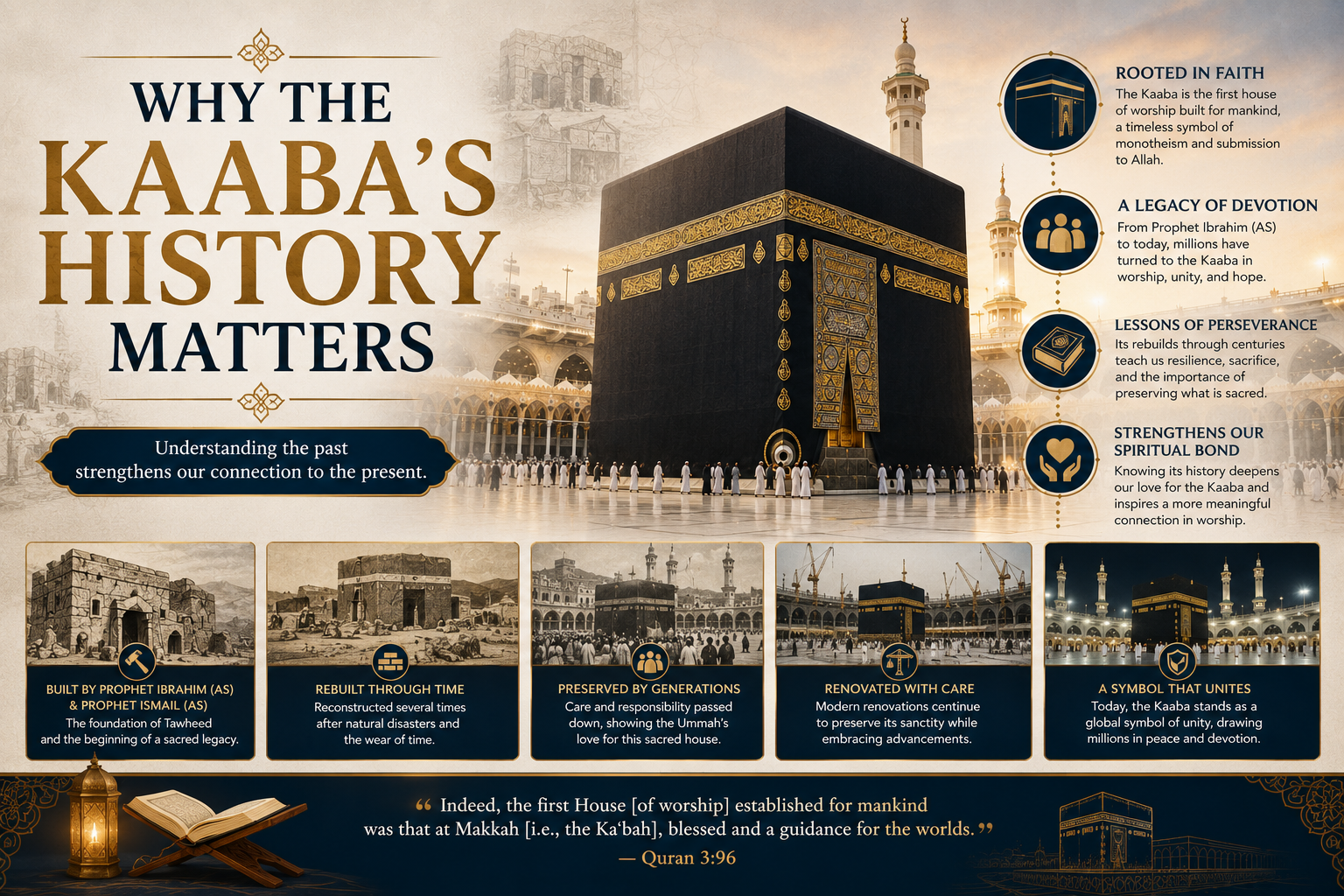
Understanding the history of Kaaba reconstruction reminds Muslims that preserving sacred places requires both respect and responsibility.
Despite floods, rebuilding projects, and the passage of centuries, the Kaaba has remained the spiritual heart of the Muslim Ummah.
Its continuity symbolises:
Unity in worship.
Preservation of Islamic heritage.
The legacy of Prophet Ibrahim (AS).
The enduring importance of Tawheed.
Every reconstruction reflects the commitment of successive generations to safeguard this sacred trust.
Common Questions About the Kaaba's Reconstruction
Was the Kaaba Ever Destroyed?
No. While sections have been damaged by floods, conflict, and natural ageing, the Kaaba has always been repaired or rebuilt with the intention of preserving it.
Why Was Hateem Left Outside the Kaaba?
During the Kaaba rebuilt by Quraish, limited lawful funds prevented reconstruction on the complete original foundation, leaving the area now known as Hijr Ismail outside the present walls.
Has the Kaaba Changed Shape?
Its overall appearance has remained remarkably consistent, although measurements and some structural details have changed slightly during different rebuilding periods.
Preserving the Legacy Through Islamic Heritage
The remarkable story of the Kaaba inspires Muslims across the world to learn more about Islamic history and preserve its legacy.
Many believers choose meaningful reminders of Makkah to keep that connection alive in their homes.
A beautifully crafted Kaaba Kiswa frame featuring certified Kiswah fabric serves as both an elegant display and a lasting tribute to one of Islam's holiest landmarks. These carefully preserved pieces remind families of the Kaaba's history, craftsmanship, and spiritual significance while honouring generations of devotion.
Conclusion
The answer to how many times has Kaaba been rebuilt reveals a remarkable history of preservation rather than replacement. From the foundations raised by Prophet Ibrahim (AS) to the Kaaba rebuilt by Quraish, later reconstructions, and responses to events recorded in Kaaba flood history, every generation has worked to protect this sacred sanctuary.
Learning about the history of Kaaba reconstruction deepens our appreciation for Islam's holiest site and the dedication shown in preserving it. For those wishing to honour this extraordinary heritage, a handcrafted Kaaba Kiswa frame offers a meaningful reminder of the Sacred House and its timeless place in the hearts of Muslims around the world.