Behind the 2026 Kaaba Kiswah: Engineering the Most Sacred Textile in Human History
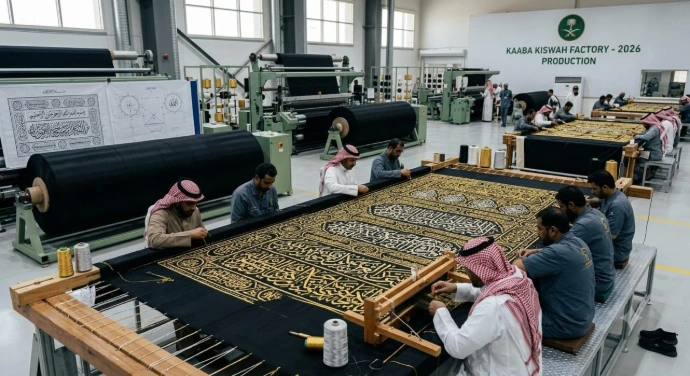
In the world of high textiles, historical preservation, and sacred art, there is no garment that commands more reverence, value, or meticulous labor than the protective covering of the Holy Kaaba. In mid-2026, a highly coordinated operation culminated in the successful installation of the newest Kiswah. While millions witnessed the majestic ceremony, a deeper look behind the 2026 Kaaba Kiswah reveals an extraordinary tale of state-sponsored craftsmanship, massive material investments, and a group of 150 select master artisans who preserve this sacred art form inside Makkah's royal workshops.
For high-profile collectors, historians, and premium Islamic cultural patrons in the United Kingdom, understanding the engineering and human mastery behind this textile is vital to recognizing the immense historical and investment value of verified Kiswah pieces.
A Century of Sovereign Saudi Craftsmanship
The production of the modern Kiswah is managed by the King Abdulaziz Complex for the Holy Kaaba Kiswa, an institution established in 1927 by King Abdulaziz Al Saud to bring this sacred responsibility entirely within the borders of the Kingdom. Over the last century, the facility has evolved from a small traditional weaving workshop into a world-class center of textile engineering.
Today, the complex houses specialized labs where materials are tested rigorously for UV degradation, tensile strength, and environmental resilience, ensuring the fabric remains immaculate despite exposure to intense sunlight and seasonal rains.
+-----------------------------------------------------------------+
| 2026 KISWAH MATERIAL COMPOSITION |
+------------------------------------+----------------------------+
| Natural Imported Silk | 825 Kilograms |
| Gold-Plated Silver Embroidery Wire | 120 Kilograms |
| Pure Silver Embroidery Wire | 60 Kilograms |
| Raw Cotton Support Lining | 400 Kilograms |
+------------------------------------+----------------------------+
The Seven Stages of Sacred Masterwork
The production process takes nearly a full year to complete, moving systematically through seven distinct phases:
Water Desalination and Washing: The raw silk is meticulously purified to remove protective waxes.
Dyeing: The silk is dyed a rich, deep black tone that absorbs light cleanly.
Automated Weaving: Jacquard looms weave the subtle background pattern containing the Shahada into the fabric itself.
Laboratory Testing: Threads undergo stress tests to confirm absolute durability.
Silkscreen Printing: Quranic templates are precisely applied over the canvas.
Hand-Embroidery: The artisans spend months hand-stitching gold and silver wire over raised cotton forms.
Assembly and Inspection: The final 47 individual panels are joined together using laser-guided sewing technology.
The Artisans: Living Links to Islamic Antiquity
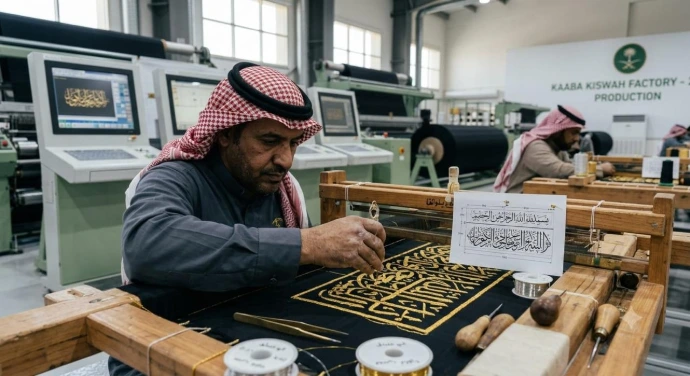
The heartbeat of the workshop is its team of traditional embroiderers. These individuals train for years under veteran masters to perfect the specific tension required to handle fine metallic wires without snapping them or wrinkling the underlying silk base.
Their work is slow, rhythmic, and incredibly precise. Using a wooden stylus, they guide the gold-plated silver thread back and forth across a pre-padded structure, creating a bold, raised effect that catches the light cleanly. This physical, human touch is what elevates the Kiswah from a beautiful fabric into a historic monument of Islamic visual culture.
The Ultimate Acquisition for UK Connoisseurs
When the old Kiswah is lowered each year, it is not discarded. Instead, it enters a highly secure decommissioning phase where it is carefully cleaned, dismantled, and segmented under royal supervision. Historically, these pieces are preserved in national museums or gifted as diplomatic honors to high-profile figures and global institutions.
For elite collectors based in London, Birmingham, and across the UK, securing a certified, historically documented fragment of an authentic Kiswah is the absolute pinnacle of Islamic heritage acquisition. It represents a tangible piece of history, an investment-grade artifact, and a source of profound spiritual blessings for generations to come.
At Kiswa Al Kaaba, we specialize in the sourcing, preservation, and certified authentication of archival Islamic artifacts. Our connections with elite global curators ensure that every piece we offer is accompanied by ironclad provenance.
Indulge your passion for sacred history. Visit our private online viewing suite at Kiswa Al Kaaba Archival Acquisitions to schedule a consultation with our heritage experts today.