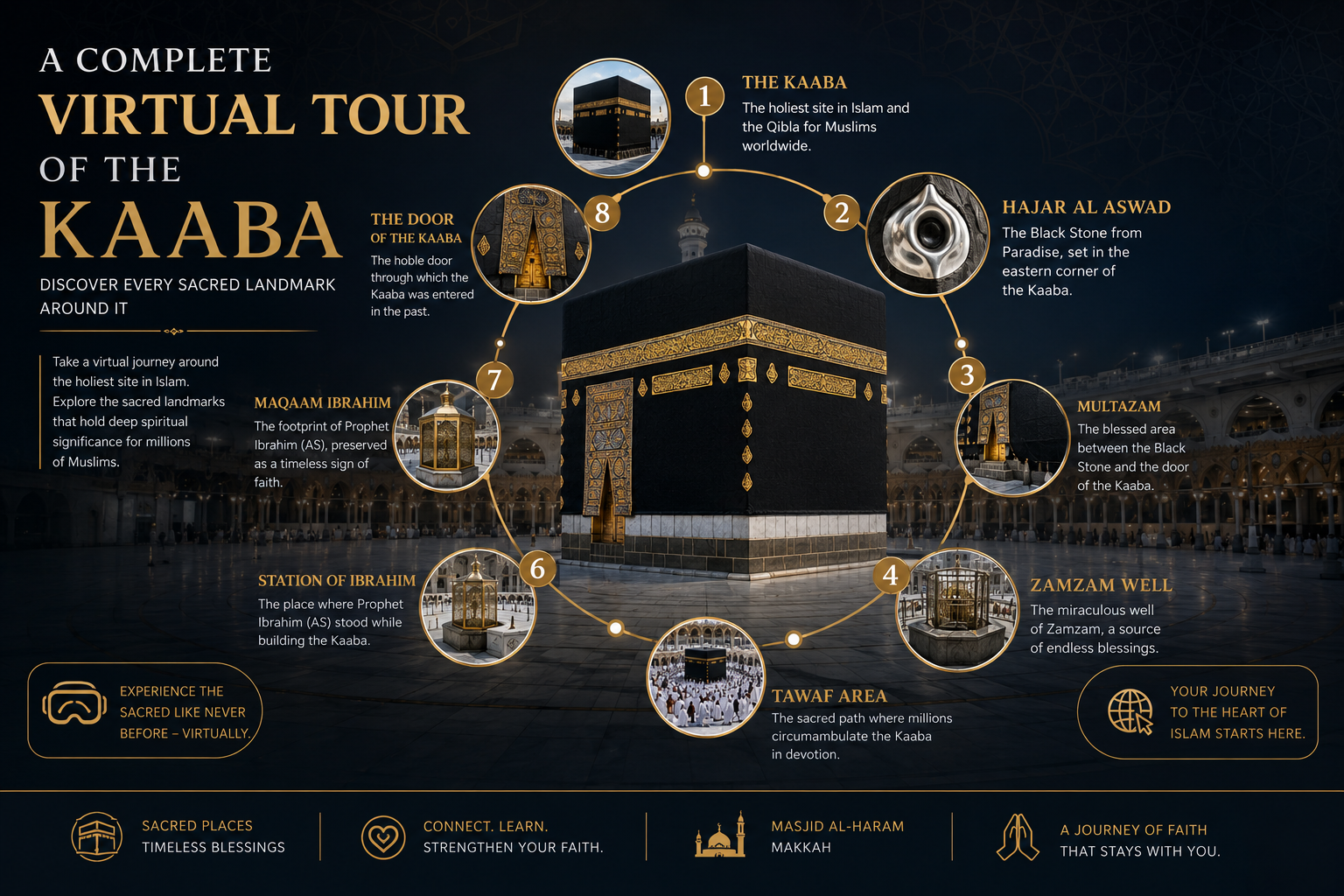
A Complete Virtual Tour of the Kaaba: Discover Every Sacred Landmark Around It
For every Muslim, the Holy Kaaba represents the centre of faith, unity, and worship. It is the direction Muslims face in daily prayers and the destination of millions of pilgrims who travel to Makkah each year for Hajj and Umrah. While nothing compares to standing before the Kaaba in person, modern technology now offers an inspiring way to explore this sacred place through a Kaaba virtual tour 360.
Interactive digital tours allow people to move around the Holy Mosque, view important landmarks from multiple angles, and understand the significance of each location before visiting. These experiences are especially valuable for first-time pilgrims, students of Islamic history, and families teaching children about the rituals of Islam.
This virtual journey introduces the most important places surrounding the Kaaba and explains why each one holds a special place in the hearts of Muslims around the world.
Why a Virtual Journey Is Worth Exploring
A virtual visit to Masjid al-Haram is more than simply viewing photographs on a screen. Today's immersive technology combines panoramic images, guided explanations, and interactive navigation to recreate the atmosphere of Islam's holiest mosque.
Instead of arriving in Makkah without knowing where to begin, future pilgrims can become familiar with the sacred surroundings before their journey. Knowing the locations of important landmarks often helps visitors feel calmer and more confident during Umrah.
Many Islamic learning centres now recommend digital experiences because they allow people of all ages to study the pilgrimage at their own pace.
Entering the Grand Mosque
Imagine walking through one of the magnificent entrances of Masjid al-Haram.
The bright marble pathways stretch across vast courtyards filled with worshippers from every corner of the world. As you continue forward, the crowds naturally guide your eyes toward the centre of the mosque, where the Holy Kaaba stands in remarkable simplicity.
This first glimpse is unforgettable for pilgrims. Even during a digital experience, seeing the Kaaba appear before you creates a powerful reminder of Allah's greatness and the unity shared by Muslims worldwide.
A well-designed Kaaba virtual tour 360 captures this first view beautifully, allowing users to pause, rotate their perspective, and appreciate the remarkable setting from every direction.
The Kaaba: The Centre of Every Prayer
Standing in the middle of Masjid al-Haram, the Kaaba remains the focal point of Islamic worship. Muslims across the globe turn towards it five times each day, making it the spiritual centre of the Muslim world.
Its elegant black silk covering, known as the Kiswah, displays beautifully embroidered Quranic verses crafted with gold and silver-plated thread. Every detail reflects centuries of Islamic tradition and exceptional craftsmanship.
Although thousands of photographs exist, a virtual experience provides something different. Users can observe every side of the Kaaba, appreciate its proportions, and understand how pilgrims move around it throughout the day.
For anyone interested in Islamic heritage, studying the Kaaba before travelling creates a stronger connection with the sacred history of Makkah.
Discovering the Black Stone
One of the highlights of every virtual experience is the Close up view of Hajar al Aswad Black Stone.
Positioned in the eastern corner of the Kaaba, Hajar al Aswad marks the beginning and conclusion of each circuit of Tawaf. Because millions of pilgrims gather around this area, many visitors are unable to approach it closely during Umrah or Hajj.
Virtual technology removes that limitation by offering detailed images that clearly show its silver frame, position, and surrounding area.
Viewing the Black Stone beforehand helps pilgrims recognise exactly where Tawaf starts, making the ritual easier to understand before arriving in Makkah.
Beyond its physical appearance, learning about its historical connection to Prophet Ibrahim (AS) enriches the spiritual meaning of every visit.
Maqam Ibrahim: A Symbol of Dedication
Only a short distance from the Kaaba stands Maqam Ibrahim, one of the most recognised landmarks inside Masjid al-Haram.
According to Islamic tradition, this stone bears the footprints associated with Prophet Ibrahim (AS) as he raised the walls of the Kaaba. Today, it is enclosed within a protective glass structure where pilgrims often perform two units of prayer after completing Tawaf.
A virtual tour allows visitors to understand the exact relationship between Maqam Ibrahim and the Kaaba. Instead of searching for it among large crowds, pilgrims arrive already knowing where it is located and why it is important.
Learning these details beforehand often makes the pilgrimage more peaceful and meaningful.
The Beauty of the Kiswah Up Close
One advantage of digital exploration is the opportunity to admire the Kaaba's Kiswah in remarkable detail.
The rich black silk covering is replaced annually and decorated with intricate Quranic calligraphy woven using precious metallic threads. Every embroidered section represents months of skilled craftsmanship and reflects the honour given to the Sacred House.
High-resolution virtual images reveal patterns and inscriptions that many pilgrims cannot easily observe while surrounded by crowds. This closer perspective helps visitors appreciate the artistic excellence behind one of Islam's most recognised symbols.
For collectors of authentic Kiswah pieces, understanding the history and design of the cloth adds even greater value to these treasured reminders of Makkah.
Standing Near the Multazam
Between the Kaaba's golden door and the Black Stone lies the area known as the Multazam.
Muslims have long regarded this place as one where heartfelt supplications are offered with sincerity and hope. Although heavy crowds often make access difficult, learning its location before travelling helps pilgrims understand its significance and recognise it during their visit.
A virtual guide clearly identifies the Multazam within the Mataf area, allowing users to visualise where worshippers gather for personal prayers.
Knowing these locations in advance transforms a digital experience into valuable preparation rather than simple sightseeing.
Continue Your Journey Around the Sacred House
After exploring the Kaaba, the Black Stone, Maqam Ibrahim, and the Multazam, your virtual journey continues to several other locations that hold deep historical and religious importance. Each landmark tells a story connected to the Prophets, the rituals of Umrah, and the centuries-old traditions that make Masjid al-Haram unlike any other place on Earth.
Whether you are preparing for your first pilgrimage or simply increasing your knowledge, understanding these places before you travel helps you appreciate every moment spent in the Holy Mosque.
Visiting the Hateem (Hijr Ismail)
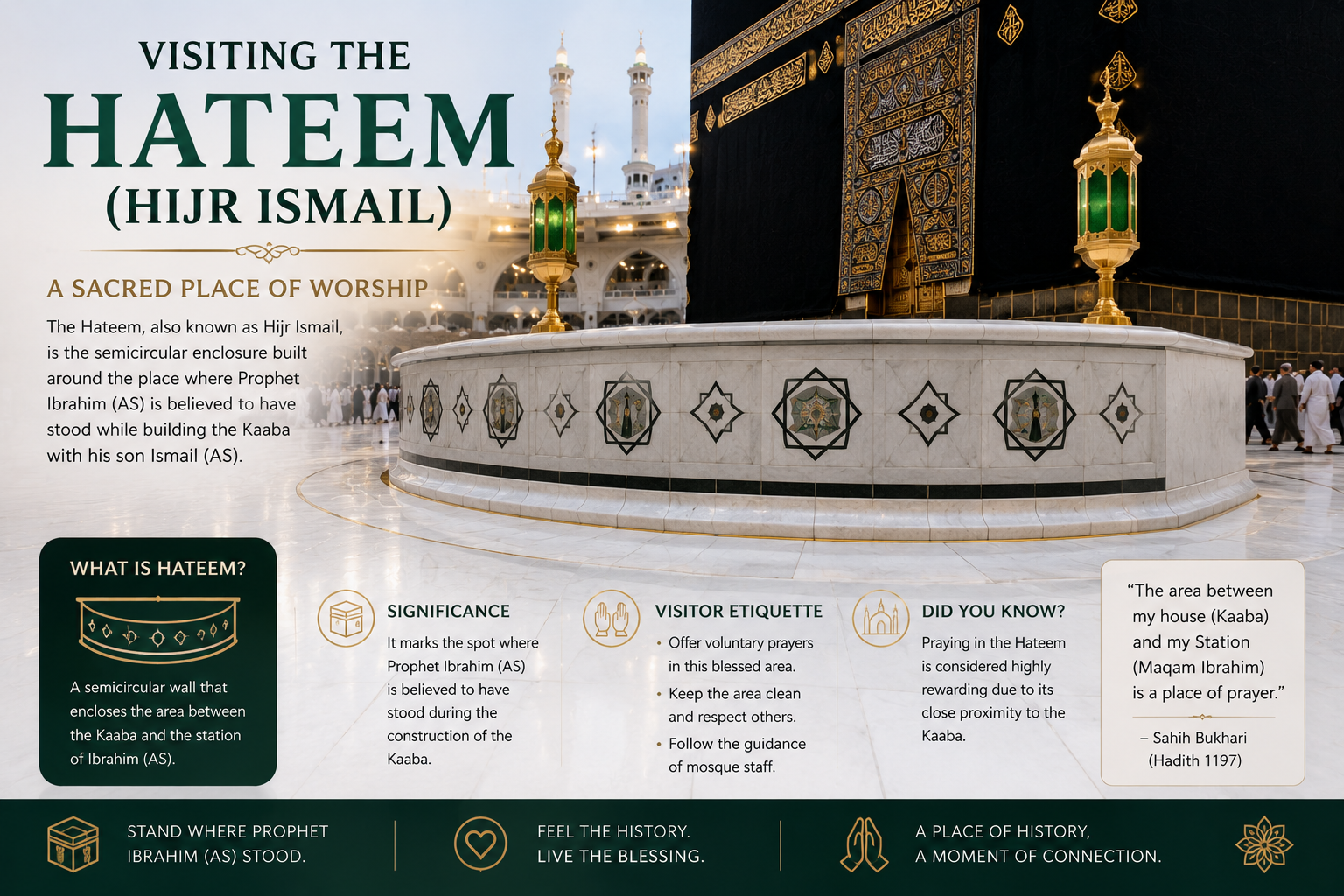
One of the first landmarks you'll notice beside the Kaaba is the semi-circular white marble wall known as the Hateem or Hijr Ismail.
Many people are surprised to learn that this area was originally part of the Kaaba's foundation during the time of Prophet Ibrahim (AS). When the Quraysh rebuilt the Kaaba before the beginning of Islam, the structure was made smaller, leaving this section outside the present-day walls.
During a virtual tour, you can clearly see how the Hateem connects to the Kaaba and why pilgrims performing Tawaf always walk around the outside of this semi-circular area. Seeing its position beforehand removes confusion and helps first-time visitors perform the ritual correctly.
When the area is accessible and not overcrowded, many worshippers offer voluntary prayers inside the Hateem because of its special status.
Admiring the Golden Door and the Mizab al-Rahmah
As you continue exploring, your attention naturally turns toward the Kaaba's famous golden door.
Raised above ground level, this beautifully crafted door is opened only on selected occasions. Although pilgrims do not enter through it during Umrah or Hajj, viewing it closely allows you to appreciate its intricate design and the respect shown to the Sacred House throughout history.
Above the Hateem is another remarkable feature called the Mizab al-Rahmah, or the Water Spout of Mercy. This golden spout carries rainwater from the roof of the Kaaba and has become one of its most recognisable architectural elements.
High-quality virtual experiences often provide detailed views that are difficult to enjoy while standing among thousands of worshippers.
Learning About Zamzam and Its Importance
No visit to Masjid al-Haram is complete without remembering the story of Zamzam.
The blessed well is closely connected to Hajar (AS), who searched desperately between Safa and Marwah for water to provide for her son, Prophet Ismail (AS). By Allah's command, the Zamzam spring emerged, continuing to provide water for millions of pilgrims today.
Although the well itself is no longer openly visible, virtual guides explain its location beneath the mosque and show where pilgrims collect Zamzam water.
Understanding this history makes drinking Zamzam a far more meaningful experience during Umrah.
Learn Umrah Steps Virtual Tour Before You Travel
Preparing for Umrah becomes much easier when you learn Umrah steps before arriving in Makkah.
Instead of trying to memorise every ritual after entering the Holy Mosque, you become familiar with the complete journey beforehand.
A typical virtual guide includes:
Entering Masjid al-Haram with confidence.
Seeing the Kaaba for the first time.
Identifying the starting point of Tawaf.
Performing seven complete circuits correctly.
Offering prayer near Maqam Ibrahim when possible.
Drinking Zamzam water.
Walking between Safa and Marwah for Sa'i.
Completing the final step of Umrah by trimming or shaving the hair.
Learning these stages before travelling allows pilgrims to concentrate more on worship and less on directions.
How to Perform Tawaf Virtual Guide
Many first-time visitors worry about making mistakes during Tawaf because of the large crowds surrounding the Kaaba. Following a How to perform Tawaf virtual guide helps remove that uncertainty.
The guide explains the process step by step.
Begin near the Black Stone with the intention of Tawaf. Walk around the Kaaba in an anti-clockwise direction while keeping the Kaaba on your left side. Continue until seven complete circuits have been finished.
Rather than focusing only on movement, the guide also reminds pilgrims to remain patient, avoid pushing through crowds, and spend their time remembering Allah through dua and Quran recitation.
Watching this process in advance helps visitors understand the natural flow of pilgrims inside the Mataf area and makes the real experience much more comfortable.
Virtual Reality Kaaba Tour UK: A Modern Way to Learn
Technology has transformed the way Muslims learn about Hajj and Umrah. Today, a Virtual reality Kaaba tour UK allows users to experience an immersive walk through Masjid al-Haram using interactive VR technology.
These educational programmes are increasingly used by:
Islamic schools.
Mosques and community centres.
Families preparing for Umrah.
Students studying Islamic history.
Elderly people who wish to explore the Holy Mosque from home.
Although virtual reality cannot replace the reward of physically visiting Makkah, it provides valuable knowledge and helps future pilgrims become familiar with their surroundings before travelling.
Bringing the Experience Home with the Kiswah
As your virtual journey comes to an end, one feature continues to capture attention—the magnificent Kiswah that covers the Kaaba.
Its elegant black silk, detailed Quranic embroidery, and centuries-old craftsmanship remind Muslims of the honour given to the Sacred House. Looking closely at the calligraphy during a virtual tour often inspires a greater appreciation for the dedication involved in producing this remarkable covering each year.
Many believers choose authentic Kiswah pieces or framed Islamic artwork as lasting reminders of their spiritual connection to Makkah. These meaningful keepsakes preserve memories of the Holy Kaaba while bringing a touch of Islamic heritage into the home.
Conclusion
A Kaaba virtual tour 360 offers an informative and inspiring way to explore Islam's holiest site from anywhere in the world. From the Close up view of Hajar al Aswad Black Stone to the Hateem, Maqam Ibrahim, Zamzam, and the route of Tawaf, every landmark helps deepen your understanding of the sacred journey that millions of Muslims undertake each year.
Whether you choose to experience a Virtual reality Kaaba tour UK, complete a Learn Umrah steps virtual tour, or study a How to perform Tawaf virtual guide, these resources can help you arrive in Makkah with greater confidence, knowledge, and appreciation.
At Kiswah Al Kabah, we are dedicated to preserving the history, beauty, and spiritual legacy of the Holy Kaaba through authentic Kiswah pieces and Islamic heritage products. As you prepare for your future pilgrimage—or simply seek to strengthen your connection with the Sacred House—we invite you to continue discovering the remarkable stories, craftsmanship, and traditions that make the Kaaba a timeless symbol of faith for Muslims around the globe.
May Allah bless every believer with the opportunity to visit His Sacred House, perform Hajj or Umrah with sincerity, and return with hearts enriched by faith, gratitude, and unforgettable memories. Ameen.