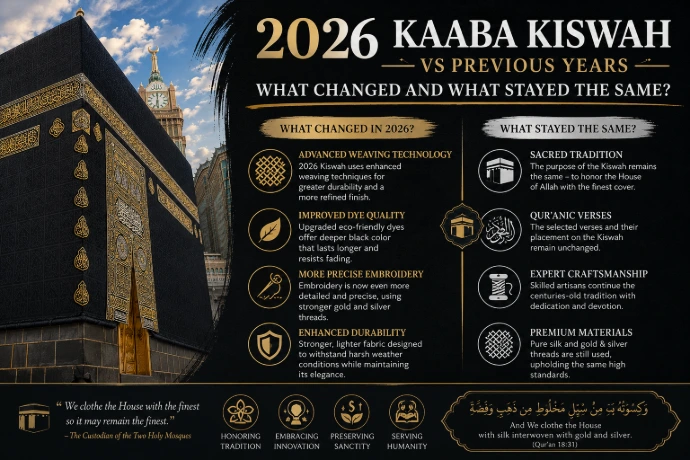
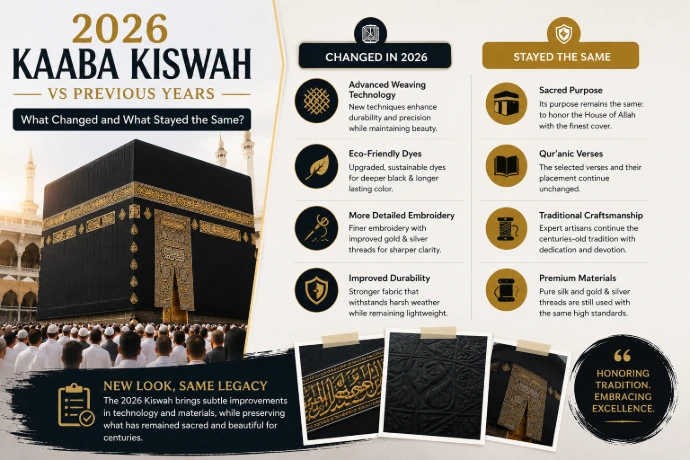
2026 Kaaba Kiswah vs Previous Years: What Changed and What Stayed the Same?
The global demand for high-end Islamic art has seen an unprecedented rise among British Muslim collectors. At the peak of this artistic and spiritual hierarchy sits the Gilaf-e-Kaaba—the sacred black covering of the Holy House of Allah. The complete assembly of the 2026 Kaaba Kiswah, which was officially installed on the 1st of Muharram 1448 AH (16 June 2026), marks a masterful intersection of traditional handcraft and advanced Saudi industrial engineering.
For serious collectors looking to understand the intrinsic asset value, spiritual heritage, and the market-driven kaaba kiswah price, evaluating what has changed and what has remained constant in the 2026 production is essential.
What Stayed the Same: The Royal Formulation of Materials
The raw value of the Kiswah is derived directly from its uncompromised material formulation. The Saudi government spares no expense at the King Abdulaziz Complex for the Holy Kaaba Kiswa, ensuring that the 2026 iteration meets the historical standards of absolute luxury:
Material Component | Exact Mass Used (2026) | Purpose & Execution |
Natural Silk | 825 Kilograms | Woven into dense, weather-resistant black jacquard panels. |
Gold-Plated Silver Wire | 120 Kilograms | Hand-embroidered to form the elevated Quranic inscriptions. |
Pure Silver Thread | 60 Kilograms | Utilized for lower borders and contrasting sacred accents. |
Raw Cotton Lining | 410 Kilograms | Provides backing and internal structural stability against tension. |
The artistic design remains steadfastly anchored in the elegant Thuluth script of Arabic calligraphy. The Sitara (the beautiful door curtain measuring 6.35 meters by 3.33 meters) continues to feature the traditional geometric layouts and specific Quranic chapters, ensuring that the visual identity of the Kaaba remains unchanged across generations.
What Changed in 2026: Technological Integration and Structural Resilience
While the raw materials remain unchanged, the production workflow of the 2026 Kiswah has adapted modern manufacturing processes to create the most durable cover in history.
[Raw Natural Silk Imported] ➔ [Desalinated Laboratory Washing & Black Dyeing] ➔ [High-Precision 9,986-Thread Jacquard Weaving] ➔ [3D Cotton Padding & Manual Gold Embroidery] ➔ [Laser-Guided Machine Seaming & Final Assembly]
1. Advanced Tensile Resistance
The climate in Makkah presents an intense physical challenge: blistering UV rays, desert sandstorms, and the manual friction from millions of performing pilgrims during Tawaf. In 2026, the state laboratory introduced advanced chemical-free stabilization treatments during the dyeing process. This treatment enhances the fastness of the jet-black dye without degrading the natural silk proteins, ensuring the fabric remains deeply black for a full year without fading.
2. Micro-Precision Mechanical Assembly
In previous decades, connecting the massive 14-meter sections of fabric relied heavily on manual tailoring. The 2026 production utilized one of the largest specialized automated sewing machines in the world, managed by laser tracking systems. This guarantees that the tension across the entire structure is completely uniform, preventing sagging or tearing during installation at the Grand Mosque.
3. Progressive Artisanship
The human element inside the Makkah complex has also expanded. The design studio utilized digital mapping software to plot out the spacing of the calligraphy before printing it onto the fabric. Additionally, the integration of highly qualified female textile experts into the quality control and material testing phases added a historic layer of inclusivity to the 2026 production run.
The Acquisition Market: Understanding Kaaba Kiswah Valuation
Because a complete Kiswah is never sold on the open market—remaining the sovereign property of the Saudi state or preserved in international museums—the private market revolves entirely around individual, preserved panels. For elite UK collectors, calculating an accurate kaaba kiswah price requires analyzing several key variables:
The Element Type: A piece of plain black jacquard silk is a subtle, beautiful acquisition. However, a section from the Hizam (the gold-embroidered belt) or the Sitara (the door curtain) commands a significant premium due to the sheer concentration of precious metals and hours of hand-embroidery.
The Condition of the Gold Thread: Genuine pieces display heavy, rigid metallic wiring that has been exposed to the spiritual energy of Makkah. True collectors check for minimal fraying and the unique patina that comes from authentic environmental exposure.
Official Verification: Unverified artifacts hold zero market value. Authentic pieces must possess a verifiable chain of custody, linking them directly back to official delegations, state distributions, or licensed conservationists.
Owning a piece of the 2026 or historical Gilaf-e-Kaaba is a rare privilege—it represents a tangible anchor to the center of the Islamic world, holding both immense spiritual weight and generational asset value.
To browse our heavily vetted portfolio of authenticated pieces, complete with professional preservation framing and insured UK shipping, visit Kiswa Al Kaaba.