What Is the Black Stone of the Kaaba? History, Significance, and Facts
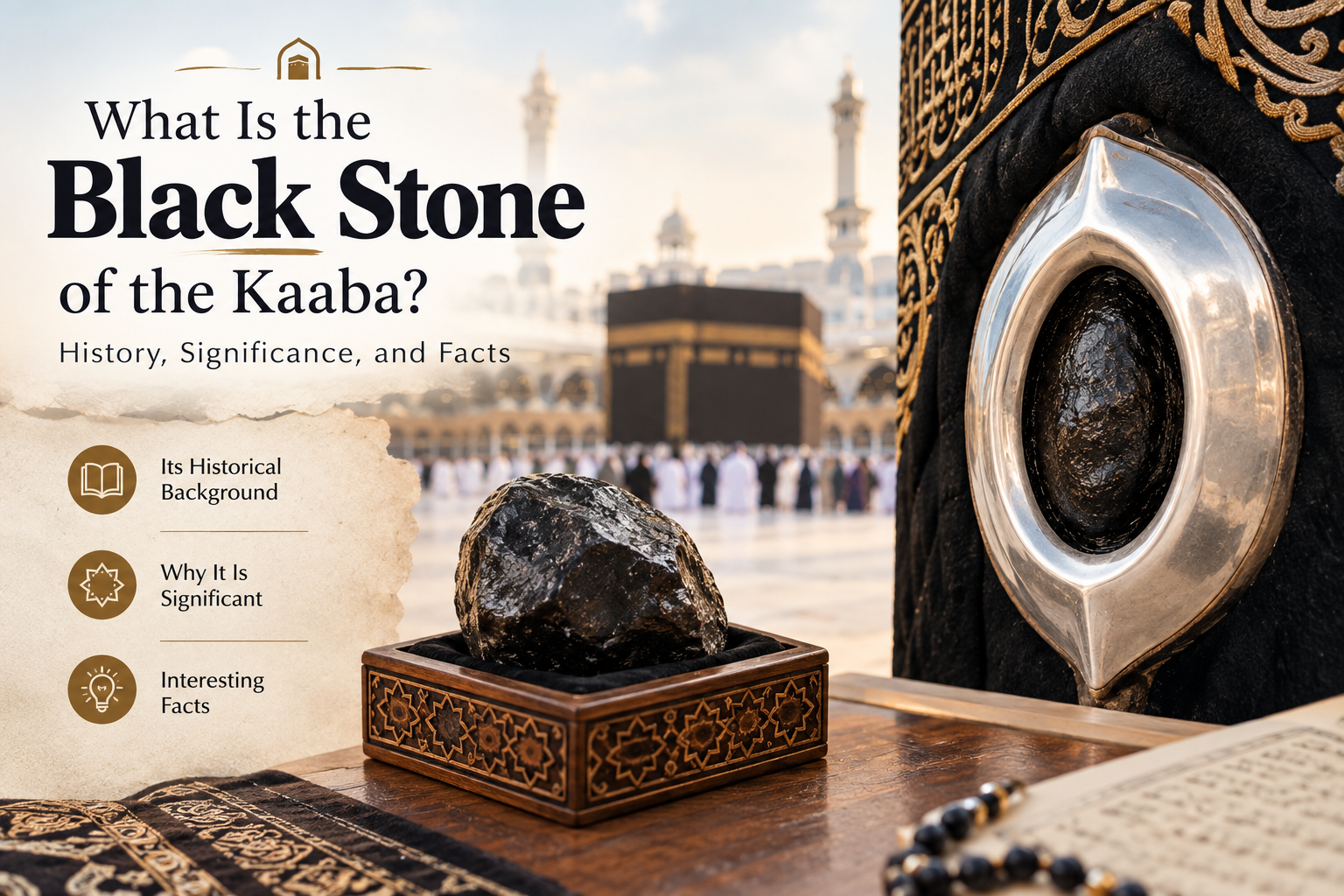
Set into the eastern corner of the Holy Kaaba in Makkah lies one of Islam’s most revered relics: Hajar al-Aswad, commonly known as the Black Stone of the Kaaba. For centuries, millions of pilgrims performing Hajj and Umrah have longed to catch a glimpse of this sacred stone, greeting or kissing it as they begin each circuit of Tawaf around Masjid al-Haram.
Whether you are preparing for pilgrimage or looking to deepen your Islamic knowledge, this detailed overview explores the origin, spiritual importance, historic journey, and fascinating facts surrounding the Black Stone.
What Is Hajar al-Aswad?
Hajar al-Aswad (Arabic: الحجر الأسود) translates directly to "the Black Stone." Located at the eastern corner (Rukn al-Aswad) of the Kaaba, it acts as the official starting and finishing marker for Tawaf—the act of circumambulating the Kaaba seven times during pilgrimage.
Visually, the stone is not a single large rock today. It consists of eight small fragments of dark rock bonded together within a smooth, protective silver casing fixed to the Kaaba’s corner wall.
The Origins and History of the Black Stone
According to Islamic tradition, the history of Hajar al-Aswad traces back to the dawn of creation and the early prophets:
Heavenly Origin: Islamic teachings hold that the stone was sent down from Jannah (Paradise) to Prophet Adam (AS) to mark the site for the first sanctuary on Earth.
Rebuilding by Prophet Ibrahim (AS): When Prophet Ibrahim (AS) and his son Prophet Ismail (AS) were building the walls of the Holy Kaaba, Angel Jibreel (Gabriel) brought the stone to be set into the corner as the starting point for worship.
Restoration by Prophet Muhammad (PBUH): Years before receiving prophethood, Prophet Muhammad (PBUH) played a pivotal role in placing the stone during a major reconstruction of the Kaaba by the Quraish tribe. When tribal leaders disputed who deserved the honor of setting the stone, the Prophet resolved the conflict peacefully by placing it on a cloth and having every tribal leader lift a corner together. He then set it into place with his own noble hands.
Key Historical Timeline of Hajar al-Aswad
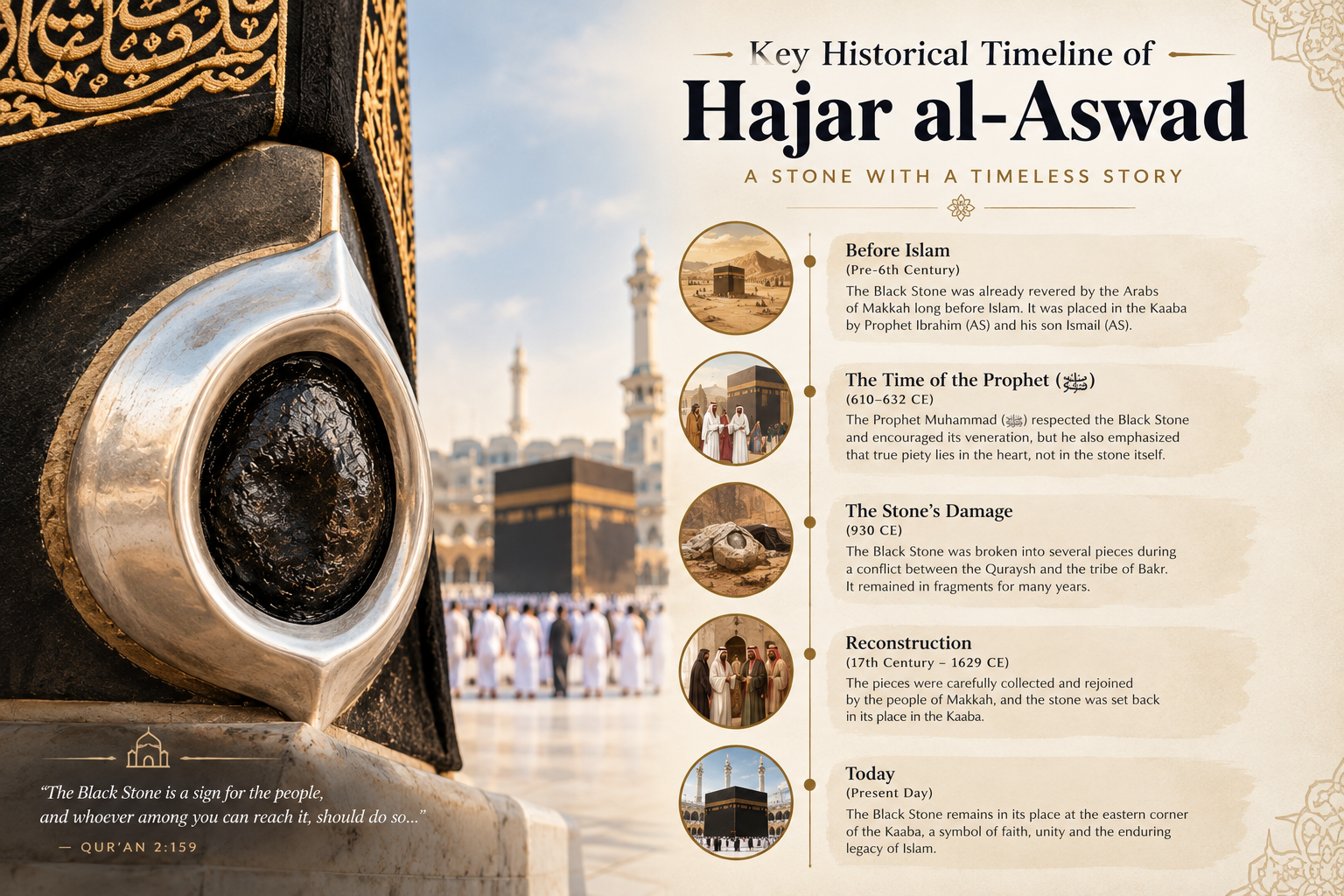
Placement in the Kaaba
Prophet Ibrahim's Era
The stone is brought from Paradise by Angel Jibreel and set into the Kaaba's eastern wall by Prophet Ibrahim (AS) and Prophet Ismail (AS).
Resolution by Prophet Muhammad (PBUH)
605 CE
Before receiving revelation, Prophet Muhammad (PBUH) mediates a dispute among the Quraish, placing the stone back into the Kaaba corner after its rebuilding.
Damage During Siege
683 CE
During the siege of Makkah, the Kaaba caught fire, causing the stone to crack into multiple fragments. It was subsequently rejoined with silver bindings by Abdullah ibn al-Zubayr.
Abduction by the Qarmatians
930 CE
A fanatic sect known as the Qarmatians sacked Makkah and stole the Black Stone, keeping it in Eastern Arabia for over 20 years before it was returned to the Kaaba.
Why Do Pilgrims Kiss the Black Stone?
Kissing or touching the Black Stone during Tawaf is a Sunnah—a practice performed and recommended by Prophet Muhammad (PBUH). However, Islamic scholarship emphasizes that the stone holds no divine powers of its own.
As Caliph Umar ibn al-Khattab (RA) famously stated when standing before the stone:
"I know that you are a stone that can neither harm nor benefit. Had I not seen the Messenger of Allah kiss you, I would not have kissed you." — (Sahih al-Bukhari)
If the mataaf area is crowded and reaching the stone is not possible, pilgrims simply gesture toward the Black Stone location with their right hand while reciting "Bismillahi Allahu Akbar" as they begin each lap of Tawaf.
Quick Facts About the Black Stone
Aspect | Fast Fact |
Original Color | Pure white when descended from Paradise; tradition states it darkened due to human sins |
Current Appearance | Dark reddish-black fragments held in a polished silver frame |
Location | Eastern corner of the Kaaba, approximately 1.5 meters above ground level |
Function in Worship | Indicates the starting line for each circuit of Tawaf |
Aroma | Frequently perfumed with high-grade Oud and Rose oils by Kaaba caretakers |
Final Thoughts
The Black Stone of the Kaaba serves as a tangible link to Islamic history—connecting modern pilgrims to Prophet Ibrahim (AS), Prophet Ismail (AS), and Prophet Muhammad (PBUH). Recognizing its history and spiritual context brings deeper gratitude and mindfulness to every step of your pilgrimage.