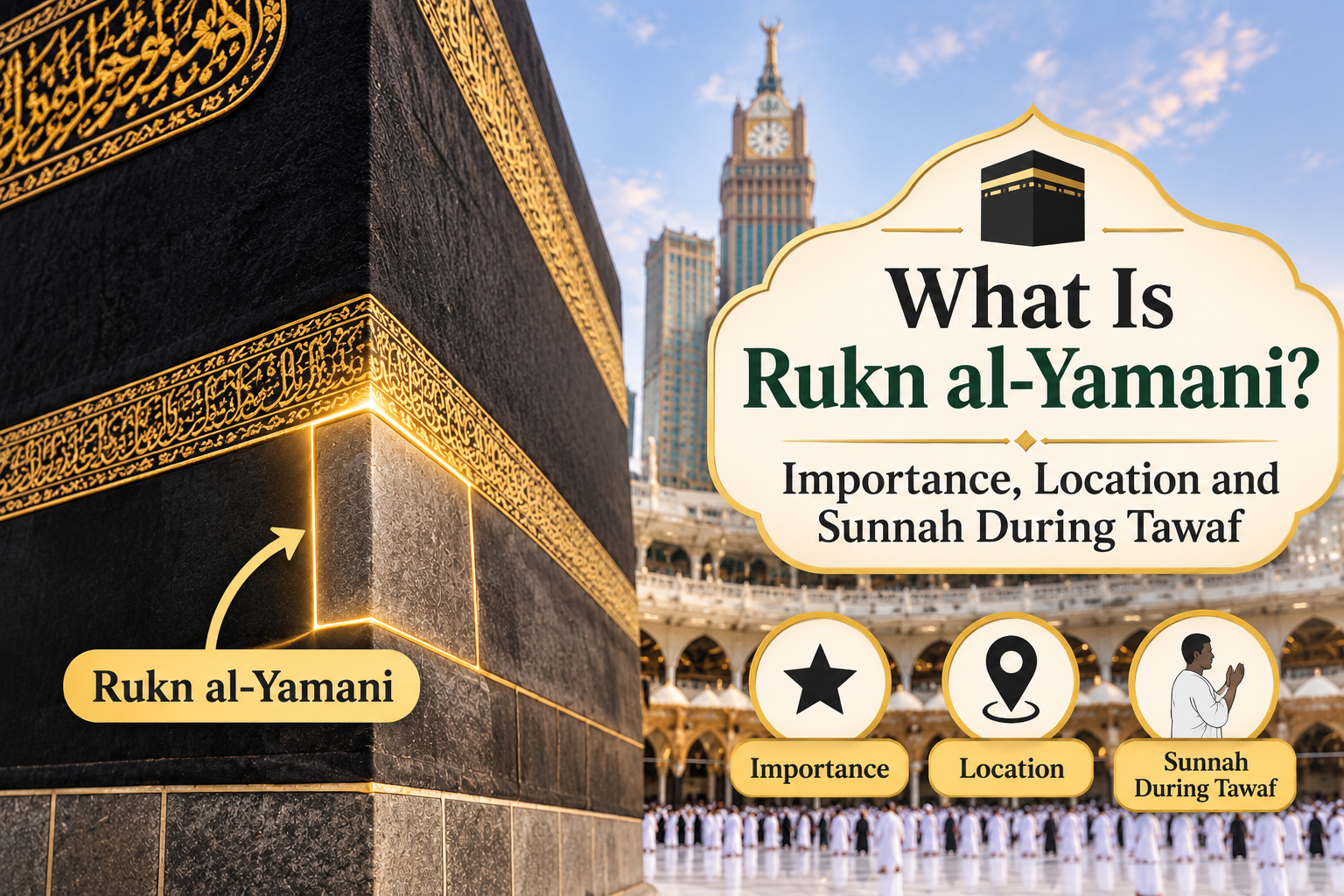
Rukn al-Yamani, also known as the Yemeni Corner, is one of the four corners of the Holy Kaaba in Masjid al-Haram, Makkah. It holds a special place in the rites of Tawaf because Prophet Muhammad (peace and blessings be upon him) touched this corner while circling the Kaaba. For pilgrims performing Hajj or Umrah, knowing its location and the correct Sunnah helps them complete Tawaf with understanding, calmness and respect for others.
What Is Rukn al-Yamani?
The Arabic word “Rukn” means corner or pillar, while “Yamani” refers to Yemen. Rukn al-Yamani is therefore called the Yemeni Corner because it faces the direction of Yemen. It is one of the four corners of the Kaaba and is especially recognised in the Sunnah of Tawaf.
The corner stands on the original foundations associated with Prophet Ibrahim (peace be upon him), who raised the Kaaba with his son Prophet Ismail (peace be upon them).
Where Is Rukn al-Yamani Located?
Rukn al-Yamani is on the southwestern corner of the Kaaba. During Tawaf, pilgrims keep the Kaaba on their left and move in an anti-clockwise direction. After passing the western and northern sides, they reach Rukn al-Yamani shortly before arriving at the Black Stone, also called Hajar al-Aswad.
It is the corner immediately before the Black Stone, which marks the start and finish of each circuit.
Unlike the Black Stone, Rukn al-Yamani is not kissed. Its Sunnah is to touch it with the hand when this can be done easily and safely.
Before starting, learn the Tawaf route and identify the Black Stone as the point where each round begins and ends. Keep the Kaaba on your left throughout. Stay with the direction of movement, avoid sudden stops for photographs, and follow mosque staff instructions. These simple steps help protect you and other worshippers.
Why Is Rukn al-Yamani Important?
Rukn al-Yamani is important because of its connection with the Prophetic practice. Abdullah ibn Umar (may Allah be pleased with him) reported that he saw the Prophet (peace and blessings be upon him) touch the Yemeni Corner and the Black Stone during Tawaf. Ibn Umar continued this practice himself. This narration is recorded in Sahih Muslim (Hadith 1268).
A narration also describes touching the Black Stone and the Yemeni Corner as a means of erasing sins. Follow this Sunnah without pushing or harming others.
What Is the Sunnah When Passing Rukn al-Yamani During Tawaf?
The Sunnah is simple. When you reach Rukn al-Yamani during a circuit, touch it with your right hand if you can do so without difficulty or causing harm. Do not kiss the corner or your hand after touching it. There is no need to say a special takbir when touching Rukn al-Yamani.
If the area is crowded and you cannot reach it comfortably, continue your Tawaf. Do not push through people, stop the flow of pilgrims or stretch across others to touch the corner. If you cannot touch it, simply walk on. Unlike the Black Stone, pointing towards Rukn al-Yamani from a distance is not established as the Sunnah.
Which Dua Should You Recite Between Rukn al-Yamani and Hajar al-Aswad?
As you walk from Rukn al-Yamani towards the Black Stone, it is Sunnah to recite the Quranic supplication:
Arabic:
رَبَّنَا آتِنَا فِي الدُّنْيَا حَسَنَةً وَفِي الْآخِرَةِ حَسَنَةً وَقِنَا عَذَابَ النَّارِ
Transliteration:
Rabbana atina fid-dunya hasanatan wa fil-akhirati hasanatan wa qina adhaban-nar.
Meaning:
“Our Lord, give us good in this world and good in the Hereafter, and protect us from the punishment of the Fire.” (Quran 2:201)
You may also make personal supplications during Tawaf; there is no fixed dua for each individual circuit.
Rukn al-Yamani and Hajar al-Aswad: What Is the Difference?
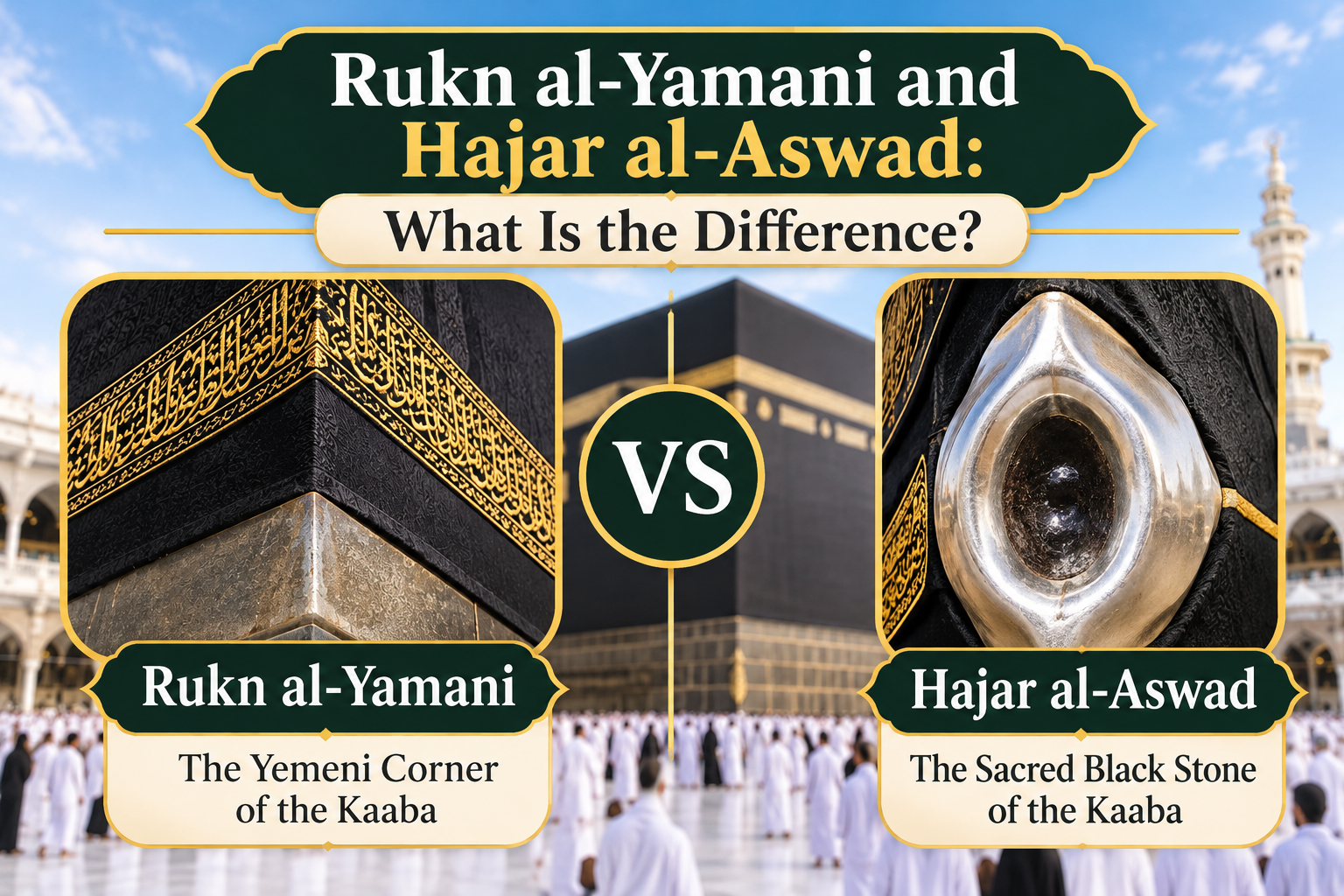
Both corners are touched during Tawaf when possible, but the Sunnah actions are different.
Hajar al-Aswad: A pilgrim may touch and kiss it if able. If unable, they may gesture towards it from a distance and say “Allahu Akbar”.
Rukn al-Yamani: A pilgrim may touch it by hand if easy. It is not kissed, and if it cannot be reached, the pilgrim continues without gesturing towards it.
The other two corners are not touched as part of the established Sunnah.
Common Mistakes to Avoid During Tawaf
Common mistakes include pushing through crowds, kissing the corner or the hand after touching it, pointing towards it when it is out of reach, and assuming a special prayer must be said at the corner. Keep moving safely and ask a qualified scholar if you are unsure about a ruling.
Respecting the Kaaba and Its Kiswah
The Kaaba is covered with the Kiswah, a black cloth decorated with Quranic calligraphy embroidered in gold-coloured thread. Pilgrims should perform Tawaf according to the Sunnah, rather than follow unverified customs involving the cloth or its embroidery.
Explore Kiswah Al Kabah to learn about the history and craftsmanship of the Kaaba Kiswah, including Kiswah Kaaba calligraphy.
Is Touching Rukn al-Yamani Compulsory?
No. Touching Rukn al-Yamani is Sunnah, not a condition for valid Tawaf. Touch it when accessible without difficulty, but missing it because of crowds does not invalidate the circuit. Complete the seven rounds correctly and avoid causing harm. The Prophet’s practice shows the value of touching the corner when possible, not permission to push or obstruct others.
Final Thoughts
Rukn al-Yamani is the southwestern corner of the Kaaba and an important point during Tawaf. The Sunnah is to touch it with the right hand when this is easy, avoid kissing it, and recite the dua from Quran 2:201 while walking between it and Hajar al-Aswad. If the crowd prevents you from reaching it, continue without pushing or pointing.
Complete Tawaf by following the Prophet’s guidance, remembering Allah and respecting fellow pilgrims. For more articles about the Kaaba and its Kiswah, visit Kiswah Al Kabah.