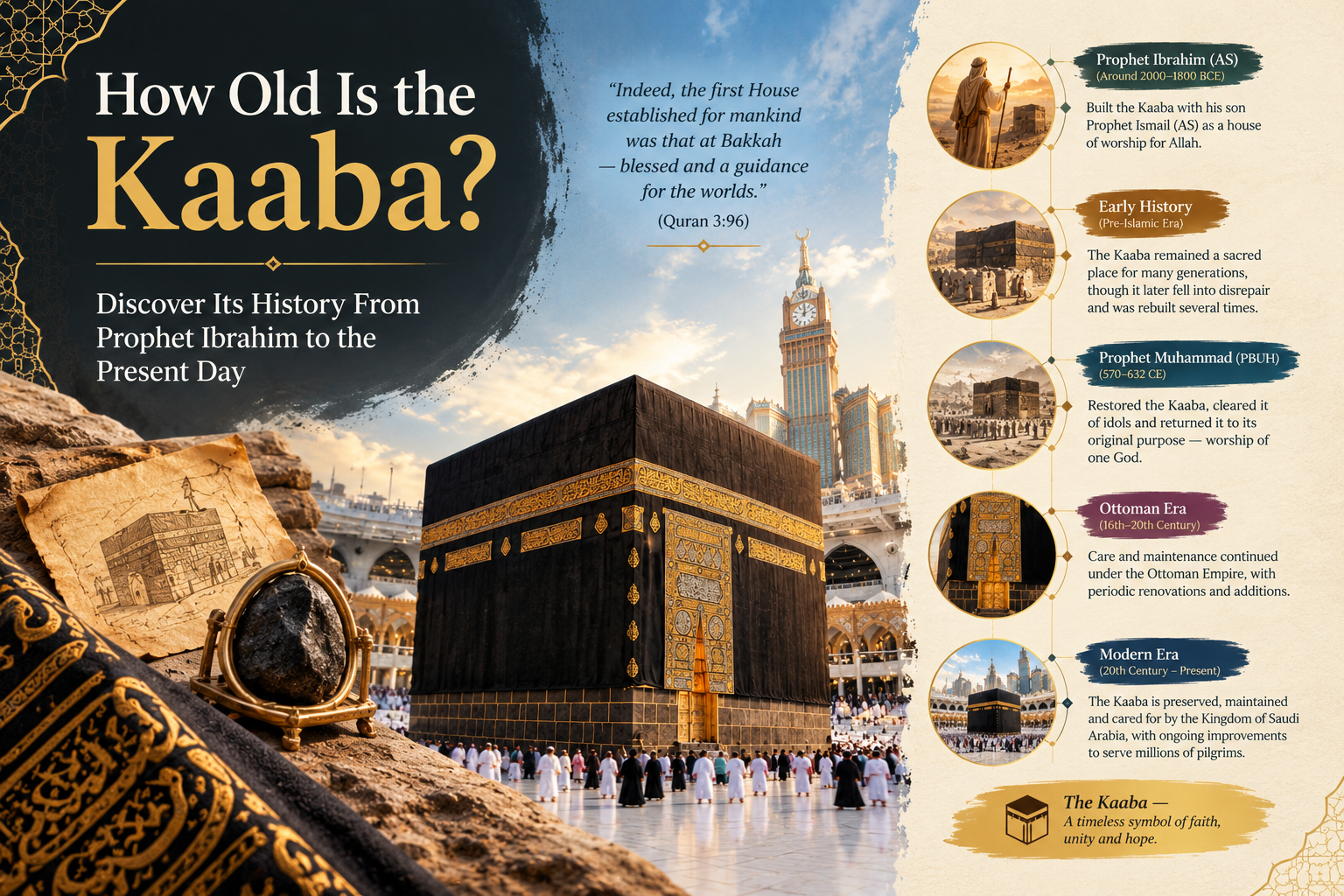
The Kaaba in Makkah holds a unique place in the lives of Muslims around the world. Every day, worshippers face it during Salah, and millions travel to Masjid al-Haram for Hajj and Umrah. Its importance raises an interesting question: how far back does the history of the Kaaba go?
Although its precise age cannot be confirmed through an exact historical date, Islamic teachings connect the sacred House with Prophet Ibrahim (AS) and Prophet Ismail (AS). The building has also experienced several changes throughout history. Understanding these events helps explain the difference between the Kaaba's religious origins and the structure seen today.
When Was the Kaaba First Established?
The Quran provides an important account of the Kaaba's foundations. Surah Al-Baqarah, verse 127, describes Prophet Ibrahim (AS) and Prophet Ismail (AS) raising the foundations of the House and asking Allah to accept their work.
For Muslims, this event is central to the story of the Kaaba. However, the Quran does not provide a calendar year for the construction. As a result, assigning the building an exact age would suggest a level of certainty that historical evidence does not establish.
Some Islamic traditions discuss the site's connection with Prophet Adam (AS). These accounts are part of the broader religious tradition, but they should be distinguished from the Quranic passage about Prophet Ibrahim (AS) and Prophet Ismail (AS).
Important Events in the Kaaba's History
1. The Work of Prophet Ibrahim and Prophet Ismail
The story of the Kaaba's foundations reflects its connection with worship and obedience to Allah. Prophet Ibrahim (AS) and Prophet Ismail (AS) are remembered for their role in raising the foundations of the sacred House.
This account remains a significant part of Islamic teaching. It also explains why the Kaaba is not viewed simply as an old architectural monument but as a place with a central role in Muslim religious life.
2. The Rebuilding by the Quraysh
Before the beginning of Prophet Muhammad's ﷺ prophethood, the Quraysh carried out reconstruction work on the Kaaba. Islamic historical accounts describe changes to its dimensions during this period.
One feature associated with this rebuilding is the semi-circular area known as Hijr Ismail. It lies beside the Kaaba and is connected with discussions about the earlier dimensions of the structure.
The Quraysh reconstruction is an important stage in the building's history because the Kaaba's current form developed through more than one period of construction.
3. The Restoration Associated With Abdullah ibn al-Zubayr
In 683 CE, conflict in Makkah resulted in damage to the Kaaba. Abdullah ibn al-Zubayr later arranged for the building to be reconstructed.
Historical accounts associate his work with an effort to restore features understood to belong to the earlier structure. These changes did not remain permanent, as another reconstruction followed during the Umayyad period.
4. The Umayyad-Era Alterations
Following the death of Abdullah ibn al-Zubayr, the Umayyad caliph Abd al-Malik ibn Marwan ordered changes to the Kaaba. The building was returned to a configuration associated with the earlier Quraysh reconstruction.
This stage demonstrates why the age of the sacred site and the age of its present physical arrangement are not necessarily the same. Its religious significance reaches further back than many features of the structure visible today.
5. Maintenance Through Different Periods
The Kaaba has needed repairs and conservation at various points in history. Exposure to weather, the ageing of building materials, and damage caused by particular events have all made maintenance necessary.
Muslim rulers and the authorities responsible for Makkah have supported preservation work across different periods. Modern restoration has also helped protect the building. Consequently, the current structure should not be assumed to consist entirely of materials dating from its earliest foundations.
6. The Kaaba Today
The Kaaba now stands at the centre of Masjid al-Haram in Makkah, Saudi Arabia. Its surroundings accommodate worshippers throughout the year, particularly during the Hajj and Umrah seasons.
Despite the changes that have taken place over centuries, its role in Islamic worship remains unchanged. For Muslims, it continues to represent a shared direction for prayer and a central destination for pilgrimage.
How Does the Kiswah Relate to the Kaaba?
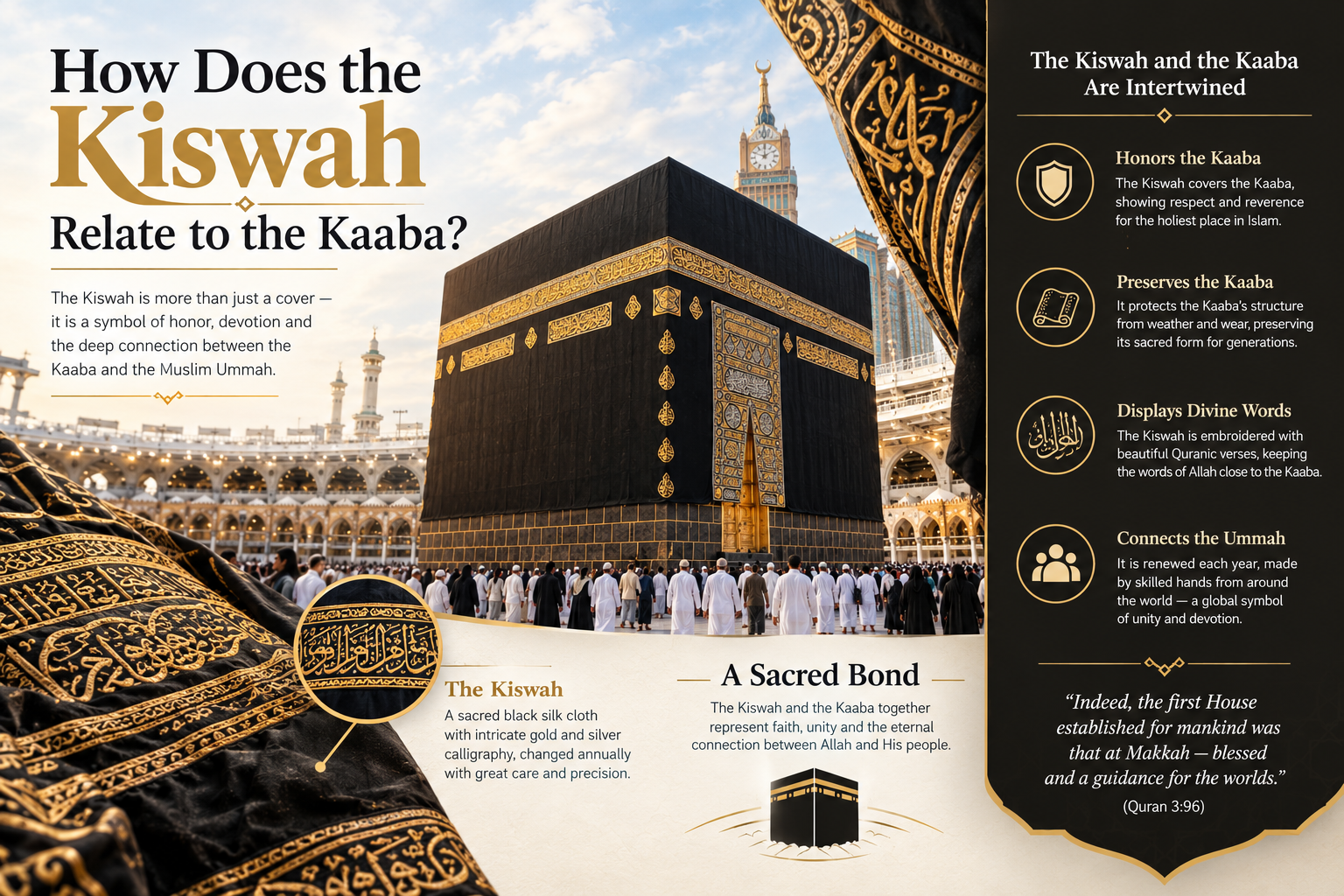
The Kiswah is the covering placed around the exterior of the Kaaba. Its black textile, embroidered Arabic inscriptions and decorative belt make it one of the most recognisable features of the sacred building.
The covering has its own history, separate from the construction of the Kaaba itself. Its design, materials and manufacturing methods have developed over different periods. Today, producing the Kiswah involves specialised textile work and detailed embroidery.
Those interested in Kiswah Kaaba calligraphy can learn about the inscriptions and decorative elements that give the covering its distinctive appearance. The craftsmanship also explains why individual sections may attract interest from collectors and people wishing to preserve a connection with Islamic heritage.
What Determines the Price of an Original Kaaba Kiswah Piece?
There is no single price that applies to every Kiswah item. The original Kaaba Kiswah price can vary according to the section's size, condition, materials, embroidery and documented history.
Provenance is particularly important. Before purchasing a piece, buyers should establish what the seller claims about its origin and examine any available supporting documentation. Certificates and product descriptions can provide useful information, but their reliability should also be assessed.
A clear understanding of these details helps buyers compare items more carefully instead of making a decision based on appearance or price alone.
Where Can You Buy Kaaba Kiswah Online?
If you are looking for where to buy Kaaba Kiswah, start by comparing specialist sellers that provide detailed descriptions of their products. Anyone planning to buy Kiswah Kaaba online should review the measurements, condition, photographs and available provenance information before placing an order.
At Kiswah Al Kabah, visitors can browse the available collection and read the details supplied for individual items. If you are interested in a Gilafe Kaaba piece, reviewing the product information can help you understand what is being offered.
Explore the Kiswah Al Kabah collection to view available pieces and learn more about their details before choosing an item for your collection or personal interest.
Frequently Asked Questions
Can anyone confirm the exact age of the Kaaba?
No universally accepted construction date establishes its exact age. Islamic teachings connect its foundations with Prophet Ibrahim (AS) and Prophet Ismail (AS).
Has the Kaaba been rebuilt?
Yes. Historical accounts describe multiple reconstruction projects, alterations and repairs across different periods.
Is the Kiswah part of the Kaaba's original structure?
No. The Kiswah is the exterior textile covering. Its history and manufacturing traditions are distinct from the building's construction.
What should buyers check before purchasing a Kiswah section?
Review the seller's description, the item's condition, its stated origin and any available supporting documentation. Do not rely on a product title alone to establish authenticity.
Final Thoughts
The Kaaba's history combines its foundations in Islamic tradition with centuries of reconstruction and preservation. Although its precise age remains uncertain, its importance in Muslim worship has continued across generations.
The Kiswah represents another aspect of this heritage through its embroidery, inscriptions and specialised craftsmanship. If you are interested in owning a Kiswah piece, visit Kiswah Al Kabah to explore the available collection and review the information provided for each item.